Speaker's Authority Can Be Delegated to Standing Committee Chair During Filibuster
Jurisdiction Over National University Hospitals Transferred from Ministry of Education to Ministry of Health and Welfare
On January 29, the National Assembly convened a plenary session to process the Special Act on Semiconductors, the amendment to the National Assembly Act, and other legislative bills.
During the session, the National Assembly passed a total of 91 bills. Initially, the ruling and opposition parties discussed processing around 60 non-controversial bills, but after multiple rounds of negotiations, they agreed to increase the number of bills to be jointly approved.
Among the bills that passed the plenary session was the Special Act on Semiconductors, which had been a point of contention between the parties. This act establishes a Presidential Committee for Strengthening the Competitiveness of the Semiconductor Industry and designates semiconductor clusters, mandating both the central and local governments to provide financial and administrative support. It also includes provisions for the government to develop and support semiconductor infrastructure, expand power, water, and road networks, grant exemptions from preliminary feasibility studies, and provide assistance with permits and approvals, all aimed at enhancing the competitiveness of the semiconductor industry.
The ruling and opposition parties had previously disagreed over whether to exempt research and development (R&D) personnel in the semiconductor industry from the 52-hour workweek regulation, given the unique characteristics of the industry. Ultimately, the opinion of the Democratic Party, which opposed the 52-hour workweek application, was accepted, allowing the Special Act on Semiconductors to be passed in the plenary session.
The amendment to the National Assembly Act, which allows the Speaker’s authority to preside over sessions to be delegated to standing committee chairs during a filibuster (unlimited debate) period, also passed the plenary session. The Democratic Party and others had included provisions in the amendment, such as requiring the maintenance of a quorum during a filibuster, after review by the National Assembly Steering Committee. However, these provisions were removed following negotiations between the parties ahead of the plenary session.
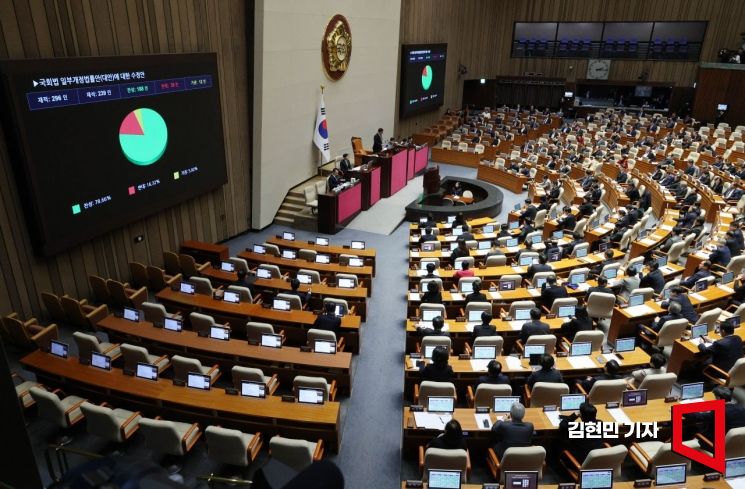 On the 29th, during the plenary session held at the National Assembly, an amendment to the Partial Revision Bill of the National Assembly Act (alternative) was approved. January 29, 2026 Photo by Hyunmin Kim
The amendment to the Act on Public Holidays, which designates Constitution Day-the only national holiday that is not currently a day off-as an official holiday, also passed the plenary session. The amendment expands the scope of public holidays from the current four national holidays (March 1st Independence Movement Day, Liberation Day, National Foundation Day, and Hangul Day) to include all national holidays. Once the amendment is promulgated after passing the Cabinet meeting, Constitution Day will become a public holiday for the first time in 18 years.
The amendment to the State Property Act, which requires the government to report the details of state property disposals to the relevant standing committee of the National Assembly, also passed the plenary session.
The amendment to the National University Hospital Establishment Act, which transfers jurisdiction over national universities from the Ministry of Education to the Ministry of Health and Welfare, was also approved. The goal is to strengthen national university hospitals as key institutions for regional and essential healthcare, and to explore strategies for advancing research and education to support this role.
The Act on the Promotion of Artificial Intelligence and Data-Based Administration, which establishes a legal framework to encourage not only the use of data but also artificial intelligence (AI) in the public sector, was also passed.
In addition, several bills were processed to strengthen support for patients suffering from Agent Orange aftereffects and their second-generation descendants, as well as for those recognized for their contributions to the May 18 Democratization Movement and their bereaved families.
© The Asia Business Daily(www.asiae.co.kr). All rights reserved.
![Clutching a Stolen Dior Bag, Saying "I Hate Being Poor but Real"... The Grotesque Con of a "Human Knockoff" [Slate]](https://cwcontent.asiae.co.kr/asiaresize/183/2026021902243444107_1771435474.jpg)
















