US Dollar Index Falls to Lowest Level in Four Years
The price of copper has soared to an all-time high. This surge is attributed to a sharp increase in demand for physical assets following the US dollar’s decline to its lowest level in four years. Expectations for global growth in data centers, robotics, and power infrastructure are also fueling projections of increased demand for non-ferrous metals.
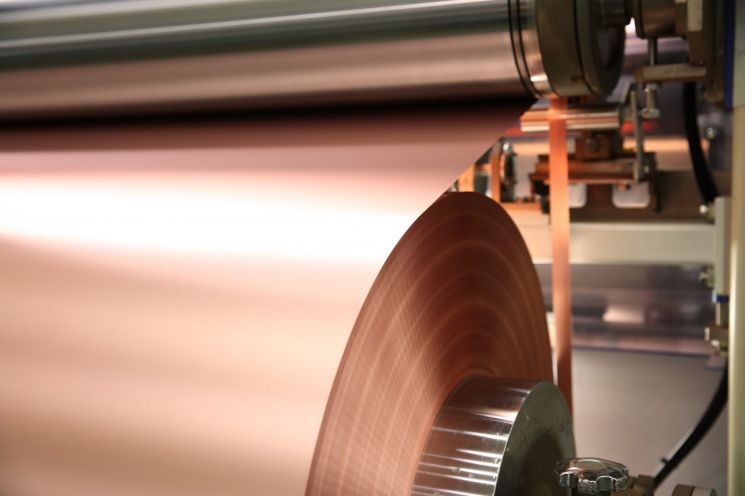 Copper foil product manufactured by SK Nexilis. Photo is unrelated to the article content. The Asia Business Daily DB
According to Bloomberg News on January 29, three-month copper futures on the London Metal Exchange (LME) rose 6.7% to reach $13,967 per ton (approximately 19,922,528 won), bringing this year’s increase to 12%. Prices for five other major metals also rose simultaneously, with aluminum nearing its highest level in four years and zinc climbing about 3%.
Bloomberg News analyzed that the commodities market is experiencing a sharp rally due to the weakening US dollar, increased demand for physical assets, and heightened geopolitical tensions stemming from US President Donald Trump’s foreign policy. In addition to copper, which is an essential material for the energy transition, precious metal prices have also hit record highs. Even crude oil, which faced concerns of a global supply glut last year, has seen an upward trend in recent weeks.
Chikai, Chief Investment Officer (CIO) at Shanghai Cosine Capital Management Partnership, stated, “Expectations for rising copper prices remain unchanged under the US’s ongoing interest rate cut cycle,” adding, “As long as the US continues to invest in artificial intelligence (AI), chips, and power infrastructure, there is no clear estimate for how high prices may go.”
The broad increase in metal prices emerged right after the US dollar index fell to its lowest level in four years. President Trump signaled indifference to the weak dollar, saying, “I think it’s great. The dollar is doing very well.” However, Bloomberg News analyzed that the decline in the dollar’s value is likely to drive up commodity prices.
Expanding global demand for AI data centers is also cited as a factor stimulating the market. On January 28 (local time), Tesla announced in its fourth-quarter earnings report that it had begun investing in robotics and AI. Meta and Microsoft also emphasized securing power infrastructure for data centers. Since high-voltage cables are essential for the stable operation of AI data centers, the expansion of data centers is accompanied by increased investment in power transmission and distribution networks.
In the domestic cable and raw materials industries, expectations for improved performance are rising. According to the industry, copper accounts for more than 60% of the manufacturing cost of cables and up to 90% depending on the product category. Many cable supply contracts include clauses that link product prices to fluctuations in raw material costs, so rising copper prices lead to higher sales prices and increased revenue scale.
Additionally, domestic refining companies are also anticipating higher sales prices and inventory gains as copper prices rise.
However, since Korea effectively imports all of its copper, there are concerns that this could lead to a worsening trade balance and increased pressure on the Korean won. As copper prices rise, there are also worries about increased manufacturing costs and product prices for semiconductor substrates, solar panels, and battery products.
© The Asia Business Daily(www.asiae.co.kr). All rights reserved.
![Clutching a Stolen Dior Bag, Saying "I Hate Being Poor but Real"... The Grotesque Con of a "Human Knockoff" [Slate]](https://cwcontent.asiae.co.kr/asiaresize/183/2026021902243444107_1771435474.jpg)















