Market Turmoil Over Greenland Annexation
Dollar Index Hits Four-Year Low
Canadian Pension Funds Eye Yen, Franc, and Gold
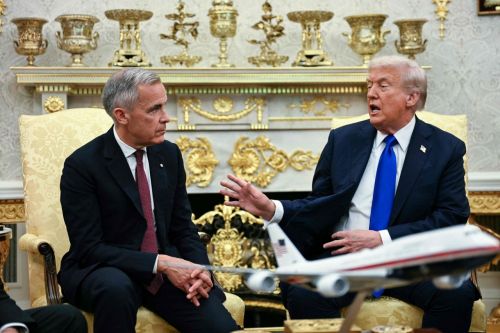 US President Donald Trump (right) and Canadian Prime Minister Mark Carney are holding a summit at the White House Oval Office in October last year. Photo by AFP Yonhap News
After President Donald Trump announced his intention to annex Greenland, European pension funds began selling off US Treasury bonds, and there are now signs that major Canadian investors may join this trend. As capital becomes weaponized and Europe pushes back, President Trump has previously retreated in response to European opposition, raising questions about whether the level of pressure on Canada will also be adjusted.
On January 28 (local time), the Investment Management Corporation of Ontario (IMCO) released a report stating, "Despite the rise in US Treasury yields, the US dollar has weakened," and mentioned the Swiss franc, Japanese yen, and gold as alternatives to the dollar. IMCO is Canada's largest institutional investor, managing $63.5 billion (approximately 91 trillion won). Canada is one of the countries with the largest holdings of US assets globally.
The report also noted, "As the US accelerates efforts to resolve global imbalances, President Trump's unpredictable and unconventional approach could put pressure on the value of the dollar for years to come, while also driving up inflation and bond yields." Bloomberg pointed out that this analysis suggests investors may no longer view the dollar as a safe haven asset. It also highlighted that recent trends in the dollar are sending a strong message that the US may not be a reliable partner.
Recently, the value of the dollar fell to its lowest level in four years since 2022, before making a slight rebound. According to MarketWatch, the dollar index, which measures the value of the dollar against the currencies of six major countries, dropped to the 95 range on January 27 and was at 96.34 as of 10 a.m. KST on January 29. At one point, it rose to 96.79 before pulling back slightly. Since President Trump took office in January of last year, he has openly emphasized the need for a weaker dollar, and rumors over the weekend that the US and Japanese governments had intervened jointly in the foreign exchange market led to a sharp drop in the dollar's value. When US Treasury Secretary Scott Bessent dismissed these rumors in an interview with CNBC, stating, "The United States always has a strong dollar policy," the dollar temporarily rebounded.
The trend to reduce exposure to US assets was first observed in Europe. Since the beginning of the year, after President Trump made clear his "territorial ambitions" regarding Danish-controlled Greenland, Europe has shown this anti-American movement. For example, some European pension funds such as AkademikerPension and Alecta have stated that President Trump's policies have created significant credit risk, leading them to reduce their holdings of US Treasuries.
Nick Shami, Chief Strategist at IMCO, said in a statement, "It is necessary to consider what a changed global role for the United States means for portfolios," and added, "This includes rebalancing by reducing US exposure and seeking opportunities to increase exposure in other regions." However, an IMCO spokesperson clarified that the report does not necessarily indicate specific investment actions regarding currency exposure.
Meanwhile, the conflict between the United States and Canada, traditionally considered "blood allies," shows no sign of resolution. Canadian Prime Minister Mark Carney, in a special address at the World Economic Forum (WEF) Annual Meeting in Davos, Switzerland, on January 20, which became a key trigger for President Trump's anger, described the current international situation as a "rupture" and stated, "Middle powers must unite." This was interpreted as a call for an anti-Trump alliance.
© The Asia Business Daily(www.asiae.co.kr). All rights reserved.
![Clutching a Stolen Dior Bag, Saying "I Hate Being Poor but Real"... The Grotesque Con of a "Human Knockoff" [Slate]](https://cwcontent.asiae.co.kr/asiaresize/183/2026021902243444107_1771435474.jpg)
















