U.S. Secretary of State Urges Caution on Military Intervention in Iran
Iranian President Issues Emergency Orders
Iranian Rial Hits Record Low
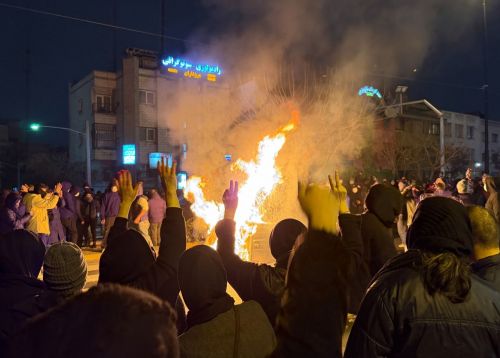 On the 9th (local time), Iranian citizens participated in anti-government protests in the capital city of Tehran. Photo by AP Yonhap News.
On January 28 (local time), as U.S. President Donald Trump warned of the possibility of direct military intervention in Iran, Iran's Permanent Mission to the United Nations stated, "If the United States applies pressure, Iran will defend itself and respond in an unprecedented manner."
The Iranian Mission made this statement on X (formerly Twitter) the same day, posting in response to President Trump's social media post that "a large fleet is heading to Iran." The Mission said, "Iran is ready for dialogue based on mutual respect and mutual benefit." It added, "The last time the United States waged reckless wars in Afghanistan and Iraq, it wasted over 7 trillion dollars and lost more than 7,000 American lives."
The previous day, Iranian President Masoud Pezeshkian, according to the Financial Times (FT), issued emergency orders to provincial governments to ensure the supply of essential goods and maintain government functions in preparation for a possible attack by the United States and Israel, which he defined as "hostile countries." President Pezeshkian, meeting with provincial governors, said, "I am delegating authority so that governors can communicate with the judiciary and other agency officials and make decisions independently."
Earlier that day, President Trump posted on Truth Social, "A massive fleet is heading to Iran. This fleet is moving quickly with great power, passion, and purpose. Led by the great aircraft carrier Abraham Lincoln, the fleet is even larger than the one we sent to Venezuela." He continued, "As with Venezuela, the fleet is ready and willing to carry out its mission swiftly and forcefully if necessary."
However, U.S. Secretary of State Marco Rubio, appearing at a Senate hearing on Venezuela, expressed caution regarding direct U.S. military intervention, stating that it would be "far more complicated" than the ousting of former Venezuelan President Nicolas Maduro and would require "a great deal of careful consideration." He said, "If necessary, it is wise and prudent to establish a military posture in the region that can preemptively prevent attacks on thousands of U.S. service members, other facilities in the area, and our allies."
He further emphasized, "They (Iran) clearly have the capability to do so. Despite their own economy collapsing, they have amassed thousands of ballistic missiles and continue to spend money on them." These remarks suggest that while the U.S. is moving its fleet into Iranian waters, the priority is to prepare for Iran's threats rather than immediately launching military intervention.
The current protests began with merchants in central Tehran rallying against the collapse of currency value and soaring prices. The Iranian government officially announced that 3,117 people have died, but this figure differs greatly from the numbers compiled by human rights organizations and anti-government media, which are based on testimonies from medical staff, bereaved families, and internal documents. According to the U.S. weekly magazine Time, citing public health officials, it is estimated that over 30,000 people died during the peak of the violent crackdown on the 8th and 9th alone.
Meanwhile, as the unrest in Iran drags on and the U.S. hints at the possibility of direct military intervention, the local currency continues to plummet. According to the Associated Press, the exchange rate in the local foreign exchange market surpassed 1.6 million rials per dollar for the first time ever on this day. This comes just one day after it exceeded 1.5 million rials for the first time. When the protests began, the exchange rate was around 1.42 million rials per dollar.
© The Asia Business Daily(www.asiae.co.kr). All rights reserved.
![Clutching a Stolen Dior Bag, Saying "I Hate Being Poor but Real"... The Grotesque Con of a "Human Knockoff" [Slate]](https://cwcontent.asiae.co.kr/asiaresize/183/2026021902243444107_1771435474.jpg)
















