Ministry of Climate, Energy and Environment Holds Floating Offshore Wind Power Forum
Supply Chain Companies: "Domestic Track Record Needed for Overseas Expansion"
100 MW Demonstration Complex Planned for 2027
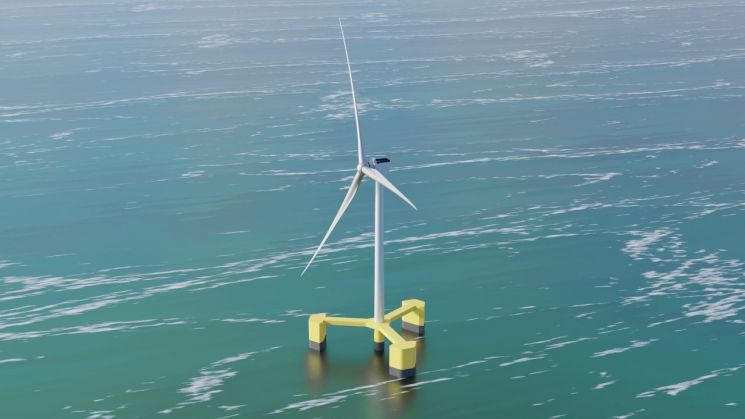
It has been assessed that South Korea's floating offshore wind power technology stands at only 53% of the level of leading countries. Experts point out that this year is a golden time to establish mid- to long-term plans in order to avoid falling behind in the growing floating offshore wind power market. The government plans to build a large-scale demonstration complex starting next year to strengthen the domestic floating offshore wind power supply chain.
Kang Geumseok, Wind Power Program Director at the Korea Institute of Energy Technology Evaluation and Planning (KETEP), stated at the "Floating Offshore Wind Power Development Strategy Forum" hosted by the Ministry of Climate, Energy and Environment at the Sangyeonjae Seoul Station branch on the 28th, "Korea's floating offshore wind power technology is at a comprehensive level of 53 points compared to the global standard."
The Korea Institute of Energy Technology Evaluation and Planning explained that this result was derived by comparing operational reliability (0 points, due to the absence of commercial operation complexes), floating body design/verification (20/60 points), mooring/power line supply chain (80/60 points), transportation/installation infrastructure (60/40 points), standards/certification capability (80 points), and future scalability (80 points).
Currently, Doosan Enerbility, as part of a government policy project, has been conducting research and development (R&D) since 2023 in Jeju, in collaboration with Samsung Heavy Industries, SK Oceanplant, Nam Sung Shipping, and the Korea Research Institute of Ships and Ocean Engineering, using 3-megawatt (MW) turbines and floating bodies. However, the wind power industry believes that for future commercialization, demonstration projects should be conducted using 10 MW-class turbines and corresponding floating bodies.
Floating offshore wind power is a method of generating electricity by placing turbines on floating structures at sea. Unlike fixed offshore wind power, which must be installed at depths of about 50 meters or less, floating offshore wind power can overcome depth limitations and be installed farther offshore, increasing the utilization of marine space. While offshore locations offer stronger wind speeds and advantages in terms of public acceptance, the high installation costs make it difficult to secure economic viability, which remains a challenge to overcome.
At the forum, Kim Kyunghwan, Principal Researcher at the Korea Research Institute of Ships and Ocean Engineering, said, "Without the expansion of floating offshore wind power, it is impossible to achieve the national greenhouse gas reduction target (NDC) and implement RE100. In Korea's marine environment, which is vast and deep, expanding floating offshore wind power is essential for energy security."
Kim pointed out, "Europe, China, and others are already focusing on increasing efficiency and lowering the cost of power generation by developing larger turbines, multi-rotor systems, and new vertical-axis wind power structures. However, Korea has no demonstration cases, resulting in a lack of business experience and a weak foundation of domestic technology across the supply chain." He emphasized, "2026 is the golden time for Korea to establish mid- to long-term plans."
The government plans to develop domestic floating offshore wind power technology and strengthen the supply chain by building a large-scale demonstration complex. Kwon Kiman, Director of the Offshore Wind Power Promotion Team at the Ministry of Climate, Energy and Environment, stated, "Separate from the fixed-price contract bidding for wind power, we plan to launch a floating offshore wind power demonstration complex project in 2027. We will establish specific plans within this year."
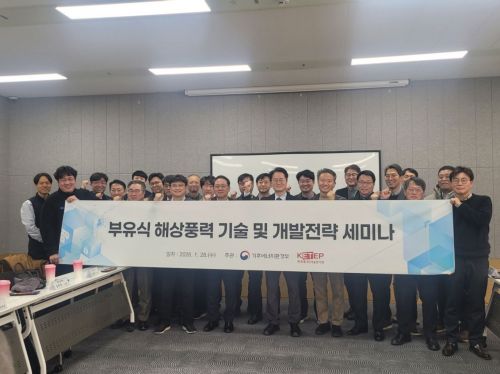 On the 28th, attendees of the "Floating Offshore Wind Power Development Strategy Forum" held by the Ministry of Climate, Energy and Environment at Sangyeonjae Seoul Station branch are taking a commemorative photo. January 28, 2026. Photo by Kang Heejong
In this regard, the Korea Institute of Energy Technology Evaluation and Planning is preparing a plan to promote a 100 MW-scale floating offshore wind power demonstration complex. Kang Geumseok, Wind Power Program Director, proposed: ▲ designating a 100 MW-class floating offshore wind power technology demonstration testbed using a planned site selection method; ▲ having public institutions participate as operators of the demonstration complex; and ▲ demonstrating domestically developed floating bodies and mooring systems.
At the forum, domestic supply chain companies unanimously stated that a track record through domestic demonstration is essential for overseas exports.
Byungyeop Yoon, Executive Director at Samsung Heavy Industries, said, "In the past, government-led orders for liquefied natural gas (LNG) carriers by SK served as a catalyst for advancing a national core industry. Likewise, government support to secure performance data for offshore wind power is crucial."
Jungsoo Moon, Executive Director at HD Hyundai Heavy Industries, said, "To strengthen the competitiveness of domestic floating offshore wind power, it is necessary to establish a program that gradually supports the localization of key components by small and medium-sized enterprises and their participation in the supply chain within a demonstration system led by the government and large corporations."
Joonmo Jung, Professor of Naval Architecture and Ocean Engineering at Inha University, commented, "Although government support has significantly improved domestic technology, there have been no opportunities for demonstration. Exchanges between power generators and technology developers should be expanded."
On this day, power generation companies requested policy support from the government to secure the business viability of floating offshore wind power. Their requests included: making the cost of public water surface usage permits more realistic, adjusting the upper limit of bid prices, gradual localization and strengthening of the domestic supply chain, and linking long-term 20-year contracts to the consumer price index and extending contract periods.
In South Korea, a total of six floating offshore wind power projects with a combined capacity of 6.2 gigawatts (GW) have been promoted off the coast of Ulsan. However, concerns about business viability have arisen as the Firefly project, led by Equinor of Norway, failed to sign a Renewable Energy Certificate (REC) trading contract within the deadline. In addition, the Gray Whale project, involving Corio Generation, TotalEnergies, and SK ecoplant, is undergoing liquidation procedures.
Jinsu Sim, Director of Renewable Energy Policy at the Ministry of Climate, Energy and Environment, emphasized, "Floating offshore wind power is still in its early stages, but it has great growth potential. It is important for companies and the government to work together to secure competitiveness through technology development and demonstration."
© The Asia Business Daily(www.asiae.co.kr). All rights reserved.
![Clutching a Stolen Dior Bag, Saying "I Hate Being Poor but Real"... The Grotesque Con of a "Human Knockoff" [Slate]](https://cwcontent.asiae.co.kr/asiaresize/183/2026021902243444107_1771435474.jpg)

















