President Lee Orders Reform Plans for Capital Market System
"KOSDAQ Still Home to 'Zombie Companies'... Restoring Its Former Glory"
"Comprehensive Overhaul Needed to Sustain KOSPI 5,000 Momentum"
"Recent Korean Stock Market Has Grown Stronger," Kim Assesses
Kim Yongbeom, Chief Presidential Secretary for Policy, stated, "There are still 'zombie companies' remaining on the KOSDAQ, and companies that fail to meet maintenance requirements are stagnating like stagnant water. We must be able to promptly address these issues as they arise." Kim further indicated a comprehensive overhaul of the system, saying, "To maintain the KOSPI 5,000-point momentum, a fundamental upgrade of the capital market system, including KOSDAQ, is necessary."
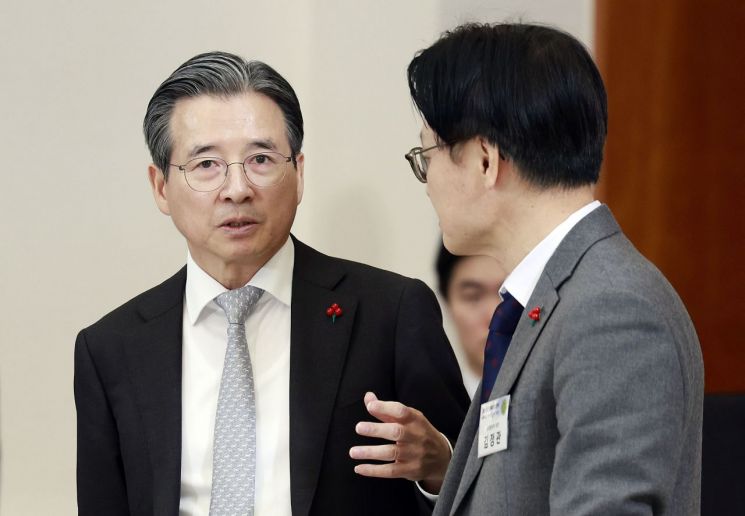
During a press briefing at the Chunchugwan in the Blue House on the 28th, Kim announced that these measures would be pursued following President Lee Jaemyung's directive to prepare capital market system reform plans. He emphasized a full-scale improvement of the KOSDAQ market's fundamentals, which currently lags behind the KOSPI in terms of investor confidence. Although the KOSDAQ index recently surpassed 1,000 points for the first time in over four years, its growth under the Lee administration has remained at just one-third the pace of the KOSPI.
He added, "We are developing measures to restore the KOSDAQ to its former stature, including transforming the market itself to accommodate startups in government-prioritized sectors such as artificial intelligence (AI) and energy." The intention is to strengthen the removal of zombie companies while streamlining the 'listing-exit' pathway for companies in key sectors, thereby improving the market overall.
Discussions have already begun, centered on the Financial Services Commission. Kim explained, "President Lee instructed us to review the entire system, including listing, governance, dual listings, and holding company requirements," and noted that related agencies such as the Financial Supervisory Service and Korea Exchange (KRX) have started discussions. He continued, "Since the exchange is the core of the capital market, we must aim for a 'world-class' standard, including trading hours."
Regarding recent trends in the Korean stock market, Kim assessed that its fundamentals have become stronger. He said, "Even when major news breaks, the domestic stock market has been closing relatively stably, giving me the sense that the market's fundamentals are changing. There are signs that capital flows, once concentrated in real estate, are shifting toward securities and stocks." He particularly noted, "An environment is being created that can further accelerate the institutional shift toward 'productive finance.'" On the 26th (local time), U.S. President Donald Trump posted on social media that, due to delays in the Korean National Assembly's passage of the Special Act on Investment in the United States, he would raise the mutual tariff rate back to 25% from 15%.
Kim also stated that efforts to improve the capital market's fundamentals would continue in line with the ongoing trend of commercial law amendments. He said, "Amendments to the commercial law have been announced, and there is a trend of introducing and establishing systems that were previously controversial. We are considering ways to upgrade the entire system to a world-leading standard."
© The Asia Business Daily(www.asiae.co.kr). All rights reserved.

















