Establishing His Unique "Peeling Off & Filling In" Technique
"My Blood, Pulse, and Everything About Me Is Contained in My Work"
Painter Jung Sang-hwa passed away at 3:40 a.m. on January 28. He was 93 years old. Gallery Hyundai announced on the same day, "Painter Jung Sang-hwa has entered eternal rest."
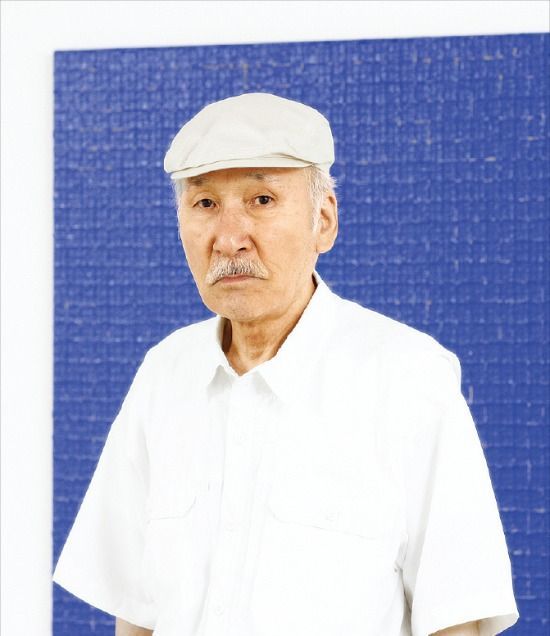
Born in 1932 in Yeongdeok, North Gyeongsang Province, Jung graduated from the Department of Painting at Seoul National University in 1957. While he primarily painted figurative works during his school years, he began experimenting with expressionist abstraction in the mid to late 1950s, seeking a transformation in his artistic style. In 1969, after moving to Kobe, Japan, he began to focus in earnest on monochromatic abstraction, and during this period, he established the grid-structured compositions that became his signature style.
Jung Sang-hwa is recognized as a leading figure in Korean monochromatic abstraction. He developed a unique visual language through his so-called "peeling off & filling in" technique, in which he would apply paint to the canvas, remove it, and then fill it in again. The grid-patterned planes created by repeatedly applying and removing paint became the hallmark of his artistic world.
He was also well known for working alone, never employing assistants throughout his life. Describing his method, he once said, "No one else can imitate it, and even if I asked someone to do it, they couldn't. It is my own methodology. If you work on something for a long time, you develop your own philosophy, and your blood, pulse, and everything about you appears in your work."
In 1967, he moved to Paris, France, and worked between Paris and Kobe, Japan, before returning to Korea in 1992. He then set up a studio in Yeoju, Gyeonggi Province, and continued his creative activities in Korea. He participated in major exhibitions such as the Korean Contemporary Artists Invitational Exhibition (1960), the Actuel Group Exhibition (1962), and the World Congress for Cultural Freedom Invitational Exhibition (1963). He also represented Korea at the Paris Biennale (1965) and the S?o Paulo Biennale (1967).
Large-scale retrospectives of his work were held at the Mus?e d’Art Moderne de Saint-?tienne in France in 2011 and at the National Museum of Modern and Contemporary Art in 2021. His works are part of the collections of major art museums in Korea and abroad, including the National Museum of Modern and Contemporary Art, Leeum Samsung Museum of Art, Seoul Museum of Art, the Smithsonian Hirshhorn Museum in the United States, the Art Institute of Chicago, M+ in Hong Kong, and the Guggenheim Abu Dhabi.
The funeral hall is set up in Room 6 of the Seoul National University Hospital Funeral Home, with the funeral scheduled for January 30.
© The Asia Business Daily(www.asiae.co.kr). All rights reserved.
![Clutching a Stolen Dior Bag, Saying "I Hate Being Poor but Real"... The Grotesque Con of a "Human Knockoff" [Slate]](https://cwcontent.asiae.co.kr/asiaresize/183/2026021902243444107_1771435474.jpg)















