BAS Unveils This Year's Doomsday Clock
Moved Forward by 4 Seconds from Last Year
Rising Concerns Over Nuclear Weapons, Authoritarianism, and AI Side Effects
Inadequate Response to Climate Change and International Cooperation
The "Doomsday Clock," which shows the time remaining until the end of humanity, has been moved forward to 85 seconds to midnight. This is the closest humanity has come to destruction since the Doomsday Clock was established in 1947. The main reasons cited for this advancement are the growing nuclear threat, insufficient action on climate change, and the negative side effects arising from the development of artificial intelligence (AI).
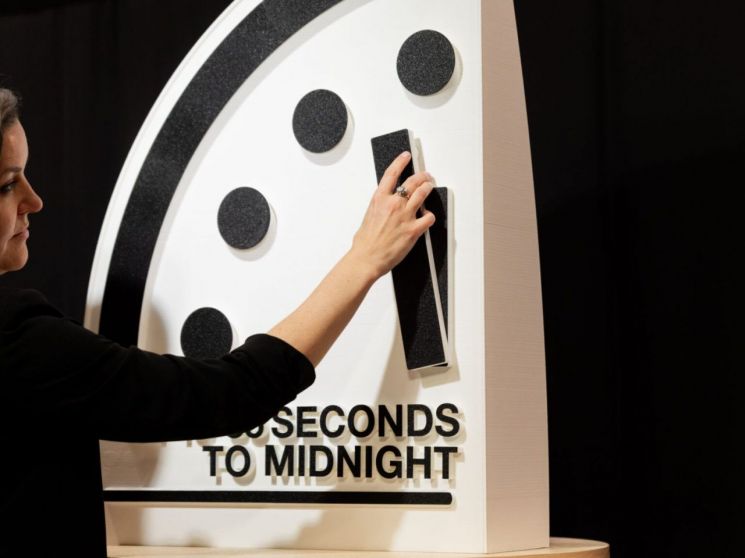 On the 27th (local time), Alexandra Bell, Chairperson of the Bulletin of the Atomic Scientists (BAS), is moving the minute hand of the Doomsday Clock forward at a press conference held in Washington DC, USA. BAS.
The Bulletin of the Atomic Scientists (BAS) pointed to changes in the geopolitical stances of major countries such as the United States, China, and Russia as reasons for moving closer to doomsday. Alexandra Bell, Chairperson of BAS, emphasized, "These countries have become increasingly aggressive and hostile, and nationalism has also strengthened." She added, "Hard-won global agreements are collapsing. Essential international cooperation on issues such as nuclear war, climate change, and the potential threats of AI is being undermined by winner-takes-all competition among great powers."
The grounds for assessing an increased nuclear threat include Russia's suggestions of possible nuclear weapon use in the war in Ukraine, Israel and the United States' interception strikes on Iranian facilities, and the increase in China's nuclear warhead stockpile. Furthermore, with the nuclear arms treaty between the United States and Russia set to expire, and the U.S. administration considering a resumption of nuclear testing, BAS predicted that nuclear arms competition would accelerate as a result.
BAS also pointed out that efforts to address climate change are inadequate. Despite global warming causing record highs in average sea levels, carbon dioxide concentrations, and average temperatures worldwide, international cooperation has not been achieved.
Biological threats have also increased. BAS noted that the successful laboratory synthesis of "mirror life forms," which have the potential to disrupt life on Earth, and the possibility of designing new pathogens with the help of AI-pathogens that humanity would not be able to defend against-are significant concerns. In particular, BAS argued that the AI revolution could, in turn, accelerate human extinction by speeding up the spread of misinformation, thereby causing confusion and dysfunction in the information ecosystem. Finally, BAS expressed concern over the global rise of authoritarian regimes.
BAS is a journal founded in 1945 by scientists who participated in the Manhattan Project (the atomic bomb development program) and Albert Einstein, with the aim of warning humanity about the dangers of nuclear weapons. In 1947, they introduced the Doomsday Clock, setting midnight as the moment of destruction, and have announced the time each year ever since. When the clock was first introduced, the United States and the Soviet Union were engaged in competitive nuclear testing, and the clock was set at seven minutes to midnight. The furthest humanity has been from doomsday was in 1991, following the fall of the Berlin Wall and the end of the Cold War, when the clock was set at seventeen minutes to midnight.
© The Asia Business Daily(www.asiae.co.kr). All rights reserved.

















