"Korea Journal" Highlights Indigenous New Religions of Early 20th Century
Exploring Old Geography: "Land as a Cultural Heritage Laden with Memory and History"
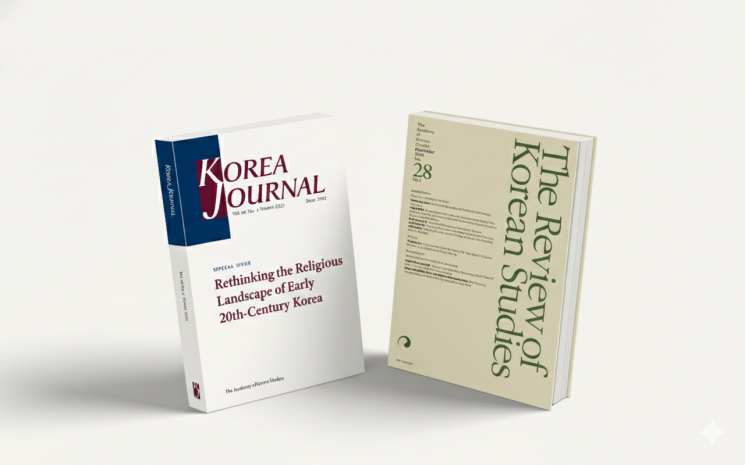
The Academy of Korean Studies announced on January 27 that it has simultaneously published the 2025 winter special issues of "Korea Journal" and "The Review of Korean Studies," two leading English-language academic journals in the field of Korean studies.
This special issue focuses on two main themes: indigenous new religions in early 20th-century Korea and the historical geography of Korea. Together, they provide a multidimensional analysis of the Korean spiritual world and lived spaces. The theme of "Korea Journal" is "Re-examining the Religious Landscape of Early 20th-Century Korea." The issue explores the unique value systems established by indigenous new religions such as Donghak, Daejonggyo, and Won Buddhism during a period of rapid modernization and enlightenment.
Park Jongcheon, a professor at Korea University, explains in his paper that these new religions share a "family resemblance" in their visions of "Later Heaven Gae-byeok"-a transformative new era-characterized by a strengthened communication with transcendent beings, reinterpretation of traditional self-cultivation, and the overcoming of oppression by the ruling class. The issue also includes five research papers covering topics such as the sanctification of personality in Cheondogyo, the concept of Gae-byeok in Won Buddhism, the religious strategies of Confucianism, and the eschatological visions found in Jeonggamnok.
"The Review of Korean Studies" features the theme "Old Geography of Korea," reinterpreting the geography of the Korean Peninsula not merely as a natural environment but as a cultural heritage imbued with history and collective memory. Professor Hong Geumsu of Korea University introduces the trend in historical geography that views landscapes as products of collective memory and identity. Professor Choi Yousik of Chonnam National University analyzes how historical and cultural markers in downtown Seoul function as "narrative devices" that mediate memory amid rapid urban change. Other included papers examine the transformation of county seats and fortresses during the Joseon Dynasty, traces of power embedded in the evolution of place names, and 19th-century Joseon landscapes recorded by the French traveler Charles Varat.
Last year, the Academy of Korean Studies fully transitioned both journals to online platforms. As a result, researchers and readers around the world can freely access the full texts of the papers on the Academy's website at no cost.
© The Asia Business Daily(www.asiae.co.kr). All rights reserved.
![Clutching a Stolen Dior Bag, Saying "I Hate Being Poor but Real"... The Grotesque Con of a "Human Knockoff" [Slate]](https://cwcontent.asiae.co.kr/asiaresize/183/2026021902243444107_1771435474.jpg)















