Government Finalizes Push Based on Public Debate and Surveys
Considers Carbon Neutrality and Industrial Power Demand
Adopts Parallel System of Renewables and Nuclear
Local Acceptance and Compensation Remain Unresolved Issues
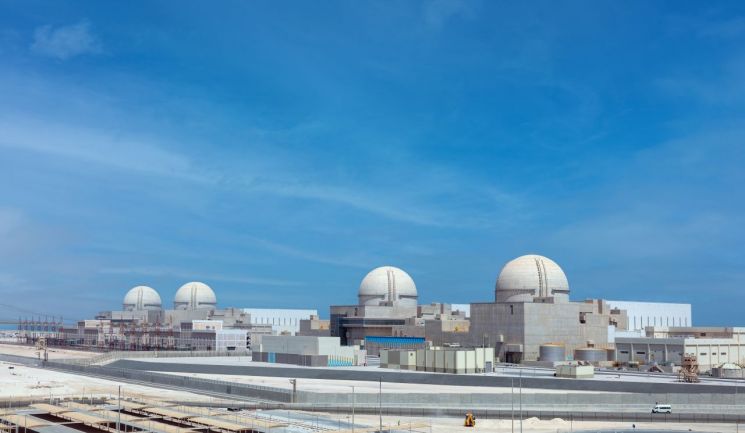
"The issue of nuclear power has become overly politicized. Let's keep an open mind and decide whether it is necessary, safe, and what the public wants."
As President Lee Jaemyung stated during a press conference on the 21st, public acceptance was the most significant factor in the decision-making process to push forward with new nuclear power plant construction. The government determined, through two policy forums and public opinion surveys, that a majority of citizens were in favor, and used this as the de facto foundation for its policy. Considering that the shift from nuclear phase-out to a renewable energy-centered policy has led to political debate over the past several years, this new plan to build two additional nuclear reactors is seen as reflecting the government's efforts to minimize conflict.
Majority Support Becomes Policy Basis
The government explained that in previous public opinion surveys, over 60% of respondents said new nuclear power plants were "necessary" or "should be pursued," and positive responses regarding the necessity of nuclear power reached around 80%. Notably, support for expanding renewable energy (43.1% for renewables, 41.9% for nuclear) was also high, suggesting that the traditional "renewables vs. nuclear" confrontation is weakening, and a new acceptance framework of a "carbon-free power mix" is emerging. Unlike in the past, the government placed the public consultation process at the forefront, apparently to preemptively absorb policy resistance.
Amid rapidly rising electricity demand, the government faced the dual challenge of meeting carbon neutrality targets and maintaining industrial competitiveness. Electricity demand forecasts have been revised upward due to new loads such as data centers, semiconductor fabs, AI computing, and electric vehicle charging infrastructure. The industrial sector has repeatedly emphasized that a stable power supply is essential to attract advanced manufacturing and data infrastructure. The government explained that, considering the increase in electricity demand and the need to reduce coal and LNG power generation, a carbon-free baseload power source is necessary.
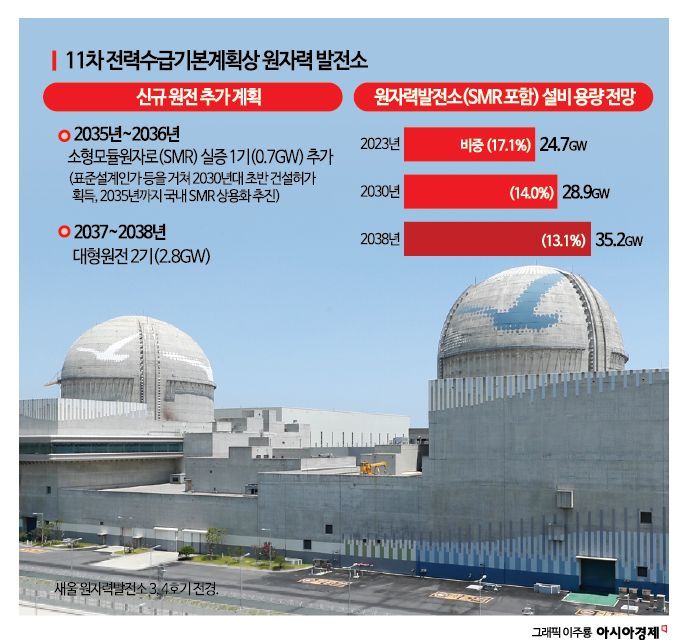
The Nuclear Power Plant Bidding War Begins
If new nuclear power plants are to be operational by around 2037, candidate sites must be selected no later than this year. Not only regions with existing nuclear infrastructure, but also local governments hoping to host new plants are expected to actively participate.
Major candidates for large-scale nuclear plants include Yeongdeok in North Gyeongsang Province, Samcheok in Gangwon Province, Ulju in Ulsan, and Gijang in Busan. Local governments that secure nuclear plant sites will receive support funds equivalent to 1.5% of construction costs and an additional 0.5% bonus, totaling up to 300 billion won in financial aid. For small modular reactors (SMRs), Daegu, Gyeongju in North Gyeongsang Province, Changwon in South Gyeongsang Province, and Busan have reportedly expressed interest.
Remaining Challenges
Even after a site is chosen, the permitting process must go through multiple agencies for environmental impact assessments, safety reviews, and radiation impact evaluations, while issues of local acceptance and compensation must be addressed in parallel. Additional issues such as transmission line route negotiations, local development support, the impact on electricity rates, and power grid design also remain. The cost issue is expected to be the subject of future public debate.
Nuclear power costs include both construction and decommissioning expenses, while renewable energy costs could fluctuate due to technological advances and subsidy reductions, making the final comparison of electricity unit costs a key variable in policy choices. The industrial sector is also watching closely to see at what point renewable energy procurement mandates, grid connection costs, and grid congestion issues will intersect with nuclear power operations. Environmental, labor, and civic groups opposed to nuclear energy may stage collective protests against the central and local governments.
Ultimately, some analysts believe that the "feasibility of policy implementation" was the core of the government's decision. The government took into account structural factors such as rising demand and carbon reduction, as well as public acceptance, potential local resistance, industry demands, and the international competitive environment. Including nuclear power in the carbon-free power mix was chosen as the most feasible option. Since the 12th Basic Plan for Electricity Supply and Demand may revisit the power mix and grid plans, this initiative is seen not as the final destination, but as the starting point of a medium- to long-term strategy.
© The Asia Business Daily(www.asiae.co.kr). All rights reserved.
![Clutching a Stolen Dior Bag, Saying "I Hate Being Poor but Real"... The Grotesque Con of a "Human Knockoff" [Slate]](https://cwcontent.asiae.co.kr/asiaresize/183/2026021902243444107_1771435474.jpg)
















