Minister Kim: "Zero Coal by 2040, Power Mix Shift Unavoidable"
Competition for New Nuclear Plant Sites Intensifies
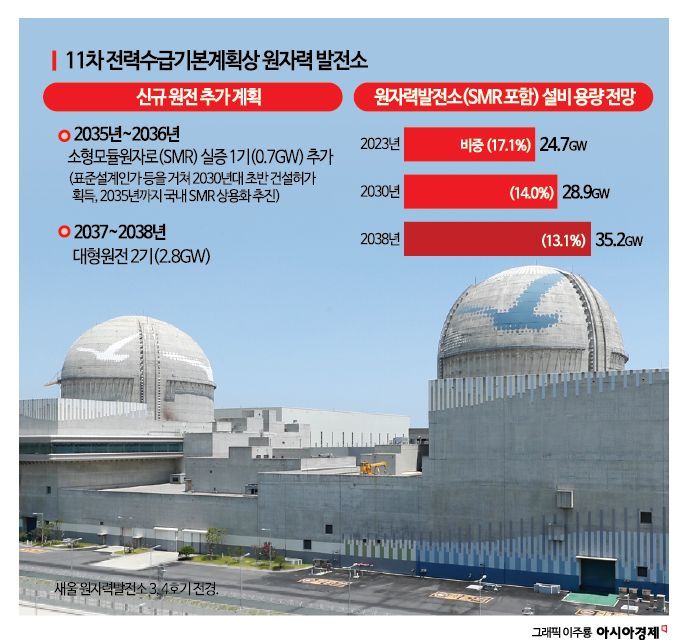
The Lee Jaemyung administration has decided to proceed as planned with the construction of two new nuclear power plants included in the 11th Basic Plan for Electricity Supply and Demand (the "Electricity Basic Plan"). As a result, local governments are expected to actively compete to attract these nuclear power plants. If the site selection is completed within this year and subsequent procedures for environmental review, construction, and operation are carried out, the government believes completion could be possible as early as 2037.
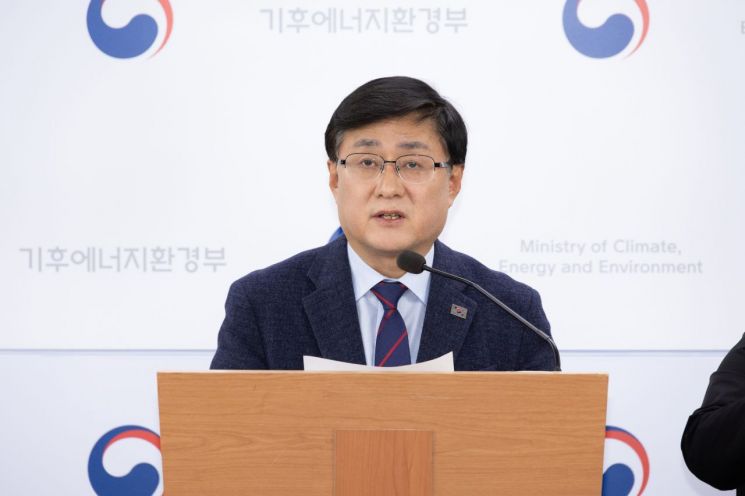
Kim Sunghwan, Minister of Climate, Energy and Environment, held a briefing at the Government Complex Sejong on January 26 and stated, "To reduce carbon emissions, we must lower the share of coal and liquefied natural gas (LNG) in power generation. In particular, to achieve reductions in the electricity sector, it is necessary to operate the power grid centered on renewable energy and nuclear power. The construction of new nuclear power plants will proceed as planned."
The government gathered public opinion through two policy forums (held on December 30, 2025, and January 7, 2026) and a public opinion survey (conducted from January 12 to 16, 2026). The survey showed that over 80% of respondents agreed on the need to expand nuclear power, and more than 60% responded positively to the construction of two new plants.
The government plans to address the intermittency of renewables through energy storage systems (ESS) and pumped-storage hydroelectricity, and to reduce the inflexibility of nuclear power by introducing flexible (adaptive) operation. Minister Kim said, "In the 12th Electricity Basic Plan, we will scientifically and objectively reflect the increase in electricity demand due to the expansion of artificial intelligence (AI) and electric vehicles, the expansion of distributed power grids, and the power mix required for carbon neutrality by 2050."
The procedures for constructing new nuclear power plants have also been detailed. Korea Hydro & Nuclear Power will soon begin soliciting site proposals and expects to complete evaluation and selection in about five to six months. The goal is to obtain construction permits in the early 2030s and complete construction between 2037 and 2038. The process will proceed in the order of site selection, licensing, construction, fuel loading and commissioning, and operation approval. Separately, small modular reactors (SMRs), which are being promoted independently, are expected to be completed by 2035.
During the briefing, questions were raised about how this policy differs from the nuclear phase-out policy of the Moon Jaein administration. In response, Minister Kim explained, "During the Moon administration, the global community was highly sensitive to nuclear risks due to the aftermath of the Fukushima accident, and there was also hope that the intermittency of renewables could be replaced by green hydrogen. However, as the climate crisis has worsened and the price of green hydrogen has not fallen sufficiently, many countries are shifting to a system where renewables are the main source and nuclear serves as a complement." He added, "South Korea is an energy island nation, and due to its geographical characteristics, it is difficult to operate the power grid solely with solar energy. We must also consider that it is not feasible to indefinitely pass on electricity costs to consumers."
The government intends to maintain its pledge to completely phase out coal-fired power generation by 2040. Minister Kim emphasized, "Achieving zero coal by 2040 is a promise to the public and aligns with the national greenhouse gas reduction target (NDC) timeline." Regarding the possibility of additional nuclear power construction, he said, "We have not deliberately closed the door on this. The level at which we combine reductions in coal and LNG with renewables and nuclear will be determined through simulation and public debate in the 12th Electricity Basic Plan."
On the technical compatibility of expanding both renewables and nuclear power, Minister Kim said, "In the past, there was no need for flexible operation of nuclear power because the share of renewables was low, but going forward, renewables and nuclear may overlap during daylight hours. We will need to absorb or distribute this through ESS, pumped-storage hydro, and flexible operation of nuclear plants." He also mentioned that the nuclear industry has stated the APR1400 design is already capable of flexible operation, adding, "We will proceed with extreme caution in demonstration, as safety could be affected." New nuclear plants will be designed on the premise of flexible operation.
Site selection and local acceptance are also key issues. Minister Kim stated, "Multiple local governments may apply during the site solicitation process, and we will comprehensively consider safety, geology, and local acceptance. It will be difficult to build unilaterally in regions with strong opposition." Regarding questions about ultra-high-voltage transmission lines, he explained, "Since the Miryang incident, the construction of 765kV AC transmission lines has virtually stopped, and the focus has shifted to 345kV AC and 500kV HVDC lines. Despite the shift to local generation and consumption, high-voltage transmission lines are still needed due to power imbalances between regions. We must enhance local acceptance through undergrounding or sharing benefits with residents."
There was also criticism that the public opinion survey and policy forums amounted to little more than "window dressing." In response, Minister Kim said, "It is true that it was difficult to address all energy issues in just two forums. However, this public opinion survey showed little difference from previous surveys, and in the 12th Electricity Basic Plan, we will bring key issues to public discussion with much more data, simulation, and information disclosure." Regarding the disclosure of the raw data from the public opinion survey, he stated, "I have instructed that it be made public, and if any data is missing, it will be released immediately."
The government also plans to pursue SMR development and nuclear power export strategies in parallel. Minister Kim said, "SMRs are significant as distributed power sources, but since there are no proven cases, evaluation will be needed after completion in 2035." He continued, "There are not many countries with the capability to design and manufacture nuclear power plants, and South Korea is competitive in this field. As many countries seek to adopt packages of renewables, nuclear, and grids, we will strengthen our export competitiveness."
Minister Kim concluded, "The 12th Electricity Basic Plan is not just a simple adjustment of the power mix, but a national energy roadmap toward carbon neutrality by 2050. We will pursue this energy transition together with the AI transition and communicate fully with the public."
© The Asia Business Daily(www.asiae.co.kr). All rights reserved.
![Clutching a Stolen Dior Bag, Saying "I Hate Being Poor but Real"... The Grotesque Con of a "Human Knockoff" [Slate]](https://cwcontent.asiae.co.kr/asiaresize/183/2026021902243444107_1771435474.jpg)

















