National Tax Service Holds Nationwide Tax Office Chiefs Meeting in the First Half of the Year
Announces "2026 National Tax Administration Operation Plan"
Regular Tax Audits Deferred for "Small Business Owners Contributing to Price Stability, Outstanding Export SMEs, and Startups"
The National Tax Service has decided to focus its investigative capabilities on malicious and sophisticated tax evaders and respond strictly. The agency will examine the operational status of large bakery cafes that are abusing the family business inheritance deduction system as a means of "illegally passing on wealth." It will also verify irregular transactions, such as manipulating stock prices through false disclosures to gain capital gains, or acquiring high-priced apartments through debt-laden gifts, including jeonse deposits. In particular, the National Tax Service plans to strengthen its response to tax evasion schemes that divert profits to family companies to reduce tax liabilities, as seen in the recent controversy involving actor Cha Eunwoo.
On January 26, the National Tax Service held a nationwide meeting of tax office chiefs at the Government Sejong Complex and announced the "2026 National Tax Administration Operation Plan" containing these measures.
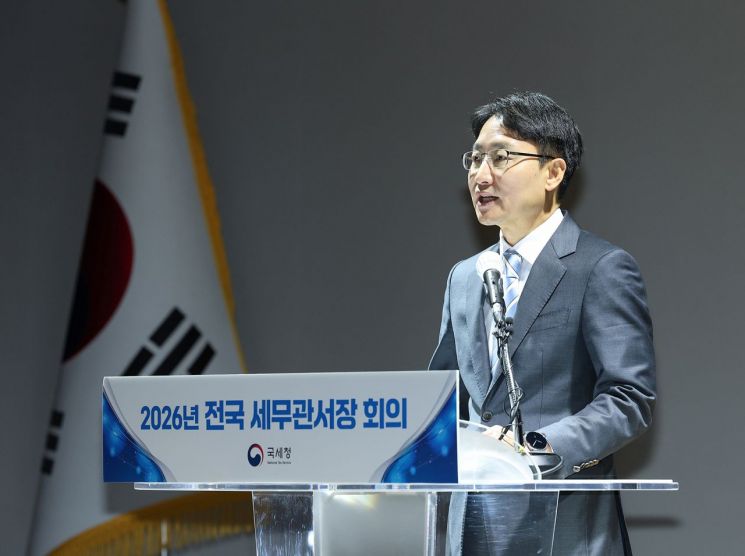 Im Kwanghyun, Commissioner of the National Tax Service, held the nationwide tax office chiefs meeting for the first half of the year at the Government Sejong Complex on the 26th and announced the "2026 National Tax Administration Operation Plan." National Tax Service
First, the National Tax Service plans to establish tax justice by eradicating anti-social tax evasion. While maintaining the number of tax audits at around 14,000 cases, similar to previous years, in consideration of domestic and international economic conditions, the agency will focus its investigative resources on malicious and sophisticated tax evasion cases that the public recognizes as legitimate and necessary, enabling a swift response.
To begin with, the National Tax Service has started reviewing the operational status of large bakery cafes, which are at risk of being abused as a means to avoid inheritance tax. The agency will also strictly respond to malicious tax evasion involving unfair and irregular practices, such as the "tunneling method" of diverting assets from listed companies to controlling shareholders and stock market manipulation. In addition, all gift transactions involving high-priced apartments in the four major districts of Gangnam (Gangnam, Seocho, Songpa, and Gangdong) and the so-called "Mayongseong" area (Mapo, Yongsan, and Seongdong) will be thoroughly verified, and the agency will focus its investigations on irregular transactions among related parties, such as disguised sales and low-price transfers.
Tax support for small business owners and small and medium-sized enterprises will be strengthened. The agency will implement a "Comprehensive Livelihood Support Plan" that includes extending payment deadlines and expanding the application of simplified taxation for small business owners. It will also establish a new center to resolve tax difficulties for small and medium-sized enterprises and small business owners, providing guidance on various tax support systems, including deductions and exemptions.
For export companies affected by customs duties and companies in the petrochemical, steel, and construction industries struggling with oversupply from China, the agency will ease tax concerns by extending payment deadlines. At the same time, it will create a more business-friendly tax environment by fully implementing the "tax audit timing selection system" and introducing a system to pre-disclose key audit items, thereby reducing the burden of tax investigations. Furthermore, for small business owners who have contributed to price stability, outstanding small and medium-sized export companies, and startups, regular tax audits will be deferred for up to two years to provide a foundation for growth.
The National Tax Service will closely examine the status of delinquent taxpayers through the National Tax Delinquency Management Division, which is scheduled to be officially launched in March this year, and implement tailored delinquency management according to taxpayer type. Based on the findings, the agency will classify delinquent taxpayers by type, supporting those facing financial hardship by extinguishing their tax liability to help them recover economically, while strengthening tracking investigations for malicious delinquents. In cases without justifiable reasons, the agency will strictly respond by proceeding with public auctions of seized assets.
The National Tax Service also plans to steadily implement major innovation tasks, such as a large-scale transition to artificial intelligence (AI) in tax administration and the integration of non-tax revenue collection. With the goal of launching the main project in 2027, the agency will swiftly establish and promote a "Comprehensive Roadmap for the AI Transformation of Tax Administration." This year, as a leading initiative, it will prioritize the development of generative AI chatbots, generative AI phone consultation, and AI-powered search services for Hometax. In addition, the agency will push ahead with integrating the collection of non-tax revenues, which are currently managed separately under more than 300 different laws.
© The Asia Business Daily(www.asiae.co.kr). All rights reserved.
![Clutching a Stolen Dior Bag, Saying "I Hate Being Poor but Real"... The Grotesque Con of a "Human Knockoff" [Slate]](https://cwcontent.asiae.co.kr/asiaresize/183/2026021902243444107_1771435474.jpg)















