Kang Hoon-sik to Depart for Canada on the 26th
Fourth Overseas Visit as Special Envoy for Strategic Cooperation
Many Korean Companies, Including Hyundai Motor, to Join Delegation
Kang Hoon-sik: "Expecting to Create 20,000 Jobs"
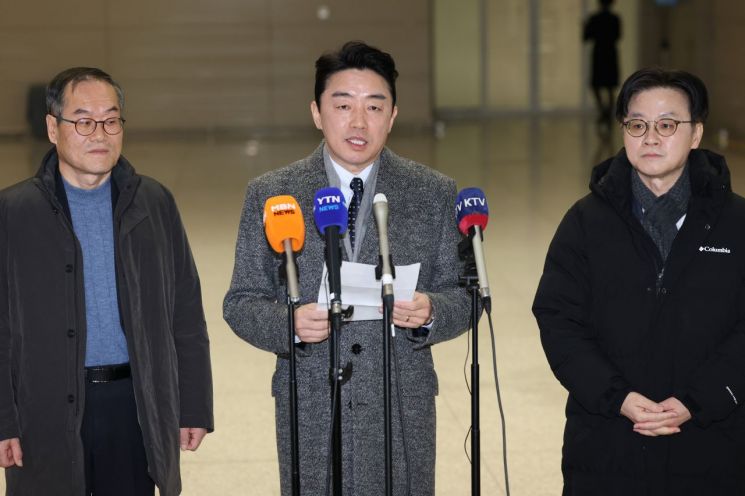 As a "Special Envoy for Strategic Economic Cooperation," Kang Hoon-sik, Chief Secretary of the Presidential Office, is speaking to the press before departing for Canada through Incheon International Airport on the 26th. Photo by Yonhap News Agency
Kang Hoon-sik, Chief Secretary of the Presidential Office, is departing for Canada on the 26th to secure a submarine contract worth 60 trillion won. With the additional production-inducing effect alone estimated at a minimum of 40 trillion won and the potential to create tens of thousands of jobs, Kang is determined to do his utmost to win the contract. Kang has devised a strategy to demonstrate South Korea's commitment to comprehensive "industrial cooperation" to the Canadian government by including a diverse range of companies, including Hyundai Motor Group, in the special envoy delegation. Following the visit to Canada, he is also expected to continue discussions in Norway regarding the export of the Korean multi-launch rocket system (MLRS) "Cheonmu (K-239)."
Speaking with reporters at Incheon International Airport before his departure for Canada on the morning of the 26th, Kang stated, "This Canadian submarine project is one of the largest defense industry projects currently underway. The domestic production-inducing effect alone is estimated to exceed at least 40 trillion won, and if we succeed in winning the contract, more than 300 partner companies will be provided with work, and as many as 20,000 jobs are expected to be created." Kang is visiting Canada as the President’s Special Envoy for Strategic Economic Cooperation; this is his fourth overseas mission as a special envoy supporting the export of Korean defense products.
Canada's "Canadian Patrol Submarine Project (CPSP)" aims to introduce up to 12 diesel submarines with a displacement of 3,000 tons. When combining construction costs with future maintenance, repair, and operation (MRO) expenses, the total project size is estimated to reach up to 60 trillion won. Hanwha Ocean and HD Hyundai Heavy Industries have formed a "One Team" consortium to participate in the bid, competing with Germany’s Thyssenkrupp Marine Systems (TKMS) in the final round. Canada plans to close the final proposal submission in March and select a preferred bidder in the first half of the year.
The special envoy delegation includes Kim Jeonggwan, Minister of Trade, Industry and Energy, and Lee Yongcheol, Commissioner of the Defense Acquisition Program Administration, as well as representatives from Hanwha Ocean and HD Hyundai Heavy Industries, who have formed the consortium. In addition, although not directly related to the contract, a large number of domestic companies, including Hyundai Motor Group, are joining the delegation. Kang explained, "There are limits to challenging such a large-scale defense contract based solely on weapon performance or the capabilities of individual companies. The Canadian government has also stated that, in addition to performance and price, industrial cooperation, such as job creation, will be an important criterion."
Industry insiders also believe that the attractiveness of the industrial cooperation proposal submitted to Canada will determine the success or failure of the bid. The Canadian government is said to have requested so-called "offset trade" at the level of the submarine contract amount. Offset trade is a type of conditional trade in which the importing country asks the exporter to provide economic benefits in return for the contract. The Canadian government requested a package including domestic equipment purchases, local production, technology investment, and resource and energy cooperation. It is reported that South Korea was asked to establish a Hyundai Motor local plant, while Germany was asked to build additional Volkswagen facilities.
"The situation is not easy... but if we can raise the chances of winning even slightly"
The outlook for winning the contract is not entirely bright. This is due to Canada's offset trade requirements, as well as the strengthening of joint arms procurement among NATO and European Union (EU) member states. With the Canadian government announcing its intention to participate in the EU's joint arms procurement program, there are growing concerns about increased uncertainty for South Korea's submarine bid. Kang acknowledged, "Considering that we received technology transfer from Germany in the early stages of our submarine development, I believe the situation is not easy."
In response, on the 25th, Kang visited the War Memorial of Korea in Yongsan to pay tribute to Canadian soldiers who fell during the Korean War. This diplomatic gesture was intended to highlight the two countries' history as comrades-in-arms during the war, as part of the bidding effort. Kang said, "At the suggestion of the Minister of Industry, it was an opportunity to honor Canada's dedication and sacrifice during the Korean War and to reaffirm the history of security cooperation. We plan to fully convey these sentiments to the Canadian side."
Kang emphasized, "In addition to the excellent performance of our submarines, I intend to directly communicate the government's commitment to expanding industrial and security cooperation between the two countries to the highest levels of the Canadian government. There is a saying in Canada: 'A real friend comes in winter.' If we can raise the chances of winning the contract even slightly and convey Korea’s sincerity, the role of the special envoy delegation is to do our utmost during this visit."
After the schedule in Canada, the special envoy delegation plans to visit Norway to support cooperation on the export of "Cheonmu." Norway is currently pursuing a multi-launch rocket procurement project, and Hanwha Aerospace is being discussed locally as a potential supplier.
Last year, Kang visited Poland, Romania, and Norway in October; the United Arab Emirates and Saudi Arabia in November; and Poland again in December, conducting "sales diplomacy" to support defense exports. Notably, in December last year, after signing a Cheonmu guided missile contract in Poland worth 3.9 billion dollars (about 5.6 trillion won), he stated in a return briefing, "The total value of defense contracts with foreign countries in 2025 was 15.2 billion dollars, and since the inauguration of the Lee Jaemyung administration in June, contracts worth more than 14.2 billion dollars, or over 90 percent, have been signed."
© The Asia Business Daily(www.asiae.co.kr). All rights reserved.

















