Key Proposals Delivered:
Expansion of Local Talent Quota at Gyeonggi Northern Science High School
and Establishment of Uijeongbu Sports Convergence Science High School
On January 22, the city of Uijeongbu in Gyeonggi Province visited the Northern Office of the Gyeonggi Provincial Office of Education, where officials met with Lim Taehee, Superintendent of the Gyeonggi Provincial Office of Education, to deliver key proposals aimed at resolving educational issues in the Uijeongbu area and implementing practical education policies.
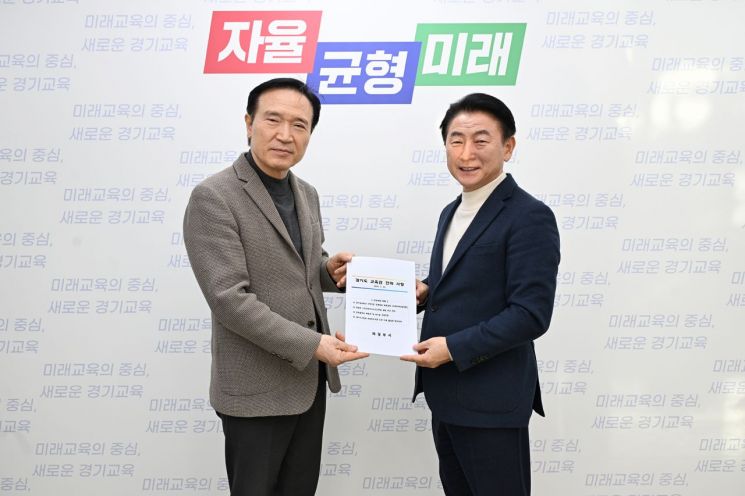 Kim Donggeun, Mayor of Uijeongbu (right), visited the Northern Office of Gyeonggi Provincial Office of Education on the 22nd and held a meeting with Lim Taehee, Superintendent of Gyeonggi Provincial Office of Education, to convey key proposals for resolving educational issues in the Uijeongbu area and realizing practical education policies. Provided by Uijeongbu City
During the meeting, the city presented four core proposals: expanding the local talent selection quota at Gyeonggi Northern Science High School; promoting the establishment of Uijeongbu Sports Convergence Science High School (tentative name); improving the gymnasium and cafeteria at Minrak Middle School and constructing a new community complex facility; and reorganizing the Uijeongbu Library of the Gyeonggi Provincial Office of Education as a regional educational and cultural hub.
First, the city proposed that the local talent admission quota at Gyeonggi Northern Science High School be increased to 20%, emphasizing that there is significant interest among local students and parents in gaining access to the high-quality education the school provides.
The city stressed the need to expand practical opportunities for nurturing scientific talent, and the Office of Education expressed its agreement with the intent of the proposal and stated that it would actively consider its implementation.
Next, the city once again proposed the establishment of the 'Uijeongbu Sports Convergence Science High School (tentative name),' a new specialized education model that integrates sports, industry, management, and marketing fields.
This proposal focused on further detailing previously suggested ideas and called for the development of a practical implementation roadmap. In particular, the city highlighted that this high school model would be unprecedented not only in northern Gyeonggi but nationwide, serving as a symbolic and policy-significant educational model reflecting local characteristics. In response, the Superintendent stated that the Office of Education would review practical measures for implementation, including the signing of a future business agreement.
The city expressed its intention to diversify student career paths and present a new model for education in northern Gyeonggi through a differentiated, integrated education system distinct from existing sports high schools.
The Office of Education promised to review practical implementation measures and agreed to discuss future cooperation. Both parties also recognized the need for long-term educational infrastructure, given the expected increase in student numbers due to the development of large-scale residential complexes in Nokyang-dong (such as Ujeong Village, with approximately 4,000 households).
In addition, to address the shortage of school facilities resulting from population growth in the Minrak and Gosan districts, the city requested improvements to the aging gymnasium and cafeteria at Minrak Middle School and proposed constructing a new complex facility that could also be used by local residents. The Office of Education agreed with the idea of sharing school facilities with the community and stated that it would review the feasibility of the proposal.
Lastly, the city proposed strengthening the functions and improving the facilities of the Uijeongbu Library of the Gyeonggi Provincial Office of Education, located in Nokyang-dong. Recognizing that it is the only library directly operated by the Office of Education in northern Gyeonggi, the city discussed the need for facility improvements and suggested remodeling led by the Office of Education, as well as integrated operation with the city's public libraries. In response, the Office of Education replied that it would actively consider these suggestions so that the library can become a representative educational and cultural space in northern Gyeonggi.
An official from the Office of Education stated, "The proposals made by Uijeongbu City are well aligned with on-site needs and the direction of education policy. We will actively review them and work closely with the city to create an educational environment that students and parents can truly experience and appreciate."
An official from Uijeongbu City commented, "This meeting was not just a simple proposal, but a meaningful opportunity to collaboratively create education policies that citizens can directly experience. We will continue to work closely with the Office of Education to establish an educational environment that satisfies both students and parents."
Meanwhile, the city plans to systematically promote major educational issues such as expanding the local talent admission quota at science high schools, establishing specialized high schools, expanding community complex facilities, and improving educational infrastructure, using this discussion as a starting point.
© The Asia Business Daily(www.asiae.co.kr). All rights reserved.
![Clutching a Stolen Dior Bag, Saying "I Hate Being Poor but Real"... The Grotesque Con of a "Human Knockoff" [Slate]](https://cwcontent.asiae.co.kr/asiaresize/183/2026021902243444107_1771435474.jpg)















