Metropolitan Office of Education Hosts Grand Debate for Gwangju Education Community
Need for Deliberation Due to Different Conditions in Gwangju and Jeonnam
Calls for Improvements in Educational Systems Including Special Schools
Decision on Unified Superintendent Left to Educational Stakeholders
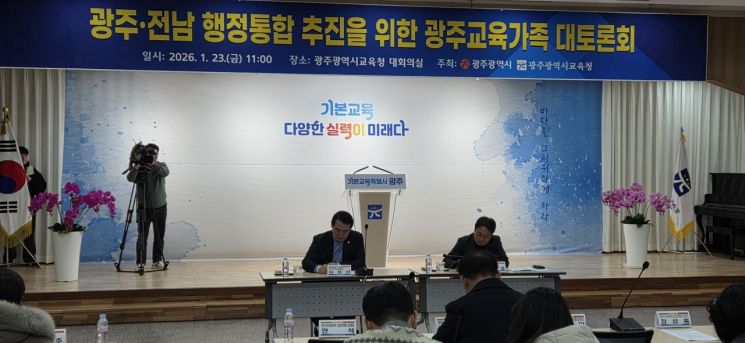 On the morning of the 23rd, a grand discussion forum for the Gwangju education family was held at the Gwangju Metropolitan Office of Education to promote the administrative integration of Gwangju and Jeonnam. Photo by Min Chanki
There are ongoing conflicts within the local education community regarding the timing of the integration and whether to elect a unified superintendent for the Gwangju-Jeonnam education integration. Many in the local education sector have argued that there needs to be sufficient discussion about the differing educational conditions between Gwangju and Jeonnam during the integration process.
On the morning of the 23rd, a grand debate for the promotion of administrative integration between Gwangju and Jeonnam was held at the Gwangju Metropolitan Office of Education. The debate was attended by Gwangju Mayor Kang Gijung, Gwangju Superintendent Lee Jeongseon, representatives from teachers' associations, public officials’ unions, public service workers’ unions, students, parents, and about 80 other participants.
This debate brought together all stakeholders involved in educational integration. The event proceeded with sharing the current status of the initiative, followed by a Q&A session and a comprehensive summary.
Opinions were divided among education stakeholders regarding the timing of the integration. One teacher said, "With the advancement of AI and robotics, education must also undergo a revolutionary change, and it is not appropriate to postpone educational autonomy integration for another four years. If a unified superintendent is not elected, we may not be able to receive the special integrated education grant, which amounts to 1 trillion won. The opportunity cost of forgoing this budget is too high."
However, Kim Yongtae, candidate for Gwangju Superintendent from the Democratic Progressive Party, stated, "I cannot agree that simply bringing in more budget will improve educational conditions. There are many factors besides budget that must be considered for children's educational environments. If educational integration proceeds, Gwangju’s educational environment will deteriorate due to intense urban negotiations, while Jeonnam will experience severe educational decline starting from its outskirts."
He continued, "Parents will do everything they can to send their children to better schools from elementary school, which will lead to overcrowding. After further deliberation, a stable educational integration in a positive direction is necessary."
Another teacher commented, "Gwangju and Jeonnam have different educational conditions. Electing a single superintendent would create serious educational imbalances. Once educational deficits occur, they are difficult to recover from. The superintendents of both cities and provinces should prepare a reasonable plan as equals before any integration takes place."
There were also voices calling for improvements to the current educational system, including special schools. An elementary school teacher from Gwangsan-gu said, "The current law allows for an increase in the number of teachers, but this undermines the professionalism and autonomy of education. My school is near a Koryoin village and has many foreign students, but due to strict requirements, they are not designated as special education recipients. I hope special provisions for special education and foreign students can be included."
A representative from a special school added, "Although the special local autonomy law includes provisions for foreigners, there are no special provisions for special education. Special education is currently overcrowded. Since special education is not a choice but a necessary safety net, measures tailored to local circumstances are needed."
Some pointed out the lack of communication with students during the integration process. One student remarked, "The Office of Education seems to have many policies prepared for students, but students are not really aware of them. Even with administrative and educational integration ahead, my friends are all planning to go to universities in Seoul. There needs to be a forum for communication with the mayor and superintendent where students can voice their opinions and hear about policies that might encourage them to stay in Gwangju."
There were also calls for ways to check the power of the unified superintendent. One teacher said, "According to the special law, the unified superintendent will have strong authority, from the size of the budget to the establishment of special-purpose and foreign schools. There must be mechanisms for educational organizations to keep this power in check."
No clear answer was given regarding the election of the unified superintendent.
Gwangju Mayor Kang Gijung said, "This administrative integration is drawing attention from the President and the ruling party, and it is an opportunity to bring significant budget and jobs to Gwangju and Jeonnam. The issues of the integrated education office building and the election of the unified superintendent should be decided by the stakeholders in education. The Local Autonomy Act stipulates the election of one superintendent, but if two are elected, it can be included as a special provision in the special law."
He added, "If we do not proceed with educational integration and elect two superintendents, it will be difficult to include provisions for educational autonomy and the special integrated education grant in the special law."
Gwangju Superintendent Lee Jeongseon stated, "I will ensure that the opinions raised at the debate on personnel, finance, audits, and curriculum are reflected in the special law."
© The Asia Business Daily(www.asiae.co.kr). All rights reserved.
![Clutching a Stolen Dior Bag, Saying "I Hate Being Poor but Real"... The Grotesque Con of a "Human Knockoff" [Slate]](https://cwcontent.asiae.co.kr/asiaresize/183/2026021902243444107_1771435474.jpg)
















