"Just in Case... Military Action if Executions Proceed"
Fleet Moves from Asia-Pacific, Set to Arrive in Middle East Within Days
President Donald Trump of the United States has left open the possibility of military intervention against Iran, stating that a large U.S. fleet is moving toward Iran.
According to the Associated Press and other sources on the same day, President Trump told reporters aboard Air Force One on his return to the United States, "A large fleet is moving in that direction," adding, "Maybe we won't have to use it."
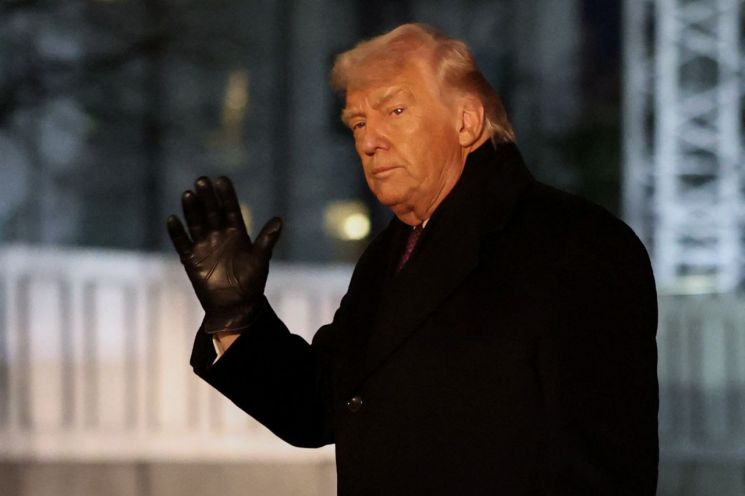
He also explained that this measure is "just in case." This is interpreted as a statement that the United States could intervene militarily if Iranian authorities crack down harshly on protesters.
President Trump claimed that he had prevented the execution of 837 Iranian dissidents and warned that Iran would face a 25% tariff if it engaged in trade with the United States. He further warned that if the Iranian government proceeds with executions of protesters, he would take military action that would make last year's airstrike on Iran's nuclear facilities "look minor" by comparison.
However, while stating that "murders are rampant," he declined to comment on whether he wanted Supreme Leader Ayatollah Seyyed Ali Khamenei to step down.
On the same day, two U.S. officials told Reuters that several U.S. Navy destroyers and fighter jets, including the aircraft carrier USS Abraham Lincoln, began moving from the Asia-Pacific region last week and will arrive in the Middle East within a few days. One official added that the United States is also considering deploying additional air defense systems to the Middle East.
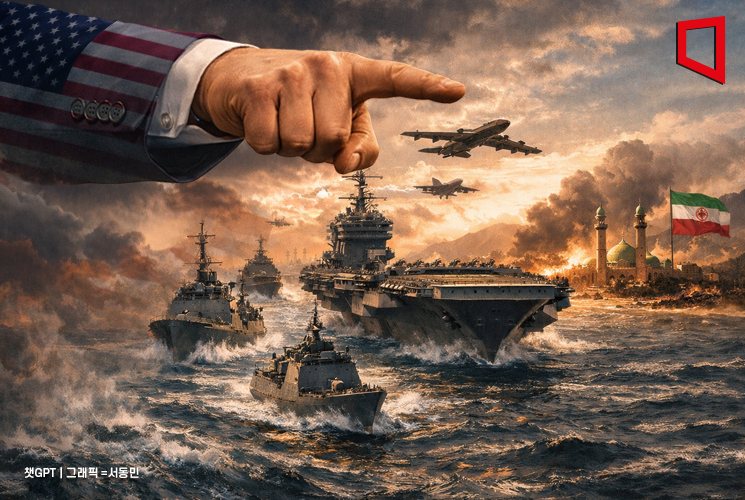
The United States has increased its military presence in the Middle East whenever tensions have escalated, typically for defensive purposes. In June of last year, ahead of the airstrike on Iran's nuclear facilities, the U.S. also carried out a large-scale military buildup in the region.
Recently, as Iranian authorities have brutally suppressed nationwide anti-government protests, tensions between the United States and Iran have escalated rapidly. While President Trump initially opposed the harsh crackdown and said he was considering strong measures, including military intervention, he has recently taken a more reserved stance.
On the 14th, he stated, "I heard that the killings in Iran have stopped," drawing a line against the possibility of intervention. On the 16th, he also mentioned the cancellation of executions by Iranian authorities, suggesting a suspension of military action against Iran. In an interview with Fox News the previous day, he said regarding possible military intervention in Iran, "I don't want to say," adding, "It would be foolish for me to say that (whether we will intervene or not)."
© The Asia Business Daily(www.asiae.co.kr). All rights reserved.
![Clutching a Stolen Dior Bag, Saying "I Hate Being Poor but Real"... The Grotesque Con of a "Human Knockoff" [Slate]](https://cwcontent.asiae.co.kr/asiaresize/183/2026021902243444107_1771435474.jpg)
















