As Demand for Secondhand Food Ingredients Rises Amid High Prices,
More Scammers Disappear After Luring Cash with Cheap Offers
Expert: "Platforms Must Implement Self-Regulation Measures Like Escrow"
Kim, a 48-year-old housewife, recently saw a post on a used goods app advertising 20 kilograms of Cheorwon Odae rice for 55,000 won. She transferred the money to the seller because the price was significantly lower than at grocery stores. The seller promised, "I will deliver it by the 20th," but even after the promised date, the item never arrived and the seller became unreachable.
Lee, 40, also suffered a similar loss. He explained, "I transferred 100,000 won after being told that rice, glutinous rice, and black rice were being sold together for less than market price, but suddenly the seller's account was suspended and the transaction was halted."
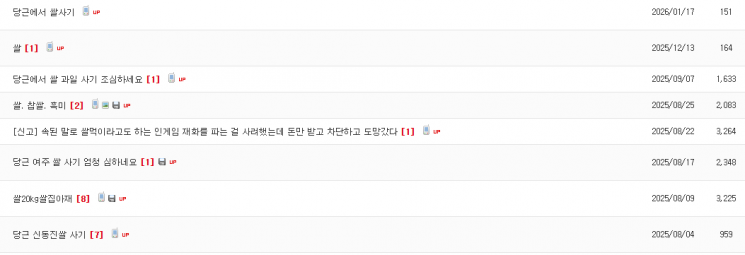 Used transaction damage cases involving rice, apples, and other items shared on The Cheat, a fraud damage information sharing site. Screenshot from The Cheat
With rising prices, more consumers are turning to secondhand platforms to buy food ingredients at lower prices, leading to a surge in so-called 'agricultural product scam and run' frauds. Scammers lure buyers with prices far below market value, induce direct cash transfers, and then cut off contact. Most secondhand platforms operate as peer-to-peer marketplaces, which limits the platform's responsibility. Even if victims report the fraud to authorities, the damage is often only a few hundred thousand won, causing these cases to be deprioritized in investigations.
On January 28, The Cheat, a fraud damage information sharing site, saw a series of reports about scams involving posts that falsely claim to offer farm-direct or gift agricultural products, such as rice and fruit, at low prices. However, it is common for sellers to take the money without sending the goods, or to send products of significantly inferior quality, so caution is advised.
There are also legal issues. Under current food sanitation laws, it is illegal for individuals who are not registered businesses to sell homemade or processed agricultural products (such as side dishes or juices) secondhand. While trading primary agricultural products like rice or vegetables is permitted, selling processed foods that have not undergone hygiene checks can be subject to regulatory action.
Experts say that in order to prevent such damage, not only should consumers exercise particular caution, but platforms must also strengthen their management and oversight. Lee Eunhee, Professor of Consumer Studies at Inha University, said, "This is a crime that exploits the desire of ordinary people to cut expenses in an era of high prices." She added, "Consumers should be wary of items priced far below the going rate, but above all, secondhand platforms need to make efforts for self-regulation, such as quickly blocking accounts suspected of fraud and implementing escrow payment systems to prevent direct money transfers between parties."
© The Asia Business Daily(www.asiae.co.kr). All rights reserved.
![Clutching a Stolen Dior Bag, Saying "I Hate Being Poor but Real"... The Grotesque Con of a "Human Knockoff" [Slate]](https://cwcontent.asiae.co.kr/asiaresize/183/2026021902243444107_1771435474.jpg)















