[Interview] Kim Mikyung, Head of the National Museum Culture Foundation
Her Criteria for Museum Merchandise
"Always Weighing Dignity and Popular Appeal"
"Significance, Rarity, and Aesthetics Must Be Upheld"
"The First Question: 'Would I Want t
The Muithz Shop, which once occupied a quiet corner of the museum, has now become an essential stop for visitors. Previously dismissed as an optional souvenir shop that could easily be skipped, it is now the first destination for many museum-goers. At the National Museum of Korea in Yongsan, scenes of so-called "open runs," where visitors rush to the Muithz Shop as soon as the museum opens, have become commonplace. This is driven by people eager to secure popular items with limited quantities.
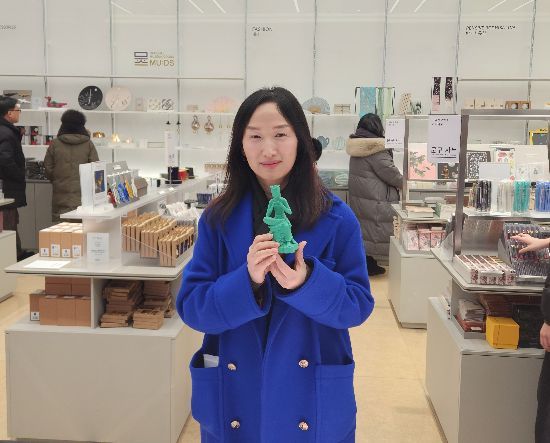 On the 22nd, Kim Mikyung, Head of the Product Business Division at the National Museum Culture Foundation, posed for a photo holding Muithz at the Muithz Shop on the first floor of the National Museum of Korea in Yongsan. Photo by Seo Mideum
It is also a common misconception that Muithz Shop employees are museum staff. In reality, those responsible for planning and operating the Muithz Shop and its products belong to the National Museum Culture Foundation. The foundation oversees the operation of Muithz Shops in national museums across the country. It is also known that the foundation is housed within the National Museum of Korea without a separate building, and that employees receive no individual incentives regardless of sales performance. This is because the foundation is classified as a government-subsidized institution: the government covers any deficits, but any profits generated are returned to the government.
However, this trend is changing. Muithz sales reached a record high last year, surpassing 41.3 billion won-about double the previous year's figure. As a result, the foundation became the first government-subsidized institution in Korea to receive government incentives.
Kim Mikyung, Head of the Product Business Division at the National Museum Culture Foundation and the driving force behind Muithz's success, recently told The Asia Business Daily, "Thanks to everyone's support, we now have a new holiday bonus," adding, "It will be paid for the first time this Lunar New Year, and from July this year, our team will be expanded by nine members."
Kim, who joined the foundation in 2016, is a marketing expert by background. She previously planned products such as "Morning Rice" and "Green Plum" at Woongjin Foods, and led marketing for the "Seven Springs" salad bar at Samyang Corporation. After completing her MBA, she joined the museum foundation, recalling that the experience was "very unfamiliar." Everything from salary levels to organizational culture and work methods was markedly different from private companies. Nevertheless, she embraced this as a "fresh challenge" and began introducing small changes.
The starting point was curation. At the time, Muithz Shop products were displayed in a uniform manner, making it difficult to stimulate consumer desire. Kim introduced product exhibitions and created a special section in the center of the store dedicated to Hwajeopdo artifacts, as well as organizing events linked to gift themes for Family Month. The response was immediate.
The criteria for Muithz planning are significance, rarity, and aesthetics. To avoid distorting the message of the artifacts, the team holds meetings and studies with the curatorial department and follows both internal and external verification procedures. Even the hand gesture of the Bangasayusang Muithz is carefully reviewed for appropriateness. Striking a balance between the dignity of the artifact and its popular appeal is the greatest challenge. Only after passing the internal test of "Would I buy this as a consumer?" is a product considered complete. The miniature "Mind Series" of the Bangasayusang, released to commemorate the 20th anniversary of the National Museum of Korea in Yongsan, was also created through this process.
Recently, sustainability has also become an important criterion. The belief is that products intended for long-term use must be of high quality. The Gyeongcheonsa Ten-Story Pagoda ice mold received an enthusiastic response upon release, but was remanufactured after the peak season to further improve its quality. Kim stated, "I hope our products are not just one-time purchases, but tools for creating lasting memories through continued use."
Kim added, "All of our staff work incredibly hard, regardless of department. The number of online mall visitors increased from around 10,000 to 700,000, so every employee was involved in packaging products, and crowds at the offline store sometimes led to queues like those at luxury boutiques." Regarding future plans, she said, "We are currently developing specialized products utilizing collections from 13 regional national museums simultaneously. The work is challenging, but we are enjoying the process."
© The Asia Business Daily(www.asiae.co.kr). All rights reserved.
![Clutching a Stolen Dior Bag, Saying "I Hate Being Poor but Real"... The Grotesque Con of a "Human Knockoff" [Slate]](https://cwcontent.asiae.co.kr/asiaresize/183/2026021902243444107_1771435474.jpg)
















