Controversy Over Continued Use of 'Sushi and Roll' Label on Gimbap Seaweed
Professor Seo Kyungduk: "It's Time to Call It KIMBAP"
Controversy has arisen as some packaging for 'gimbap seaweed' products still uses the English label 'Sushi and Roll.' With gimbap now established as a beloved K-food worldwide, critics argue that the unique name 'KIMBAP' (or 'GIMBAP') should be used instead.
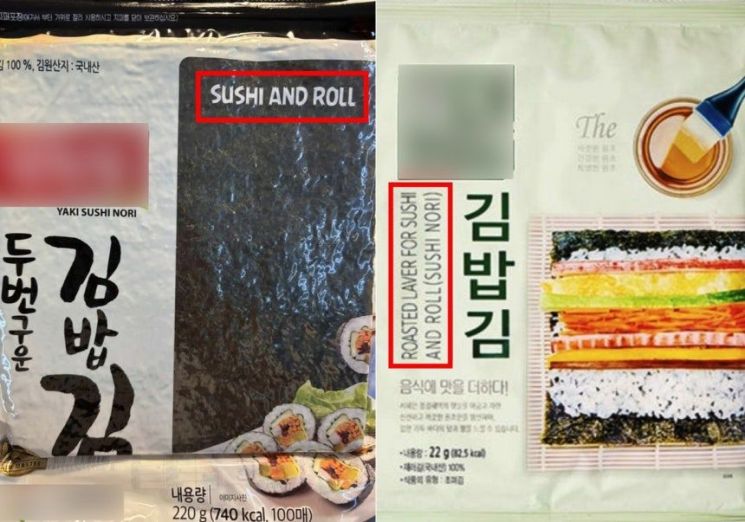 Some packaging for 'gimbap seaweed' uses the label 'Sushi and Roll.' Photo by Professor Seokyung Duk on Instagram
Professor Seo Kyungduk of Sungshin Women's University pointed out on his social media (SNS) Instagram account on the 23rd, "It remains problematic that some gimbap seaweed packaging still uses the English label 'Sushi and Roll.'"
Professor Seo emphasized that gimbap has already become a signature Korean dish enjoyed by people around the world. Last year, the Netflix animation 'K-Pop Demon Hunters,' which gained global popularity, featured a scene where a main character, a member of the Huntrix, eats gimbap, drawing attention. In addition, frozen gimbap is being sold at the major American supermarket chain Trader Joe's, receiving a positive response from local consumers.
He also noted that among foreign tourists visiting Korea, seaweed is considered a popular shopping item, and 'gimbap seaweed' in particular is reportedly recording high sales.
Professor Seo said, "In the past, because foreigners were unfamiliar with gimbap, it was understandable that the label 'Sushi and Roll' was used to aid their understanding. However, now that gimbap has grown into a leading representative of K-food enjoyed worldwide, it should be confidently labeled as 'KIMBAP' (or 'GIMBAP')."
He added, "Until now, we have consistently promoted kimchi, bibimbap, and bulgogi around the world, but starting this year, we plan to widely promote gimbap, as well as tteokbokki and Korean-style toast."
© The Asia Business Daily(www.asiae.co.kr). All rights reserved.

















