Challenges Remain Over Dual Special Investigation Demand and Han Donghoon's Expulsion
Attention Turns to Potential Opposition Alliance Ahead of Local Elections
Jang Donghyuk, the leader of the People Power Party, who had demanded a dual special investigation into the Unification Church and Democratic Party nomination bribery allegations, ended his hunger strike after eight days. Although his hunger strike succeeded in rallying internal unity amid heightened backlash over the expulsion of former leader Han Donghoon, it has left significant challenges unresolved.
According to the People Power Party on January 23, Jang is currently recovering in the hospital while awaiting test results. The previous day, former President Park Geunhye made a surprise visit to the National Assembly and persuaded Jang to end his hunger strike, which he accepted. Kwak Gyutaek, the chief spokesperson for the People Power Party, stated, "He is expected to return next week, but we need to monitor his health condition further."
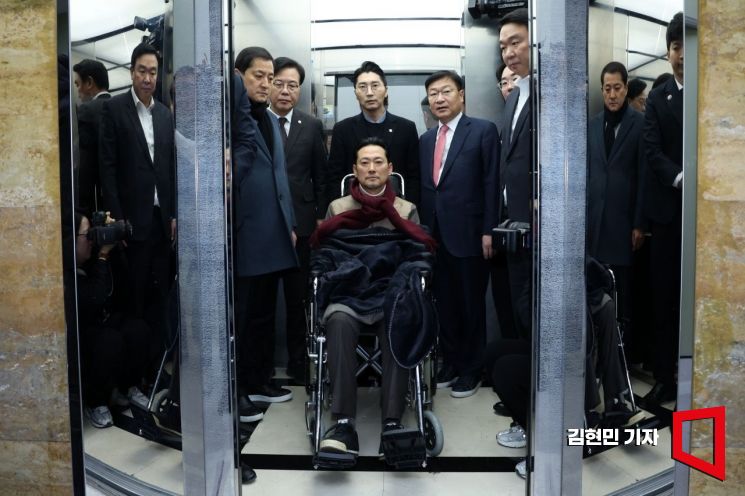 Jang Donghyuk, the leader of the People Power Party, who has been fasting for eight days urging the acceptance of the dual special investigation law on the Unification Church and nomination bribery, stopped fasting and was being transported to a hospital at the National Assembly on January 22, 2026. Photo by Kim Hyunmin
Within and outside the party, there is an assessment that Jang's hunger strike provided an opportunity to consolidate the conservative base. Following former President Park's first visit to the National Assembly in a decade since 2016, prominent conservative figures such as Yoo Seungmin, a former lawmaker with centrist-conservative leanings, and Kim Moonsu, former Minister of Employment and Labor who previously competed with Jang for party leadership, visited Jang in succession. Local government heads affiliated with the People Power Party, such as Seoul Mayor Oh Sehoon-who had previously called on Jang to change course-and reformist lawmakers within the party, also expressed their support for the hunger strike.
However, the original objective of the hunger strike-demanding a dual special investigation-was not achieved. With the government and ruling party still opposing the dual special investigation, there is no clear way forward other than intensifying public campaigns. This is why the People Power Party immediately launched a public appeal campaign following Jang's decision to end his hunger strike. Song Eonseok, the party's floor leader, stated at a parliamentary strategy meeting that "this weekend, lawmakers and local party chapter heads will go into their constituencies to campaign for the acceptance of the dual special investigation." Additional protest measures will be discussed at a general assembly of lawmakers scheduled for the afternoon of January 26.
Internal discord remains unresolved depending on whether former leader Han Donghoon will be expelled. The immediate focus is on whether Jang will decide on Han's expulsion at the Supreme Council meeting scheduled for January 26. While some expect the party leadership to finalize the expulsion, Han Donghoon's supporters are voicing strong opposition, calling for the motion to be withdrawn. Assemblyman Jeong Seongguk warned on SBS Radio that "if the party pushes through with the expulsion, the unity achieved through the hunger strike could quickly turn into division."
There is also the formidable challenge of boosting approval ratings ahead of the local elections in June. Attention is focused on the possibility of opposition electoral alliances amid efforts by the ruling bloc to reorganize the political landscape. Some within the People Power Party are calling for an electoral alliance, but the Reform Party has dismissed this possibility. While the Reform Party is willing to cooperate on the dual special investigation into the Unification Church and Democratic Party nomination bribery allegations, it is not considering an electoral alliance. Cheon Haram, the Reform Party's floor leader, said on BBS Radio that "there has always been pressure for the two parties to join forces, but the Reform Party has its own distinctiveness and independence, so we are unlikely to yield." A Reform Party official added, "There is little to gain from a local election alliance, and there is no reason for Chairman Lee Junseok to risk his political future by abandoning the party's identity."
There are concerns that failing to achieve an opposition alliance could lead to losses in key battlegrounds in the local elections. Seoul and Busan-where Cho Kuk, the leader of the Innovation Party, is likely to run if the Democratic Party and Innovation Party merge-are considered must-win regions for the People Power Party. A People Power Party lawmaker from Busan commented, "If the ruling bloc merges, there is a high possibility that Cho Kuk will run for mayor of Busan, which is raising tensions. In what is already a difficult election, if we only manage to hold onto Daegu and North Gyeongsang Province (TK), the party could become even more isolated."
© The Asia Business Daily(www.asiae.co.kr). All rights reserved.
![Clutching a Stolen Dior Bag, Saying "I Hate Being Poor but Real"... The Grotesque Con of a "Human Knockoff" [Slate]](https://cwcontent.asiae.co.kr/asiaresize/183/2026021902243444107_1771435474.jpg)
















