Ruling Party Lawmakers Oppose Dual-Track Structure for SCIA at Closed Policy Caucus
Many Lawmakers Assert "Field Operations Would Be Impossible"
Review of Overall Framework for SCIA and Prosecution Agency Act
Party Expected to Accelerate Consensus and Legislative Drafting
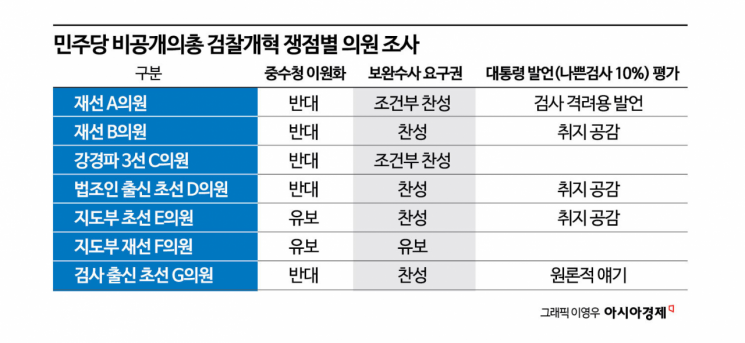
At the closed policy caucus on the Serious Crimes Investigation Agency (SCIA) and the Prosecution Agency Act held on the 22nd, a significant number of Democratic Party of Korea lawmakers reportedly voiced opposition to the dual-track structure that would establish 'judicial investigators' as a separate track to incentivize prosecutors to join the SCIA.
According to The Asia Business Daily’s coverage on the 23rd, the caucus the previous day focused on the following issues: the supplementary investigation authority of prosecutors in the Prosecution Agency, the SCIA's authority to investigate nine major crimes, and the dual-track structure of the SCIA. On the issue of dualization, consensus formed in opposition. Many pointed out that a dual structure of judicial investigators and professional investigators would make it impossible to operate field organizations effectively.
Assemblyman A, in his second term, told The Asia Business Daily in a phone call after the caucus, "Even in ordinary public service organizations, those who passed the civil service exam and those who did not work together. Just because someone has a lawyer’s license does not justify creating a separate structure for investigators." Another second-term lawmaker, Assemblyman B, said that consensus was also reached regarding the judicial investigator system. He stated, "This is not an issue that should be resolved by dividing status into separate tracks, but rather by using rank." Assemblyman C, in his third term, questioned, "If you can distinguish by rank from level 1 to level 9, why do you need another judicial investigator? That is something that has already been settled within the party."
After the caucus, there was also much discussion among lawmakers regarding President Lee Jaemyung’s comments on prosecutorial reform during his New Year’s press conference. Assemblyman D, a first-term lawmaker with a legal background, said, "Those unfamiliar with practical affairs continue to talk about the ‘prosecutorial apocalypse theory,’ but many lawmakers with legal backgrounds have become more moderate following the President’s remarks." Assemblyman B, in his second term, said, "It is difficult to see the President’s remarks as a guideline, but it is a point for us to consider how to address those concerns." However, following the President’s comment that 'out of 2,000 prosecutors, perhaps 10% are bad,' lawmakers who had previously belonged to the moderate camp on prosecutorial reform reportedly made their presence clearly felt at the caucus. Assemblyman E, in his first term, expressed support for granting supplementary investigation authority to prosecutors, saying, "I think the President’s remarks are reasonable."
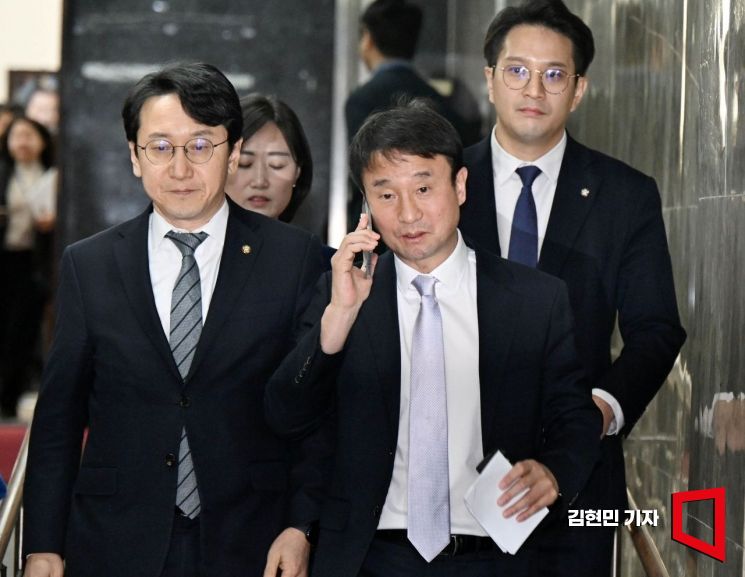 Hyun-Do Han, the floor leader of the Democratic Party of Korea, is attending the policy meeting held at the National Assembly on January 22, 2026. Photo by Hyunmin Kim
It was also reported that statements reaffirming the justification for prosecutorial reform were made during the caucus. Assemblywoman Choo Mi-ae reportedly emphasized the need to "resolve distrust in the prosecution." She argued that, given the repeated controversies over political bias in the exercise of prosecutorial power, the momentum for reform must not be lost. Assemblyman C said, "I did not get a chance to speak at today’s caucus, but if I had, I would have suggested abolishing the prosecutor’s title and using ‘public prosecutor’ instead."
With the Democratic Party of Korea having reviewed the overall direction regarding the SCIA through the policy caucus, it is expected that the party will accelerate the process of formulating its official stance and drafting legislation in subsequent steps. Assemblyman F, in his second term, said, "Once it comes to the party through the Cabinet meeting, further revisions can be made during the standing committee and plenary session processes," adding, "The leadership will make a political judgment after consultations with the government."
© The Asia Business Daily(www.asiae.co.kr). All rights reserved.
![Clutching a Stolen Dior Bag, Saying "I Hate Being Poor but Real"... The Grotesque Con of a "Human Knockoff" [Slate]](https://cwcontent.asiae.co.kr/asiaresize/183/2026021902243444107_1771435474.jpg)
















