Expanding the AI Manufacturing Ecosystem to Include SMEs and Mid-Sized Companies
Directly Addressing On-Site Concerns: Supplier Transition Challenges and Financial Support
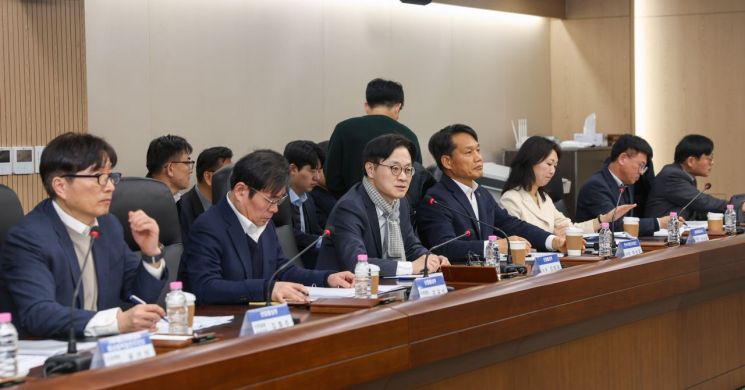
The government has launched a full-scale initiative to restructure key regional industries and build a collaborative ecosystem in the southeastern region, centering on the manufacturing innovation strategy known as M.AX (Manufacturing AX).
On January 23, Minister of Trade, Industry and Energy Kim Jeonggwan visited the southeastern region connecting Ulsan, Busan, and Gyeongnam to hold a series of consultations on the M.AX expansion strategy and ways to enhance the competitiveness of automotive parts suppliers. This move is part of the government's "Five Poles, Three Special Zones" regional growth project, aiming to spread manufacturing innovation directly to industrial sites.
During a roundtable with local manufacturing and AI companies and local governments, Minister Kim shared M.AX application cases tailored to regional characteristics and focused on strategies to build a collaborative ecosystem across the entire manufacturing value chain. Minister Kim stated, "M.AX is a key tool to elevate the manufacturing competitiveness of the southeastern region," adding, "We will actively support efforts to ensure innovation leads to tangible results for companies, not just declarations."
The southeastern region is a core manufacturing hub in Korea, home to leading shipbuilding, automotive, and petrochemical industries. The government plans to pursue both digital-based productivity improvements and on-site production process optimization through M.AX. In the shipbuilding sector, an advanced case was introduced involving the use of collaborative robot-based AI manufacturing systems to upgrade ship assembly processes.
At the "Regional AX Breakfast Roundtable" held that morning, local companies and AI experts participated to share the achievements of the M.AX Alliance and future expansion strategies. The Ministry of Trade, Industry and Energy identified the creation of an M.AX ecosystem that includes small and medium-sized manufacturers as a core task. In subsequent meetings with local governments in Busan, Ulsan, and Gyeongnam, strategies to strengthen competitiveness in the automotive, petrochemical, and defense sectors, as well as the progress of the "Five Poles, Three Special Zones" regional growth engine, were discussed. The ministry announced plans to further develop region-specific growth strategies that reflect local needs.
During a luncheon roundtable, first, second, and third-tier automotive parts suppliers directly explained the investment, process, and R&D burdens, as well as mass production risks they face during the transition to electric vehicles and smart mobility. They also raised the need for financial and commercialization support and the restructuring of trade finance. The ministry sees strengthening the competitiveness of parts suppliers as key to the sustainability of the complete vehicle industry and discussed ways to build a collaborative value chain.
Following his visits to Jeonbuk and the southeastern region, Minister Kim plans to continue on-site activities based on M.AX in other regions, including Gangwon, Daegu-Gyeongbuk, and the central region.
Meanwhile, M.AX, promoted by the government, is a strategic initiative that combines "manufacturing" and "AI transformation (AX)." The M.AX Alliance is a public-private partnership involving manufacturing companies, AI technology firms, research institutes, and universities, aiming to introduce AI technology across manufacturing to boost productivity and strengthen industrial competitiveness as a national project.
M.AX goes beyond simple technology adoption, targeting a structural transformation in which AI is utilized at every stage of manufacturing, including process automation, data sharing, AI model development, and on-device AI semiconductor development. According to the government, this aims to overcome stagnant productivity in manufacturing, secure a lead in global manufacturing data standards, and build a future industrial ecosystem.
Through the M.AX Alliance, the government has set out to create over 100 trillion won in added value by 2030 and to spread AI-based innovation from traditional manufacturing to autonomous driving, robotics, and AI factory sectors.
© The Asia Business Daily(www.asiae.co.kr). All rights reserved.
![Clutching a Stolen Dior Bag, Saying "I Hate Being Poor but Real"... The Grotesque Con of a "Human Knockoff" [Slate]](https://cwcontent.asiae.co.kr/asiaresize/183/2026021902243444107_1771435474.jpg)















