First Appearance at Davos Forum
Signals Shift Toward Robot- and AI-Centered Economy
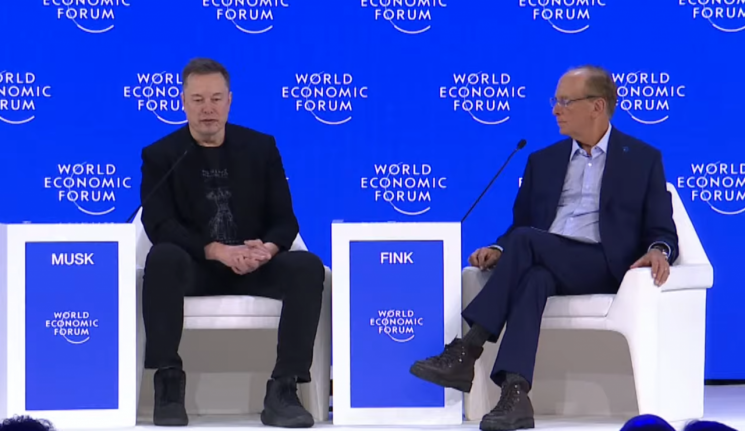 Elon Musk, CEO of Tesla (left), is having a conversation with Larry Fink, CEO of BlackRock, at the World Economic Forum on the 22nd (local time). YouTube capture
At CES 2026, as Hyundai Motor Group's humanoid robot "Atlas" made its debut and ignited a full-fledged debate over humanoid robots in global manufacturing sites, Elon Musk, CEO of Tesla, took the stage at the World Economic Forum (WEF) in Davos and openly declared a shift toward mass deployment of robots and an AI-driven economy, further fueling the controversy.
With conflicts over the introduction of robots becoming a reality, Musk's remarks are expected to further intensify the debate, not only about technological advancement but also about the overall structure of labor and employment.
On the 22nd (local time), Musk appeared on the WEF stage in Davos, Switzerland, engaging in a conversation with Larry Fink, CEO of BlackRock, and candidly shared his outlook on the changes that AI and robots will bring. Musk, who had previously dismissed the WEF as "boring" and avoided it, made a surprise appearance this year, with news of his attendance only emerging the day before the discussion.
Musk predicted, "There will come a time when the number of humanoid robots surpasses that of humans." Regarding Tesla's Optimus humanoid robot, he stated, "It is already performing simple tasks in factories, and by the end of this year, it will expand to more complex industrial work." He also presented a concrete timeline, saying, "As early as the end of next year, after achieving sufficient safety and reliability, we will be able to sell it to general consumers." He added, "Assuming a very high level of safety, it will be natural for robots to take care of children, look after pets, and assist the elderly in the future." This signals that humanoid robots will not only be involved in car manufacturing but will also begin to transform human life and disrupt economic structures.
He asserted, "In the future, economic output will no longer be determined by working hours or population growth." He explained, "The upper limit of the economy will be defined by multiplying the average productivity per robot by the number of robots," and diagnosed, "At that stage, it will be difficult to even imagine what more we could possibly want due to the abundance that will become possible."
Musk argued, "Abundance is impossible in a system where only a few work and the majority are left out," and insisted, "Only by having AI and robots replace human labor can goods and services become universally accessible."
The "Atlas" humanoid robot unveiled by Hyundai Motor Group at CES 2026 has drawn attention for its technological sophistication, but its actual deployment in production sites faces strong resistance from labor unions. The Hyundai Motor labor union has made it clear that robots cannot be introduced without labor-management agreement.
Seemingly aware of the transitional period, Musk emphasized, "There is no way to solve global poverty without robots and AI," and "Having machines take on tasks that humans do not want or that are dangerous is a direction that increases overall social efficiency." However, Musk did not provide specific comments on the potential disruptions during the labor transition brought about by robots and AI, nor on the social mechanisms needed to absorb such changes.
While advocating for the expansion of AI and robots, Musk pointed to electricity as the biggest bottleneck. Although AI chip production is increasing exponentially, the pace of power infrastructure expansion is not keeping up. For this reason, Musk mentioned space-based energy and AI infrastructure, such as space solar power and reusable rockets.
© The Asia Business Daily(www.asiae.co.kr). All rights reserved.
![Clutching a Stolen Dior Bag, Saying "I Hate Being Poor but Real"... The Grotesque Con of a "Human Knockoff" [Slate]](https://cwcontent.asiae.co.kr/asiaresize/183/2026021902243444107_1771435474.jpg)















