Real Personal Consumption Posts Largest Increase in Four Months
The United States' Personal Consumption Expenditures (PCE) inflation rate for November of last year increased slightly compared to the previous month, but was in line with market expectations. With inflation remaining at a high level, the likelihood of a policy rate freeze next week is gaining traction.
According to the Bureau of Economic Analysis (BEA) under the U.S. Department of Commerce on the 22nd (local time), the PCE price index in November of last year rose 2.8% year-on-year. This figure is 0.1 percentage point higher than October's 2.7%, and matches the market consensus compiled by Dow Jones.
The core PCE price index, which excludes the highly volatile energy and food sectors, also rose 2.8% year-on-year, slightly above October's 2.7%, but was in line with market forecasts. The month-on-month increase in the PCE price index for November was 0.2% for both the headline and core indicators, matching expectations.
This release of the PCE price index was made as both the October and November figures were disclosed together due to the impact of last year's temporary federal government shutdown.
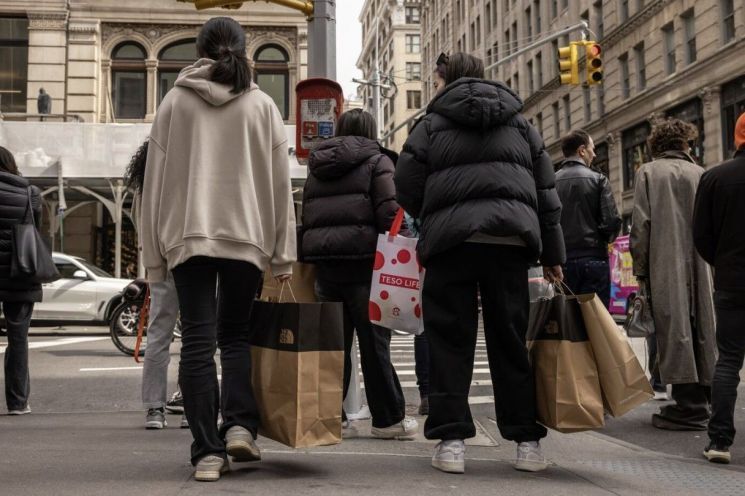
Real personal consumption, reflecting inflation, increased 0.3% from the previous month, expanding from October's 0.1%. This is attributed to robust consumer spending during the year-end shopping season. Despite concerns over a slowing labor market and the burden of high prices, consumption has remained relatively solid, supporting the U.S. economy.
In particular, the increase in personal consumption in November was largely driven by the sharpest rise in goods spending-such as automobiles, apparel, and gasoline-since July. In contrast, service spending slowed compared to the previous month due to a decline in medical expenses.
These indicators underscore the resilience of the U.S. economy. On the same day, the BEA announced that the U.S. real gross domestic product (GDP) for the third quarter grew at an annualized rate of 4.4% compared to the previous quarter. This is 0.1 percentage point higher than the previously released advance estimate of 4.3%, supported by strong exports and a reduction in corporate inventories.
With signals that growth momentum is being maintained, centered on robust consumption despite signs of some cooling in the labor market, the possibility of a rate freeze next week is anticipated. Persistent inflationary pressures are also reinforcing this outlook. According to the Chicago Mercantile Exchange (CME) FedWatch, the current interest rate futures market is pricing in a 95% probability that the Federal Reserve will keep the benchmark rate at the current 3.5-3.75% range at the Federal Open Market Committee (FOMC) regular meeting on the 28th.
© The Asia Business Daily(www.asiae.co.kr). All rights reserved.
![Clutching a Stolen Dior Bag, Saying "I Hate Being Poor but Real"... The Grotesque Con of a "Human Knockoff" [Slate]](https://cwcontent.asiae.co.kr/asiaresize/183/2026021902243444107_1771435474.jpg)
















