Started with 12 Companies at the Korea Stock Exchange in 1956
Overcame Numerous Crises Including the IMF, COVID-19, and Martial Law
Market Capitalization Grows 310,000-Fold Over 70 Years
The long-dreamed-of "Ohcheonpi" has become a reality. Marking the 70th anniversary of the birth of the Korean stock market, which began with the establishment of the Korea Stock Exchange in 1956, the KOSPI achieved a monumental milestone by surpassing the 5,000 mark in the New Year of 2026.
According to the Korea Exchange on January 22, the KOSPI closed at 4,952.53, up 0.87%. At the opening, the index surpassed 5,000 for the first time in history, setting a new intraday all-time high of 5,019.54. Until the previous day, the KOSPI repeatedly failed to break through the 5,000 threshold due to escalating geopolitical tensions originating from the United States, but ultimately demonstrated its resilience by rebounding like a roly-poly toy.
Ranked 12th in the World by Market Cap with 12 Listed Companies at Inception
The year 2026, the Year of the Red Horse, when the KOSPI broke through 5,000, is particularly significant as it marks the 70th anniversary of the Korean stock market. The modern history of Korea's stock market began on March 3, 1956, with the establishment of the Korea Stock Exchange. According to the National Archives, there were only 12 listed companies when the securities market division first opened, and the total market capitalization was just 15 billion won.
The initial listed companies included four banks-Chohung Bank, Savings Bank, Korea Commercial Bank, and Heungeop Bank-along with six general companies such as Korea Shipping Corporation, Korea Shipbuilding Corporation, Gyeongseong Electric, Namsun Electric, Chosun Transportation, and Gyeongseong Textile. The Korea Stock Exchange and Korea United Securities Finance were also listed for policy reasons. Most of these companies have since been merged or delisted, but today, Korea Electric Power Corporation (formerly Gyeongseong Electric and Namsun Electric), CJ Logistics (formerly Chosun Transportation), HJ Shipbuilding & Construction (formerly Korea Shipbuilding Corporation), and Kyungbang (formerly Gyeongseong Textile) continue to carry on their legacies.
The number of listed companies, which started at 12, steadily increased to 100 by 1973 and 1,000 by 1997. As of this day, there are 844 companies listed on the KOSPI and 1,824 on the KOSDAQ, totaling 2,668 companies trading on the domestic stock market. The total market capitalization, which was around 15 billion won, has soared, and on January 16, the KOSPI's market capitalization surpassed 4,000 trillion won for the first time in history. Including the KOSDAQ, the combined market capitalization reached 4,655.294 trillion won, an increase of about 310,000 times over 70 years. The Korean stock market now ranks 12th in the world by market capitalization.
However, like any other stock market, Korea's stock market has not always had a smooth path. After the enactment of the Securities and Exchange Act in January 1962, the stock trading volume, which was only 400 million won in 1961, soared to about 100 billion won the following year, continuing its growth trend. However, the market faced its first crisis in May 1962 with the "Securities Turmoil." Speculative forces seeking to exploit the rapid expansion of the market caused the exchange to become insolvent. Buyers reneged on their settlement commitments, stock prices plummeted, and the exchange and securities finance companies were left buried in debt.
Overcoming this crisis, the Korean stock market began to grow rapidly in March 1981, when the Korea Securities Association led the computerization of stock trading. It was during this period that the basic work of the stock distribution market was standardized, and stock analysis techniques began to develop.
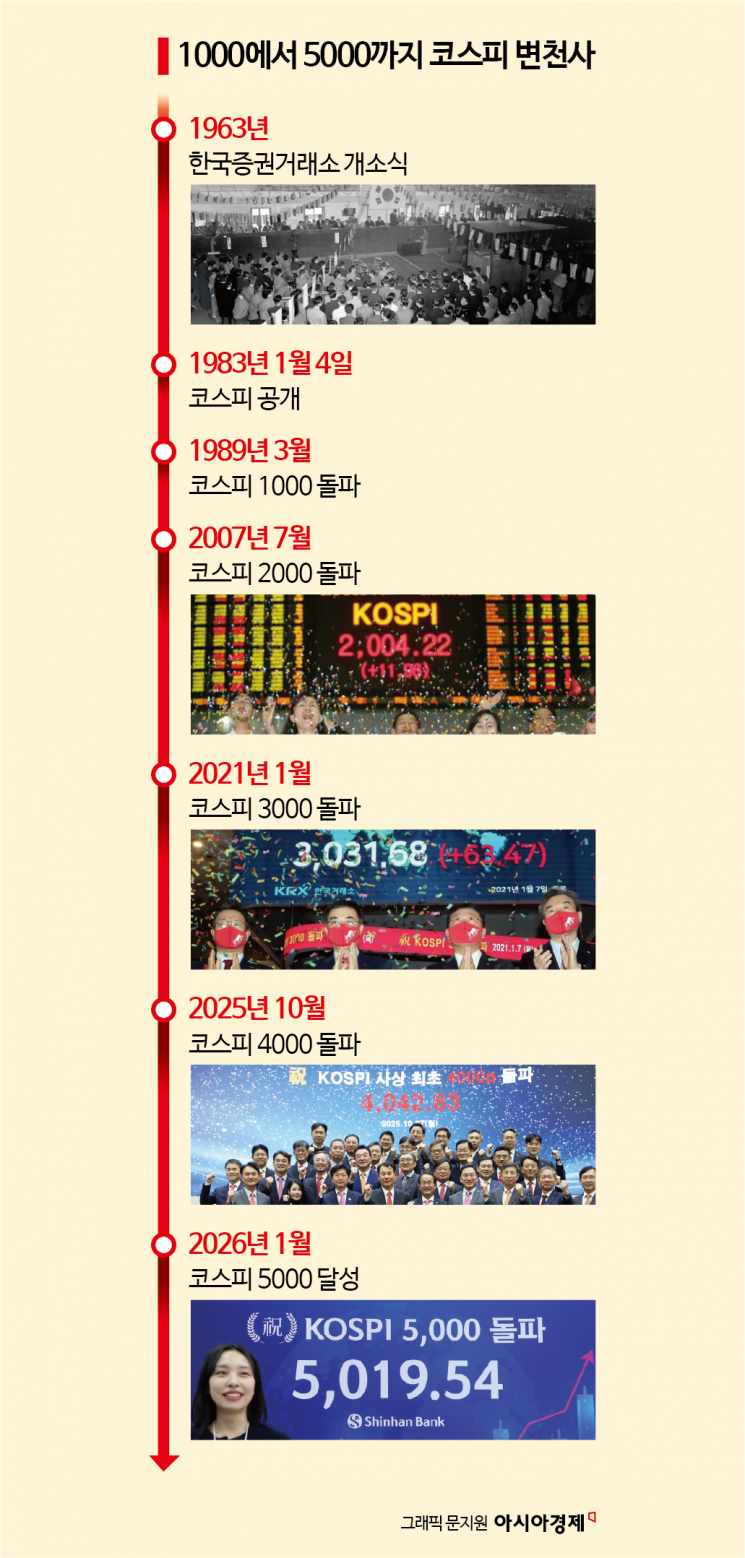
Milestone Years: 1989, 2007, 2021, 2025, and 2026
On January 4, 1983, the KOSPI was introduced to the world for the first time. The comprehensive stock price index system based on market capitalization was adopted. The KOSPI index was first announced at 122.52, calculated using the market capitalization as of January 4, 1980, as the base value (100).
Thanks to the unprecedented export boom and economic growth brought about by the "Three Lows" (low interest rates, low oil prices, and low exchange rates), the Korean stock market experienced a massive stock frenzy. On March 31, 1989, the year after the Seoul 1988 Olympics, the KOSPI surpassed 1,000 for the first time. In 1992, foreign capital began to flow in in earnest, and the KOSDAQ market opened in 1996. Although the market faced temporary crises, such as the International Monetary Fund (IMF) foreign exchange crisis in 1997 and the dot-com bubble burst in the early 2000s, the KOSPI entered the 2,000 era in July 2007, buoyed by rapid economic recovery and a fund investment boom.
However, just as the market was envisioning a bright future in the "Samcheonpi" (KOSPI 3,000) era, the global financial crisis of 2008 struck, causing the KOSPI to be cut in half once again. In 2017, the global semiconductor industry boom briefly pushed the index above 2,500, but investment sentiment cooled again due to the impact of the US-China trade conflict triggered by the first Trump administration. The COVID-19 pandemic in March 2020 also dealt a direct blow to the stock market.
The KOSPI, which had plunged to the 1,500 level, fired a signal for revival through the "Donghak Ant Movement." As ultra-low interest rate policies and economic stimulus measures spread worldwide, the KOSPI reached the 3,000 mark for the first time in January 2021.
Since then, the KOSPI's upward curve has steepened. Although the index fell below 2,400 at the end of 2024 due to the impact of martial law, investment sentiment revived with the inauguration of the Lee Jaemyung administration and various stock market stimulus measures. After recovering to 3,000 in June of last year, the index reached the 4,000 milestone on October 27, less than half a year later. With a 75.63% surge last year, the KOSPI finished as the best-performing major stock market and continued its unstoppable momentum into the New Year, successfully changing its leading digit to '5' on this day.
© The Asia Business Daily(www.asiae.co.kr). All rights reserved.
![Clutching a Stolen Dior Bag, Saying "I Hate Being Poor but Real"... The Grotesque Con of a "Human Knockoff" [Slate]](https://cwcontent.asiae.co.kr/asiaresize/183/2026021902243444107_1771435474.jpg)
















