Seeking Internal Collaborators in Cuba
Plan to Weaken Cuban Regime by Cutting Off Oil Supply
WSJ Points Out: "Applying the Venezuela Model to Cuba May Be Difficult"
The Wall Street Journal (WSJ) reported on January 21 (local time) that the Donald Trump administration, after ousting Venezuelan President Nicolas Maduro, is seeking internal collaborators to push for regime change in Cuba by the end of this year.
According to sources, the Trump administration believes that Cuba's economy is in a fragile, near-collapse state after losing its biggest supporter, President Maduro. Since former Venezuelan President Hugo Chavez took office in 1999, Cuba has relied on Venezuelan oil as the backbone of its economy.
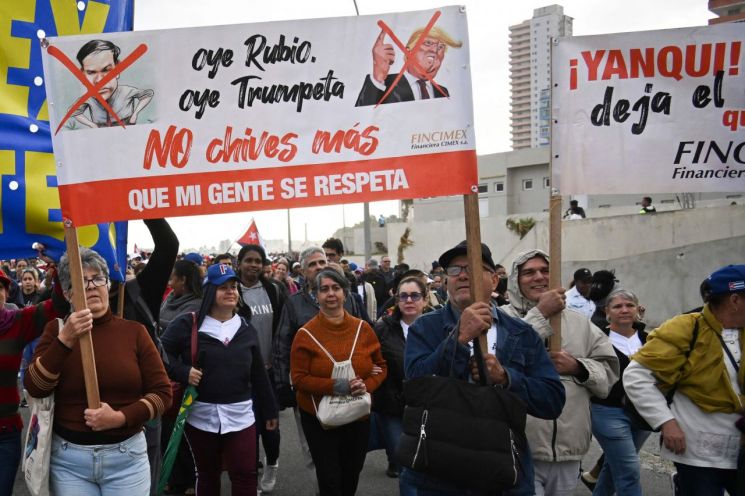 On the 16th (local time), protests were held in front of the U.S. Embassy in Havana, Cuba, where Cubans were holding banners opposing U.S. President Donald Trump and Secretary of State Marco Rubio. Photo by AFP Yonhap News
According to senior U.S. officials, the Trump administration plans to cut off Cuba's oil supply to weaken the regime. Economists say that if oil supplies are cut, Cuba will face an oil shortage crisis within a few weeks, and its economy will effectively come to a halt. The administration is also considering sanctions such as banning the issuance of visas for Cuba's overseas medical dispatch program, which is a major source of foreign currency revenue for the country.
However, senior officials stated that the authorities do not have a specific plan to end Cuba's communist regime. Nevertheless, they view the operation to capture President Maduro as both a strong warning and a blueprint for action against Cuba.
On January 11, President Trump posted on the social media platform Truth Social, saying, "There will be no more oil or money going from Venezuela to Cuba," and "I strongly advise them to make a deal before it is too late."
U.S. government officials are currently reaching out to Cuban exiles and civic groups to gain an accurate understanding of the internal situation and to identify individuals who could enter negotiations. This effort to find internal informants mirrors the assistance they received from President Maduro's closest intelligence aide during the operation to capture him on January 3.
According to officials, President Trump and his close aides see toppling Cuba's communist regime as a critical test for their national security strategy of reshaping the Western Hemisphere. They cite cooperation with Venezuelan Interim President Delcy Rodriguez and the agreement with Venezuela as successful examples.
An official from the first Trump administration told WSJ that President Trump believes ending the Castro era would solidify his legacy and achieve what President John F. Kennedy could not. At the same time, this has long been a stated goal of Secretary of State Marco Rubio, who was born to a Cuban immigrant family.
However, WSJ pointed out that applying the Venezuelan model to Cuba may prove difficult. Unlike Venezuela, which had an opposition and once frequent protests, Cuba is a one-party dictatorship with virtually no political opposition. Raul Castro, Fidel Castro's brother, still holds power, while President Miguel Diaz-Canel manages state affairs. Recently, President Diaz-Canel attended a memorial service in military uniform for a Cuban bodyguard who died protecting President Maduro, stating, "There can be no surrender or submission, and no agreement based on coercion or threats in any form."
Ricardo Zuniga, who served as a senior State Department official during the Obama administration, said, "They are a much tougher opponent," adding, "There is no one with an incentive to work on the U.S. side."
© The Asia Business Daily(www.asiae.co.kr). All rights reserved.
![Clutching a Stolen Dior Bag, Saying "I Hate Being Poor but Real"... The Grotesque Con of a "Human Knockoff" [Slate]](https://cwcontent.asiae.co.kr/asiaresize/183/2026021902243444107_1771435474.jpg)















