A technology that enables drug delivery without pain or discomfort, even when attached to the skin for an extended period, has been developed.
On January 22, National Hanbat University announced that a research team led by Professor Ha Jihwan of the Department of Mechanical Engineering, in collaboration with Senior Researcher Jeon Sohee from the Korea Institute of Machinery and Materials, Professor Kang Wongu from the College of Pharmacy at Chung-Ang University, and a research team from the Agency for Defense Development, has developed a "bee-stinger-inspired electrospun web microneedle" with such capabilities.
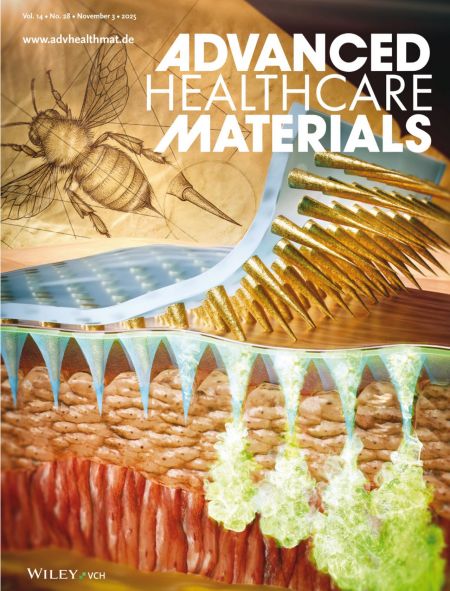 Image of the full cover paper of the international academic journal Advanced Healthcare Materials. Provided by Hanbat National University
The bee-stinger-inspired microneedle is designed to mimic the mechanism by which a bee stinger penetrates and anchors in the skin, enabling the fiber-shaped microneedle to continuously deliver drugs inside the skin.
The microneedle developed by the joint research team boasts excellent flexibility, causing almost no skin pain or foreign body sensation even after prolonged attachment.
Additionally, the application of a nano-to-microscale porous structure inside the microneedle enhances breathability, significantly reducing the risk of skin rashes even with long-term use.
According to the joint research team, when the microneedle (loaded with drugs targeting the central nervous system) was attached to animal test subjects, the results confirmed the therapeutic mechanism and efficacy, demonstrating the possibility of sustained drug release over several days.
Professor Ha stated, "This research marks the world's first case of applying the electrospinning process to microneedles, and is significant in that it has developed a microneedle that reduces the burden on patients. We hope that the technology developed by the joint research team will be meaningfully utilized for the treatment of chronic disease patients who require continuous therapy in the future."
Meanwhile, Professor Ha participated as the first author in this research. The results were published in the international academic journal Advanced Healthcare Materials, which covers the fields of materials and nanoscience.
© The Asia Business Daily(www.asiae.co.kr). All rights reserved.
![Clutching a Stolen Dior Bag, Saying "I Hate Being Poor but Real"... The Grotesque Con of a "Human Knockoff" [Slate]](https://cwcontent.asiae.co.kr/asiaresize/183/2026021902243444107_1771435474.jpg)
















