Comprehensive Inspections for Workplaces with a History of Wage Arrears
Supervision of Unpaid and Long Working Hours Expanded to 400 Workplaces
Number of Industrial Safety Inspectors Increased from 895 to 2,095

The government has announced plans to inspect 90,000 workplaces this year in the fields of labor and industrial safety, representing an increase of approximately 73% compared to last year. In particular, the focus in the labor sector will be on eradicating wage arrears and eliminating unpaid and excessive working hours. Efforts will also be made to protect vulnerable groups, including foreign and young workers. In the area of industrial safety, the number of inspectors will be significantly increased to 2,095 this year.
On January 22, the Ministry of Employment and Labor unveiled its "2026 Workplace Inspection Plan," which aims to robustly protect the working conditions of all employees and create fair and safe workplaces free from risk disparities.
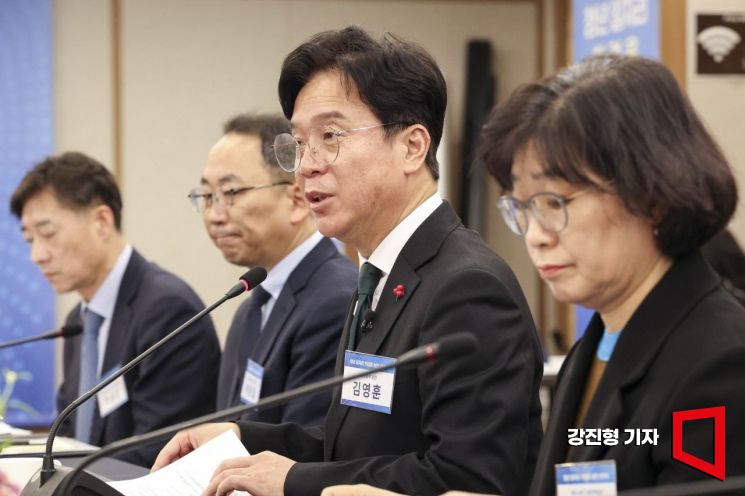 Kim Younghoon, Minister of Employment and Labor, speaking at an event held last month at the Press Center in Jung-gu, Seoul.
Inspection Target Set at 90,000 Workplaces This Year... Minister of Labor: "Mobilizing All Departmental Capabilities"
This year, the Ministry of Employment and Labor will significantly increase the number of inspections from 52,000 last year to 90,000 (40,000 labor-related and 50,000 industrial safety-related). In addition, the ministry will expand the integrated labor and industrial safety inspections initiated last year to strengthen efforts to identify and address the structural causes of legal violations and safety risks at worksites. Workplaces that habitually or maliciously violate the law or fail to fulfill occupational safety and health obligations will be subject to immediate sanctions to enhance the effectiveness of inspections.
For small and micro-enterprises, the government plans to raise their basic labor and safety management capabilities through consulting, technical, and financial support. In particular, the government will focus its administrative resources on preventing risks before accidents occur, aiming for tangible reductions in workplace injuries. The inspection approach will emphasize both regular and special inspections to increase public awareness and impact.
Kim Younghoon, Minister of Employment and Labor, stated, "The realization of workplace democracy depends on how we conduct workplace inspections. By raising the level of workplace inspections this year, we will enhance the standards of labor and industrial safety in Korea, close risk gaps at workplaces, and lay the foundation for genuine growth based on respect for labor by mobilizing all departmental capabilities."
Uncovering Hidden Wage Arrears First... Largest-Ever Crackdown on Unpaid and Excessive Working Hours
To address disparities in the labor market, the government will strengthen inspections aimed at eradicating wage arrears, eliminating unpaid and excessive working hours, and protecting vulnerable groups. Inspection resources will be concentrated on proactively uncovering hidden wage arrears. Full-scale inspections will be conducted at workplaces that have reported wage arrears more than twice in the past year, allowing for preemptive management of these issues. Regular and special inspections will also be carried out in stages.
 Kim Younghoon, Minister of Employment and Labor, speaking at the Ministry of Labor briefing room in the Government Complex Sejong in September last year. Photo by Yonhap News
Inspections to eradicate unpaid and excessive working hours will be expanded to an unprecedented scale, targeting 400 workplaces annually. Oversight will also be strengthened to prevent the misuse and abuse of comprehensive wage systems. In addition, new inspections will be launched for vulnerable groups, including foreign workers in rural and fishing communities, young workers at convenience stores and cafes near universities, and workers with disabilities. For non-regular workers, focused inspections will be conducted at 200 workplaces each year to ensure they are not subject to discrimination when performing the same work as regular employees.
Starting this year, the "Anonymous Reporting Center for Employees" will operate on a permanent basis, greatly expanding anonymous whistleblower inspections. The government will also increase preventive inspections and expand oversight to address new social issues and areas, such as disguised employment classified as "fake 3.3" and the splitting of business entities. In the public sector, new inspections will be introduced to ensure appropriate labor management, such as verifying whether workers performing the same duties in cleaning and security receive equal pay.
Number of Industrial Safety Inspectors to Reach 2,095 This Year
In the field of industrial safety, the government will expand inspection personnel and infrastructure to eliminate blind spots. The number of industrial safety inspectors will be dramatically increased from 895 last year to 2,095 this year, and the proportion of highly skilled technical staff will be raised. Seventy patrol teams will be deployed nationwide, and the number of patrol cars will be doubled to 286 compared to last year, establishing a system for continuous mobile response. Drones will also be deployed at local offices across the country.

If legal violations are identified, the government will respond strictly. The principle will be to pursue judicial and administrative actions, not merely issue corrective orders. Notably, a new inspection system will be introduced this year to focus on "serious injury accidents," which are precursors to major disasters, with an emphasis on preemptive prevention. For workplaces previously inspected where on-site risks remain high, repeated inspections will be conducted until improvements are confirmed, to ensure substantive safety enhancements.
For small workplaces with weak safety and health management capabilities, a phased approach will be used to encourage systematic improvements. In addition, guidance will be strengthened to ensure that both employers and workers comply with basic safety rules, such as wearing safety helmets, harnesses, and belts. If violations are detected, strict measures will be taken, including imposing fines on both employers and workers.
© The Asia Business Daily(www.asiae.co.kr). All rights reserved.



















