Han Ducksoo Sentenced to 23 Years in First Trial
Convicted of Engaging in Important Duties Related to Rebellion
Sentence Exceeds Special Prosecutor's 15-Year Recommendation
Former Prime Minister Han Ducksoo was sentenced to 23 years in prison and taken into custody following his conviction at the first trial for engaging in important duties related to the 12·3 Martial Law incident. The court’s recognition of martial law as “rebellion” under criminal law is expected to have a significant impact on ongoing trials related to martial law, including the case against former President Yoon Sukyeol as the leader of the rebellion.
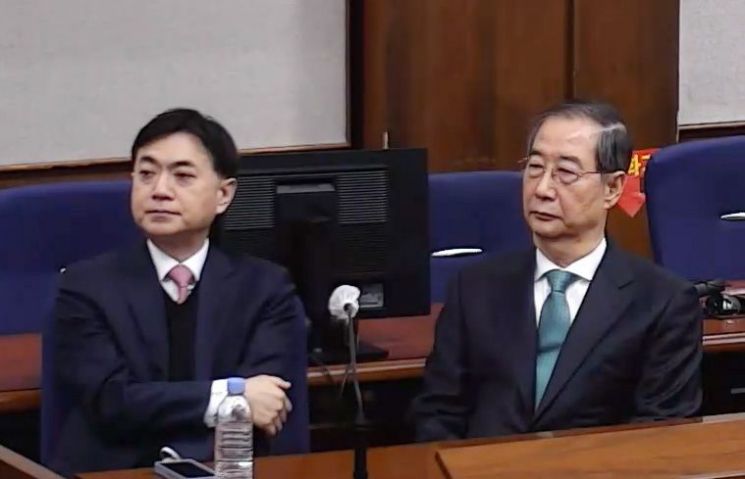 Former Prime Minister Han Duck-soo (right), who is accused of engaging in important duties related to the internal conflict, attended the first trial sentencing hearing held at the Seoul Central District Court on the 21st. Photo by Yonhap News Agency, provided by Seoul Central District Court
The 33rd Criminal Division of the Seoul Central District Court (Presiding Judge Lee Jinkwan) sentenced former Prime Minister Han to 23 years in prison on January 21 for aiding the leader of the rebellion, engaging in important duties related to rebellion, and perjury. The court defined the proclamation of the 12·3 Martial Law, the issuance of unconstitutional and unlawful proclamations, and the attempts to occupy and restrict access to key institutions such as the National Assembly and the National Election Commission through military and police mobilization as an “insurrection for the purpose of undermining the constitutional order,” and classified it as the “12·3 Rebellion.”
In particular, the court stated, “A leader elected by the people disregarded and violated the Constitution and the law, fundamentally shaking the very belief in democracy and the rule of law,” and characterized the incident as a “top-down rebellion, a praetorian coup.” The court found that Han, as Prime Minister, shirked responsibility despite the possibility that the rebellion might succeed, and sentenced him to 23 years in prison, exceeding the 15-year sentence requested by Special Prosecutor Cho Eonseok’s team.
The court found that, rather than trying to prevent the declaration of martial law, Han proposed convening a Cabinet meeting and urged Cabinet members to attend, thereby creating an “appearance of procedural legitimacy.” The court also determined that after the declaration of martial law, Han was involved in securing document signatures and in the drafting and destruction of the subsequent proclamation. Additionally, the court judged that Han’s discussions with former Minister of the Interior and Safety Lee Sangmin regarding measures such as cutting off electricity and water to media outlets constituted “engaging in important duties.” The court also found Han guilty of perjury and other charges.
However, the court acquitted Han of several charges, including calling then-ruling party floor leader Chu Kyungho after the martial law declaration to check on the National Assembly’s status and whether it had been notified, delaying Cabinet deliberation on lifting martial law after it was rescinded, and exercising the false official document known as the “subsequent martial law proclamation.”
Although this ruling does not legally bind other trials, legal experts believe that, because the court has set forth a legal framework for “the establishment of rebellion (purpose of undermining the constitutional order and insurrection)” and “the scope of participation,” it will be difficult for subsequent cases to completely disregard this precedent.
Given that the court in the upcoming verdict for former President Yoon’s rebellion leadership case, scheduled for February 19, will need to re-examine the same evidence and testimonies, some observers suggest that it would be burdensome for the court to reach a conclusion that directly contradicts the previous “rebellion” determination. This increases the likelihood of a heavy sentence in the main verdict as well.
Attention is also focused on whether the court’s reasoning in this case will be applied to other cases, such as those involving former Minister of the Interior and Safety Lee Sangmin and former Minister of Justice Park Sungjae, both accused of engaging in important duties related to rebellion.
© The Asia Business Daily(www.asiae.co.kr). All rights reserved.
![Clutching a Stolen Dior Bag, Saying "I Hate Being Poor but Real"... The Grotesque Con of a "Human Knockoff" [Slate]](https://cwcontent.asiae.co.kr/asiaresize/183/2026021902243444107_1771435474.jpg)















