Proposal for a 'NATO-Style Collective Economic Deterrence Agreement'
Among South Korea, the United States, Japan, and the G7
to Counter China's Coercion
An analysis has emerged suggesting that an agreement between South Korea and the United States on the construction of a nuclear-powered submarine could provoke strong backlash and economic retaliation from China, and that South Korea should respond by cooperating with its allies such as the United States and Japan.
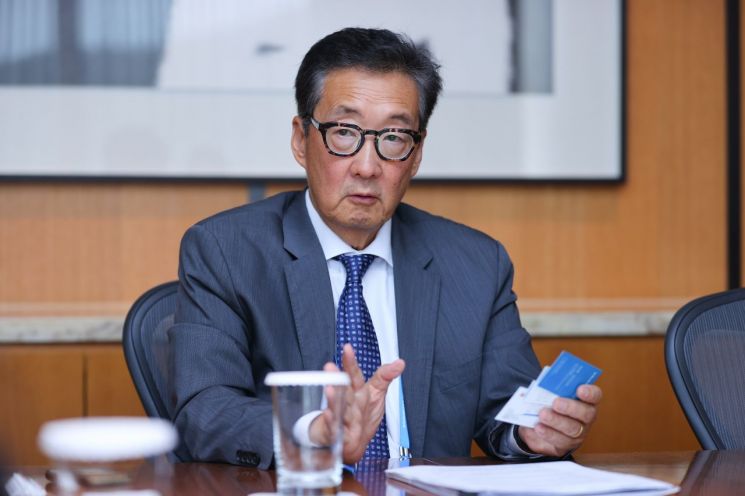 Victor Cha, Korea Chair at the Center for Strategic and International Studies (CSIS). Yonhap News Agency
Victor Cha, Korea Chair at the Center for Strategic and International Studies (CSIS), wrote in a contribution to the U.S. foreign affairs journal Foreign Affairs on January 21 (local time) that the agreement on nuclear submarines reached between President Lee Jaemyung and U.S. President Donald Trump during the Asia-Pacific Economic Cooperation (APEC) summit in October last year would be "a reality that will greatly anger China."
Cha noted that even though President Lee recently visited China and held a summit with President Xi Jinping, "China will not forget the nuclear submarine agreement," predicting that "China's 'bullying' will become more aggressive." He observed that possible responses from China could include targeting South Korean companies in China, as it did during the Terminal High Altitude Area Defense (THAAD) incident, restricting exports of rare earth minerals, or suspending group tours of Chinese tourists to South Korea.
Cha stated, "South Korea has traditionally regarded friendly relations with China as a strategic necessity for economic prosperity. However, as China is increasingly proving to be an unreliable partner, it may be time to completely reconsider this strategic perspective." He continued, "No country in the Asia-Pacific region possesses the political or economic power to stand up to China alone. But collectively, they can wield sufficient influence." He suggested that the best option for South Korea would be to "cooperate with the United States, Japan, Australia, and other G7 countries to organize a 'collective economic deterrence agreement' to counter China's economic offensives."
Regarding such an agreement, Cha explained that, like the mutual defense pact of the North Atlantic Treaty Organization (NATO), "coercion against one country should be regarded as coercion against all, and automatic retaliation should follow." He clarified, "This is not about starting a trade war with China. It is simply about blocking China's economic coercion."
On President Trump, Cha said, "When he visits Beijing this April, he should directly express to President Xi his opposition to China's economic pressure," emphasizing that "by signaling that China will pay a price if it continues to pressure Japan or target American companies, China can be deterred. This would preemptively block Chinese retaliation against South Korea's nuclear submarine initiative."
Additionally, Cha emphasized the importance of trilateral cooperation between South Korea, the United States, and Japan against China, stating, "The three countries should thoroughly assess their trade dependence on China through cooperation between their commerce departments and intelligence agencies." He added, "This trilateral alliance, working with G7 partners, will help find the best way to counter China."
© The Asia Business Daily(www.asiae.co.kr). All rights reserved.
![Clutching a Stolen Dior Bag, Saying "I Hate Being Poor but Real"... The Grotesque Con of a "Human Knockoff" [Slate]](https://cwcontent.asiae.co.kr/asiaresize/183/2026021902243444107_1771435474.jpg)
















