Kakao Adds Watermarks to Kanana Template Outputs
Samsung and SK Telecom Apply Perceptible Watermarks to AI Images
Some Startups, Including AnchorNode and DeepBrain AI, Also Adopt Watermarking
Government to Actively Support On-Site Implement
On January 22, with the implementation of the world's first "Framework Act on the Advancement and Trust Foundation of Artificial Intelligence (AI Framework Act)," companies are taking action to comply with the legal obligation to watermark AI-generated content. Although the government has provided a grace period of over one year, many companies believe it is better to proactively prepare, in line with the intent of the legislation.
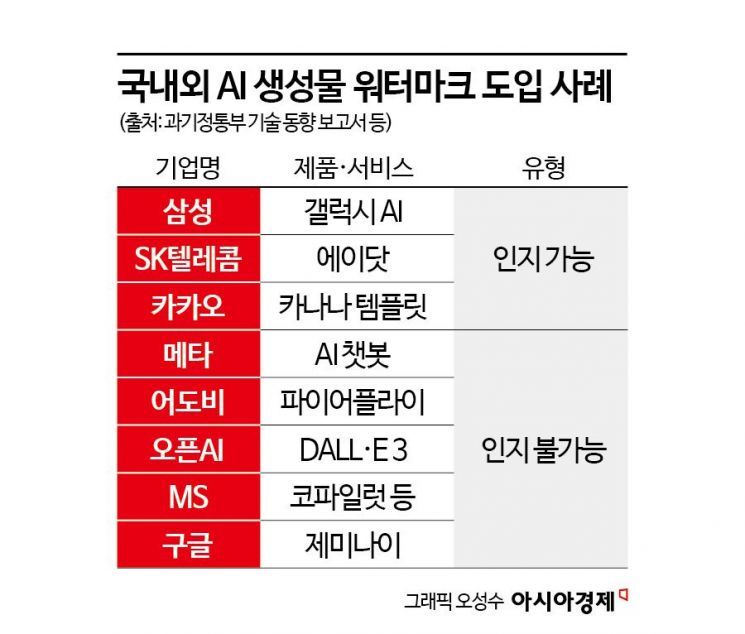
Kakao has recently incorporated the "AI usage disclosure obligation" specified in the Framework Act into its newly launched "Kanana Template." When users create a video from a KakaoTalk photo using the Kanana Template, a watermark and logo reading "kanana" appear in the lower right corner of the AI-generated output. This watermark is a measure to comply with the AI Framework Act, and Kakao has also included in its terms of service a provision stating, "When the company provides AI-generated content, it will notify and mark it in accordance with relevant laws." A Kakao representative stated, "We have specified the necessary provisions in our integrated service terms, considering the implementation of the AI Framework Act for new AI-based features and services."
Watermarks are classified as either perceptible or imperceptible to users. Samsung Electronics and SK Telecom have also implemented perceptible watermarks on images generated by AI. In contrast, major international companies such as Google, OpenAI, and Meta are using imperceptible watermarks, either through the international standard C2PA or their own proprietary algorithms. C2PA, which has established AI technology standards, is a global consortium founded in 2021 by Adobe, BBC, Microsoft (MS), Intel, and others. In Korea, Naver and ESTsoft have joined C2PA.
The AI Framework Act imposes obligations on businesses to ensure transparency and safety. Deepfake content that is difficult to distinguish from reality must be clearly marked so that people can recognize it. Watermarks must also be added when AI-generated content is exported outside the service. However, if AI-generated content is used solely within service environments such as chatbots, games, or metaverse platforms, companies can use more flexible methods such as user interface notifications or logo displays. In addition, users who utilize AI-generated content for content creation or upload it to social networking services (SNS) are not subject to legal obligations.
Some small and startup companies are aware of the watermarking obligation, but only those with sufficient personnel and resources to respond to regulatory changes are actively taking action. Since the end of last year, AnchorNode has ensured that images generated by its generative AI-based game production solution display a "gameAify" watermark. Although the implementation was costly, the company decided to comply with the government's policy to prevent misuse and abuse of AI-generated content. Earlier this month, DeepBrain AI also released an imperceptible watermark solution and applied it to its own platform, "AI Studio." While the watermark is not visible, it leaves traces of important information such as whether the file was AI-generated and its source, allowing for tracking even after editing, duplication, or recording.
The government emphasizes that the Framework Act is not focused on strengthening regulations for the AI industry, but rather on promoting the industry. To reduce confusion in the field and ensure smooth adoption, a one-year grace period will be provided along with support measures. During the grace period, fact-finding investigations will be conducted only in exceptional cases where social issues such as loss of life, human rights violations, or national damage occur.
An official from the Ministry of Science and ICT stated, "The AI Framework Act imposes only the minimum necessary obligations on businesses to enhance safety and reliability," adding, "We will establish a platform to respond to inquiries, provide consulting services, and prepare case books to help companies understand and adopt the new regulations."
© The Asia Business Daily(www.asiae.co.kr). All rights reserved.
![Clutching a Stolen Dior Bag, Saying "I Hate Being Poor but Real"... The Grotesque Con of a "Human Knockoff" [Slate]](https://cwcontent.asiae.co.kr/asiaresize/183/2026021902243444107_1771435474.jpg)
















