Only 2% of AI Startups Have Response Plans
Startups Without Legal Staff Scramble for Law Firms
Concerns Grow Over Widespread Conservative Development Assuming "High-Impact AI"
Mr. A, who is solely responsible for policy and external cooperation at an artificial intelligence (AI)-based technology solution startup in its Series B round, has recently found his work virtually paralyzed due to the need to respond to the so-called “AI Basic Act.” With 420 pages of subordinate regulations and guidelines to review one by one, it has become nearly impossible to handle any other work simultaneously. Mr. A said, “Even so, our company is relatively better off since I am dedicated to this task. There are so many places without even a single dedicated staff member, let alone a separate team, and I doubt they will be able to respond at all.”
With the enforcement ordinance of the “Framework Act on the Promotion of Artificial Intelligence and the Creation of a Trust-Based Environment,” commonly known as the AI Basic Act, taking effect on January 22, most startups with small organizations and limited personnel are struggling to come up with appropriate measures and are feeling confused. Few companies fully understand the legislation, and even when they are aware of its content, they severely lack the capacity to respond on their own. An industry official commented, “Companies that recognize the seriousness are overwhelmed with seeking legal advice. Since most do not have in-house legal personnel, they are busy visiting law firms for consultations.”
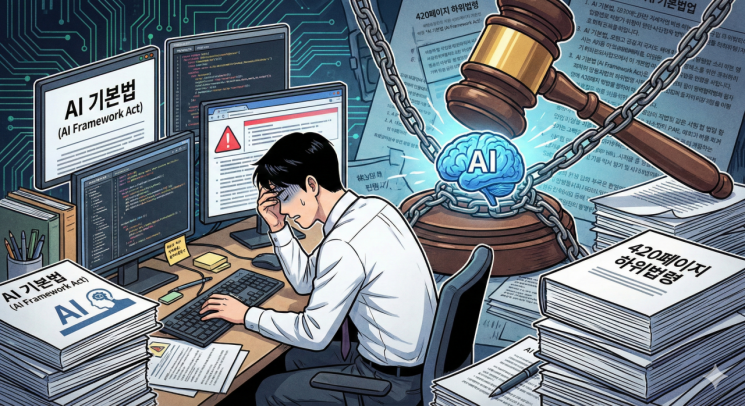
The AI Basic Act was introduced with the aim of ensuring the safety and reliability of AI technology while simultaneously protecting citizens’ rights and promoting industrial development. It defines “high-impact AI,” which affects life or rights, and specifies safety requirements. The problem is that the burden of complying with these regulations can be relatively greater for small startups. According to a survey conducted last month by Startup Alliance, only 2% of startups responded that they were “establishing and preparing a response plan” for the AI Basic Act. In contrast, 48.5% said they “do not know the details and are unprepared,” while another 48.5% responded that they “are aware of the law but are not adequately responding.”
What the industry finds particularly burdensome is that it is not enough to simply “know” the law; they must also redesign their service operation procedures. From revising notification statements and clarifying the scope of AI application by function to establishing internal inspection systems, additional development and operational resources are required. Although guidelines were released the day before the law took effect, providing some standards, there are criticisms that announcing them right before implementation only increased confusion on the ground.
The Ministry of Science and ICT has decided to operate a support desk, but startups are finding it highly challenging that they are required to submit internal company information and technology-related materials to the government as part of the response process. A startup representative stated, “Having a support channel and actually making inquiries and submitting materials are completely different matters. The smaller the company, the harder it is.”
There are also concerns that the enforcement of the AI Basic Act could lead AI startups to adopt more conservative development strategies, thereby slowing the pace of innovation. Jung Jooyeon, Senior Expert at Startup Alliance, said, “Rather than developing technology first and then having the business fail due to the Basic Act, there is a growing tendency to preemptively treat their technology as high-impact AI and respond cautiously from the development stage.” She added, “Based on the cases accumulated after implementation, institutional improvements and follow-up measures should be pursued in parallel.”
© The Asia Business Daily(www.asiae.co.kr). All rights reserved.
![Clutching a Stolen Dior Bag, Saying "I Hate Being Poor but Real"... The Grotesque Con of a "Human Knockoff" [Slate]](https://cwcontent.asiae.co.kr/asiaresize/183/2026021902243444107_1771435474.jpg)















