The amount of drug smuggling detected at the border last year reached an all-time high. This surge is largely attributed to the increase in new types of club drugs, a rise in smuggling through local airports, and a series of large-scale smuggling attempts originating from Central and South America.
According to the Korea Customs Service on January 21, a total of 1,256 cases involving 3,318 kilograms of drugs were detected at the border last year. Compared to the previous year, the number of cases increased by 46%, and the total weight rose by 321%, both marking record highs.
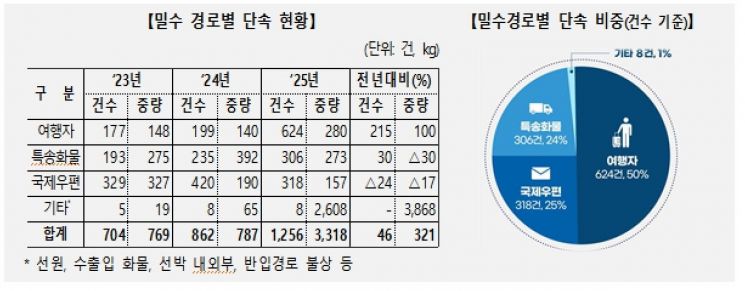
By smuggling route, attempts by travelers saw a significant increase in both the number of cases and total weight (199 cases and 140 kg in 2024 → 624 cases and 280 kg last year). Express cargo shipments increased in number but decreased in weight (235 cases and 392 kg → 306 cases and 273 kg). International mail, a major smuggling route, saw decreases in both the number of cases and total weight (420 cases and 190 kg → 318 cases and 157 kg).
By drug type, cocaine saw the largest increase in seizures due to the detection of large-scale smuggling, while methamphetamine cases and total weight both declined, mainly due to a decrease in methamphetamine (yaba) smuggled from Thailand. All other drug types, except methamphetamine, saw an increase in the amount seized.
By continent of origin, smuggling attempts were most frequent from Central and South America, followed by Asia and North America. By country, the largest amounts were seized from Peru, Ecuador, Thailand, and the United States, in that order. Excluding large-scale cocaine smuggling, Asia remained the top region for smuggling attempts, but the amount of drugs smuggled from Thailand, which had been the top country since 2023, recently declined.
Large-scale cocaine smuggling refers to the cases detected at Okgyebang Port in Gangneung in April last year (1,690 kg from Peru) and at Busan New Port in May and August last year (a total of 900 kg from Ecuador).
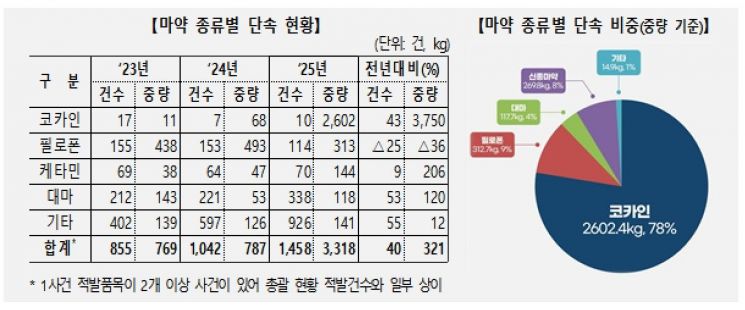
The Korea Customs Service analyzes that the record-breaking scale of drug smuggling detected last year was influenced by the consecutive detection of large-scale cocaine smuggling from Central and South America, as well as a sharp increase in the seizure of club drugs such as ketamine and pharmaceuticals containing drug ingredients.
In fact, last year, the amount of so-called "club drugs" such as ketamine and LSD, known for their anesthetic and hallucinogenic effects, more than doubled. In particular, among club drugs, ketamine saw a sharp rise in large-scale smuggling cases involving more than 1 kg, indicating a trend toward larger-scale smuggling. This is due to the increase in cases where people in their 20s to 40s, the main consumers in nightlife culture, smuggle club drugs for personal use.
The increase in smuggling through local airports is also noteworthy. Last year, a total of 36 cases involving 87 kg of drugs were detected at local airports, excluding Incheon International Airport. Notable examples include the seizure of 3 kg of methamphetamine from Cambodia at Jeju Airport in February last year, and 30.6 kg of methamphetamine from Canada at Gimhae Airport in June.
This is interpreted as a kind of "balloon effect" resulting from the Korea Customs Service strengthening its drug enforcement capabilities, such as expanding advanced screening equipment and enhancing risk management, especially at Incheon International Airport, which sees the most frequent movement of travelers, express cargo, and international mail.
There is also analysis that achievements through international cooperation have contributed to the success of drug enforcement. For example, last year, the Korea Customs Service conducted joint international crackdowns with five countries-Thailand, the Netherlands, Vietnam, Malaysia, and the United States-seizing a total of 123 kg of drugs bound for Korea in 97 cases.
These achievements highlight the need for the Korea Customs Service to continue cooperating and expanding information sharing with major drug-originating countries in order to effectively respond to transnational drug crimes.
A Korea Customs Service official stated, "This year, we plan to expand the list of countries participating in joint international crackdowns to include major drug-originating countries such as France, Germany, Canada, Cambodia, and Laos. We will mobilize the full capabilities of customs administration to block the illegal import of drugs at the border."
© The Asia Business Daily(www.asiae.co.kr). All rights reserved.
![Clutching a Stolen Dior Bag, Saying "I Hate Being Poor but Real"... The Grotesque Con of a "Human Knockoff" [Slate]](https://cwcontent.asiae.co.kr/asiaresize/183/2026021902243444107_1771435474.jpg)
















