Daejeon-South Chungcheong and Gwangju-South Jeolla Administrative Integration
A Symbolic Starting Point and a National Survival Strategy
Balanced Regional Development Needed
to Address Real Estate Issues
On January 21, President Lee Jae-myung introduced the concept of 'region-led growth' during his New Year's press conference. He explained that the government would pursue a major shift, not by providing indiscriminate support to local areas, but by enabling each region to take the lead in driving growth.
Speaking at the Blue House State Guest House that morning under the theme 'Great Transformation Achieved Together, Great Leap Forward Enjoyed by All,' President Lee emphasized the significance of region-led growth, calling it "an ambitious challenge to redraw the growth map of Korea." He clarified, "This does not simply mean giving an extra piece of the pie to local areas," and added, "It means a complete reallocation of the government's resources and capabilities."
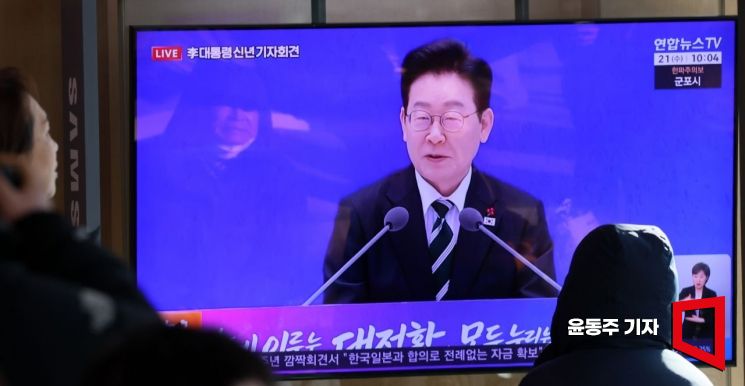 On the 21st, citizens are watching the broadcast of President Lee Jae-myung's New Year's press conference in the Seoul Station concourse, Yongsan-gu, Seoul. 2026.01.21 Photo by Yoon Dongju
As a starting point for this initiative, he highlighted the ongoing administrative integration efforts between the metropolitan governments of Daejeon and South Chungcheong, as well as Gwangju and South Jeolla. He explained that for each region to lead Korea's growth, it must have the appropriate scale. President Lee stated, "Metropolitan integration is both the symbolic starting point for region-led growth and a national survival strategy that must succeed." He pledged, "The direction of metropolitan integration will not waver due to political advantages or disadvantages." He also declared, "If there are differing opinions, we will engage in intense debate to find reasonable alternatives, and we will take full responsibility for providing administrative, financial, and institutional support to achieve this."
To support administrative integration, the government will form a task force (TF) with participation from the Blue House and relevant ministries. Kim Yongbeom, Chief Presidential Secretary for Policy, will head the task force, with Ryu Deokhyun, Presidential Secretary for Fiscal Planning, and Lim Kigeun, Vice Minister of the Ministry of Planning and Budget, serving as joint secretaries. Hong Ikpyo, Chief Presidential Secretary for Political Affairs, Ha Junkyung, Chief Presidential Secretary for Economic Growth, as well as vice ministers from the Ministry of Economy and Finance, Ministry of the Interior and Safety, Ministry of Land, Infrastructure and Transport, Ministry of Trade, Industry and Energy, and Ministry of Education will also participate. The government plans to hold the first meeting swiftly within January and quickly develop and announce detailed plans for fiscal support for the integrated local governments. In addition, the government will make every effort to pass related administrative integration bills in the National Assembly in February, in cooperation with the Democratic Party of Korea.
President Lee further explained, "Building on metropolitan integration, Korea's territory, which has been dominated by a single-capital-region system, will be newly reorganized into a 'five-pole, three-special zone system' led by the regions." He added, "The fundamental principle that the farther from the capital region, the more robust the support, will be implemented through all government policies."
He also emphasized balanced regional development as a way to address real estate issues. President Lee pointed out, "There is a problem of population concentrating in the capital region, causing housing prices to rise," and diagnosed, "The fundamental solution is to invest in the regions so that people can move to local areas." He stated, "We intend to take overwhelming measures such as providing fiscal support, delegating authority, attracting companies, and prioritizing the relocation of public enterprises to areas far from the capital region." He added, "If we do this, it will gradually have an effect." He also mentioned the pilot project of basic income for rural and fishing villages, which is one of his key pledges. This program provides residents of areas at risk of population extinction with 150,000 won per month in local gift certificates. President Lee said, "After providing local currency so that it could be spent in the community, it is reported that the population increased significantly." He added, "If we pursue this in the long term and supplement it with basic pensions and other measures, and determine that people can live without difficulty, there is a possibility that more people will move to local areas."
© The Asia Business Daily(www.asiae.co.kr). All rights reserved.
![Clutching a Stolen Dior Bag, Saying "I Hate Being Poor but Real"... The Grotesque Con of a "Human Knockoff" [Slate]](https://cwcontent.asiae.co.kr/asiaresize/183/2026021902243444107_1771435474.jpg)
















