Launch of Korean Innovative Fusion Reactor Development and Construction of Regional Demonstration Facilities
1.124 Trillion Won to Be Invested in 2026 Fusion R&D
99% Increase from Previous Year
The Ministry of Science and ICT will significantly expand its investment in research and development, as well as demonstration projects, to accelerate the timeline for nuclear fusion energy power generation. The ministry announced that it has finalized the "2026 Nuclear Fusion Research and Development Implementation Plan" and will begin full-scale development of the Korean Innovative Fusion Reactor and its industrial integration.
This implementation plan is a concrete follow-up to the "Strategy to Accelerate the Realization of Fusion Energy" established by the government last year. It focuses on advancing the entire nuclear fusion ecosystem, centering on the development of the Korean Innovative Fusion Reactor, integrating artificial intelligence (AI) technologies, supporting ambitious research into various fusion methods, strengthening collaboration among academia, industry, and research institutes, and building regional demonstration infrastructure.
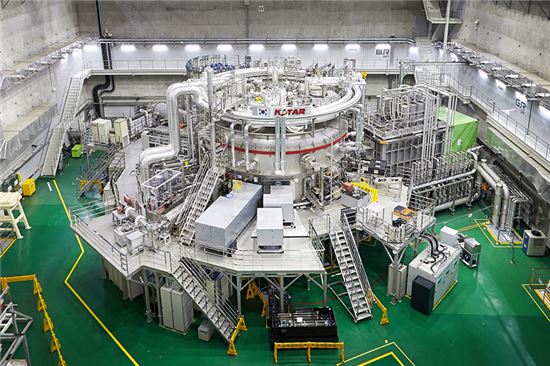 KSTAR used in nuclear fusion research. Provided by the National Fusion Research Institute
2026 marks the first year the government will begin full-scale development of the "Korean Innovative Fusion Demonstration Reactor." To create a virtuous cycle in which research outcomes are translated into demonstration and industrial applications, the ministry has nearly doubled its nuclear fusion research and development budget from 56.4 billion won in the previous year to 112.4 billion won, an increase of 99%. Investment will be made across the entire cycle of fusion technology development, including two new projects.
First, a new project for developing design technology for the Korean Innovative Fusion Reactor (2.1 billion won in 2026) will be launched. Through this project, the government will define the basic specifications, such as power output and device scale, and establish a detailed step-by-step construction schedule and a mid- to long-term roadmap for demonstration and commercialization.
A new project (4.5 billion won in 2026) to integrate AI into all aspects of nuclear fusion research will also be promoted. By applying AI technologies to plasma control, experimental and operational data analysis, and the advancement of design and analysis, research efficiency and performance prediction capabilities are expected to be significantly enhanced.
Support for ambitious research into various nuclear fusion methods, beyond the traditional focus on the tokamak approach, will also be expanded. The government will continue to support next-generation fusion concepts such as the spherical torus, reversed field pinch, and stellarator, while simultaneously fostering specialized personnel and expanding research infrastructure to secure both technological diversity and long-term innovation potential.
Industrial integration through collaboration among academia, industry, and research institutes will also be strengthened. The government will enhance the cooperative framework among government-funded research institutes, universities, and companies, centered on the "Fusion Innovation Alliance." It will establish a unified team system for each of the eight core fusion technology sectors to expand corporate participation throughout the entire research and development process.
The construction of regional demonstration infrastructure will also be accelerated. The completion of a superconducting conductor testing facility will strengthen the testing and verification capabilities for key fusion components and materials, and a large-scale preliminary feasibility study will be conducted to establish fusion demonstration facilities in regional areas. Through these efforts, the government aims to link fusion research achievements with the development of local industries.
In addition, strategies for AI+fusion, global fusion cooperation, and KSTAR 2.0 will be developed to promote both international collaboration and the advancement of research equipment. The revision of the Fusion Promotion Act will also strengthen industrial support functions.
Kim Seongsu, Director General for R&D Policy at the Ministry of Science and ICT, stated, "Through the 2026 implementation plan, we will simultaneously expand the speed and scope of nuclear fusion research and development and systematically pursue a full-cycle strategy from technology development to demonstration and industrialization. We will focus our policy capabilities on substantially advancing the timeline for nuclear fusion energy power generation."
© The Asia Business Daily(www.asiae.co.kr). All rights reserved.
















