On January 21, the won-dollar exchange rate started the day by breaking through the 1,480 won level once again. This was the result of heightened risk aversion after U.S. President Donald Trump announced plans to impose tariffs on eight European countries that have deployed troops to Greenland.
On this day, the won-dollar exchange rate opened at 1,480.4 won in the Seoul foreign exchange market, up 2.3 won from the previous trading day, and hovered around the 1,480 won level in early trading. This is the first time the weekly opening price has exceeded the 1,480 won mark since December 24 of last year (1,484.9 won), when foreign exchange authorities carried out strong intervention. However, the increase was limited, with the rate rising to 1,481.4 won at one point during the session before falling back to the 1,477 won range, reflecting caution over possible intervention by authorities.
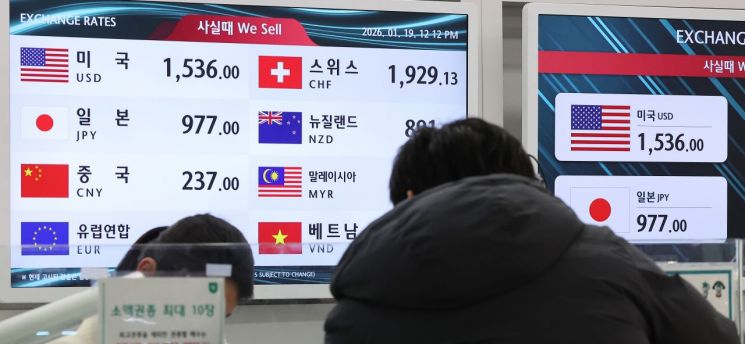 On the 19th, domestic and foreign nationals were inquiring about currency exchange at a bank exchange counter located at Incheon Airport. Photo by Yonhap News
President Trump announced that, starting next month, a 10% tariff will be imposed on goods from eight countries, including the United Kingdom, France, Germany, and Denmark, which have deployed troops to Greenland. The tariff rate will increase to 25% from June. As a result, concerns over a "Sell America" trend have intensified. Overnight, all three major New York stock indexes weakened. The Dow Jones Industrial Average fell by 870.74 points (-1.76%) to close at 48,488.59. The Standard & Poor's (S&P) 500 Index dropped 143.15 points (-2.06%) to 6,796.86, while the Nasdaq Composite Index ended at 22,964.32, down 561.07 points (-2.39%).
The dollar index, which measures the value of the dollar against six major currencies, stood at 98.595, down 0.37% from the previous trading day. Despite the weaker dollar, the depreciation of the yen is also putting upward pressure on the won-dollar exchange rate.
Min Kyungwon, an economist at Woori Bank, said, "The won-dollar exchange rate is rising as risk appetite weakens in response to President Trump's threat to raise tariffs on allied countries." He added, "European countries could also put pressure on the United States based on the $8 trillion in U.S. Treasury bonds and stocks they hold, which is a negative factor for the won, a risk currency." However, he noted that caution over possible micro-adjustments by foreign exchange authorities would likely limit the upside.
© The Asia Business Daily(www.asiae.co.kr). All rights reserved.
![Clutching a Stolen Dior Bag, Saying "I Hate Being Poor but Real"... The Grotesque Con of a "Human Knockoff" [Slate]](https://cwcontent.asiae.co.kr/asiaresize/183/2026021902243444107_1771435474.jpg)















