Rational Consumption, Maximizing AI, and Brain-Oriented Consumption
Spread of Subculture, Changes in Health Management, and Increase in Collaborative Consumption
Shinhan Card presented "WISE UP" as this year's key consumer trend keyword on January 21. The company explained that consumers are now actively utilizing artificial intelligence (AI) in their purchasing processes.
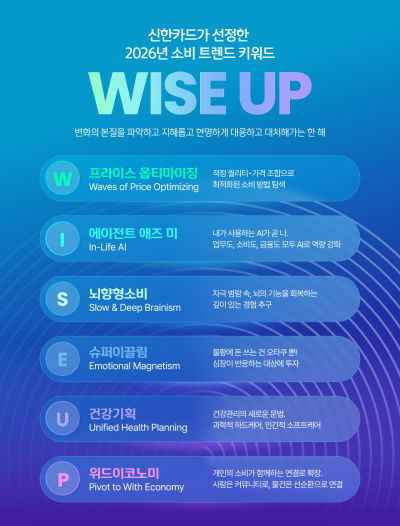
The Shinhan Card Big Data Research Institute identified the following detailed keywords: Waves of Price Optimizing (rational consumption), In-Life AI (maximizing AI), Slow & Deep Brainism (brain-oriented consumption), Emotional Magnetism (spread of subculture), Unified Health Planning (changes in health management), and Pivot to With Economy (increase in collaborative consumption).
A Shinhan Card representative stated, "This year's keyword, WISE UP, means 'to become wise, to open one's eyes,'" and added, "It conveys the idea of understanding the essence of change and responding wisely in an era of major transformation driven by AI."
Rational consumption refers to not simply reducing overall spending, but rather seeking ways to purchase as cheaply as possible by leveraging various channels, brands, and events. This trend is driven by the growing importance of price over brand, and the growth of companies that offer products with above-average quality at reasonable prices. For example, between January and October last year, Shinhan Card usage increased by 1,771% for a workwear brand (often called the "Daiso of fashion") and by 5,055% for a beauty outlet, compared to the same period the previous year. In contrast, usage at four department stores decreased by 2%, and at three online luxury platforms by 27%.
Maximizing AI indicates a clear trend of consumers using AI as an agent. Between January and October last year, Shinhan Card customers' subscriptions to AI services increased by 165.4% for those with one subscription and by 187.9% for those with two or more, compared to the previous year. There has also been a rise in shopping through AI platforms and in the use of AI for financial management.
Brain-oriented consumption describes the phenomenon where, as AI-powered summarization, playback speed adjustment, and short-form videos become overly prevalent, people seek experiences that slow down the pace and help their brains function more naturally. One example is the emergence of "writing cafes," spaces where people write without digital devices. According to Shinhan Card usage statistics at major writing cafes in the Seoul metropolitan area between January and October last year, the number of transactions and users both increased by 37%, while the total amount spent rose by 71% compared to the previous year.
The spread of subculture is also notable. Consumption of subculture intellectual property (IP), such as animation and games, is on the rise. According to Shinhan Card Big Data Research Institute, between January and October last year, character IP-related pop-ups like "Crayon Shin-chan," "Harry Potter," and "Pok?mon" ranked high in the number of mentions in "pop-up" discussions. Consumption at regional hubs, such as the Seoul International Electronics Center, also increased. During the same period, Shinhan Card usage at regional hubs grew by 106% among those in their 20s and younger, 98% among those in their 30s, and 93% among those in their 40s, compared to the previous year.
Health management methods have also changed. It has become common to monitor health with data devices such as continuous glucose monitors or smart rings, and to manage beauty systematically with home beauty devices. According to Shinhan Card Big Data Research Institute, between January and October last year, mentions of keywords related to "beauty" and "health" increased as follows: "PDRN" by 224%, "Wegovy" by 194%, "retinol" by 169%, and "niacinamide" by 82%. This indicates that consumers' knowledge of health and beauty has significantly improved.
Consumption, which used to be centered on individuals, has evolved into forms that connect people with those around them. Community-based consumption, where people share shopping lists and make purchases together at the right time, has become more widespread, and group buying methods have diversified. For example, the number of Shinhan Card merchants affiliated with a company specializing in online and offline group purchases increased by 930% as of the third quarter last year compared to the previous year.
© The Asia Business Daily(www.asiae.co.kr). All rights reserved.
![Clutching a Stolen Dior Bag, Saying "I Hate Being Poor but Real"... The Grotesque Con of a "Human Knockoff" [Slate]](https://cwcontent.asiae.co.kr/asiaresize/183/2026021902243444107_1771435474.jpg)















