Annual Sales Reach 1.5 Billion Won as the Industry Grows...
Targeting 2 Billion Won in 2026 and Full-Scale Entry into the Global Market
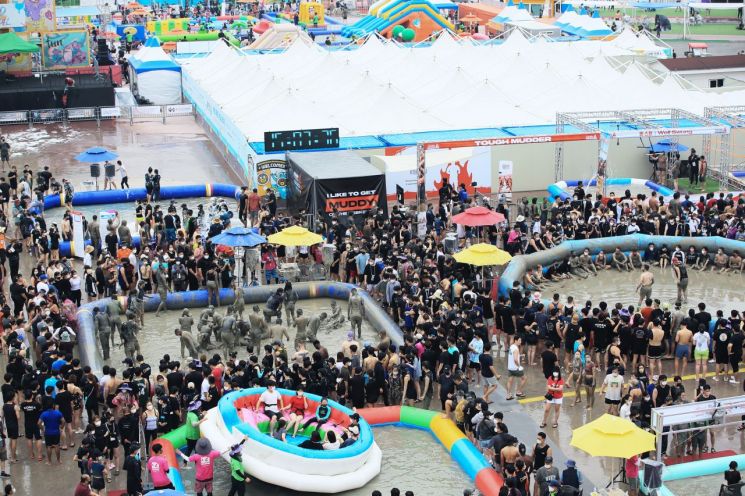
In the 1992 film "Player," there is a scene where the male and female leads cover themselves in mud and enjoy a mud bath at a hotel.
This single scene would later change the future of Boryeong, South Chungcheong Province. The idea that "mud can become an industry" began here.
In 1994, Boryeong City decided to utilize the mudflats near Daecheon Beach as a tourism resource. That same year, an analysis by the Korea Research Institute of Chemical Technology confirmed that the mud from the Boryeong mudflats contained large amounts of nine minerals, including aluminum. It was the moment when mud, once discarded, was transformed into an industrial resource.
The challenge of entering the cosmetics industry was a first in Korea. In 1996, four types of mud-based cosmetics-mud packs, body cleansers, soaps, and shampoos-were released, but the market response was cold. There was neither brand recognition nor a distribution network.
Boryeong City chose "experience" over products. In 1998, the first Boryeong Mud Festival was held, allowing people to apply and enjoy the mud firsthand. The festival spread by word of mouth, and mud became a brand. Since then, Boryeong Mud has developed a unique structure where the festival and the industry have grown together.
In 2001, a soap factory was completed, and in 2004, the mud factory was consolidated to establish a solid production base. In 2006, "Boryeong Clay" was listed in the International Cosmetic Ingredient Dictionary (ICID), gaining official recognition as a global ingredient. In 2009, a patent was secured for the method of manufacturing mud powder, and in 2018, a 3 billion won advancement project further enhanced production capabilities.

In 2019, after transferring operations to the Boryeong Festival and Tourism Foundation, the brand was renewed as "BORYEONG MUD+," accelerating industrialization.
Winning the Korea Quality Innovation Award (Natural Cosmetics category) in 2020 and 2021, and the Premium Brand Award for No. 1 Customer Trust from 2022 to 2024, provided measurable proof of consumer trust.
The turning point that elevated Boryeong Mud’s status came in 2022. The Boryeong Marine Mud Expo, held under the theme "Rediscovery of the Ocean, Future Value of Mud," attracted 1.35 million visitors over 31 days.
Eighty-four institutions and companies from Korea and abroad participated in the expo, resulting in 5.01 million dollars in export consultations and 1.87 million dollars in contracts. This demonstrated that mud could expand beyond being a local specialty to become a new marine industry.
Currently, Boryeong Mud produces 37 types of products and achieved sales of 1.5 billion won in 2025. The target for 2026 is 2 billion won.
The cosmetics lineup, including mud cleansers, mask packs, and bubble packs, has been expanded to include K-POP concert merchandise, broadening the consumer base. The distribution network has also been expanded to Wadiz, the duty-free shop at Incheon Airport Terminal 1, and Hanaro Mart. With U.S. FDA certification, the brand has established a foothold for entry into North America and is expanding exports to Japan, Hong Kong, Singapore, and other countries.
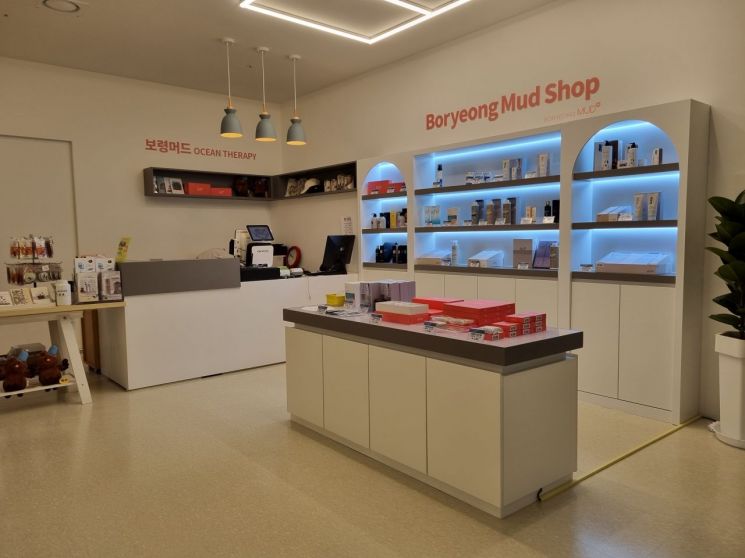
Boryeong Mud has been selected for the Ministry of Trade, Industry and Energy's "Local Industry Promotion Project" and will receive support through 2026. Over 30 mud-related companies in the region will receive integrated support for prototype production, certification, design, and marketing.
Efforts are also underway to establish a K-Beauty hub in collaboration with Konyang University’s RISE project. The integration of advanced technologies such as a metaverse exhibition hall and a blockchain-based certification and distribution system is a key focus.
Since its inception in 1998, the Boryeong Mud Festival has become a leading summer festival, attracting 1.69 million visitors annually. This year, it was selected as a major Hallyu event by the Ministry of Culture, Sports and Tourism, securing 280 million won in national funding. Experts say the structure linking the festival, industry, and exports has now reached a stable phase.
An idea that began with a single movie scene has, after 30 years, grown into an industry. Mud from the Boryeong mudflats is now heading toward the global market under the name "K-Mud."
© The Asia Business Daily(www.asiae.co.kr). All rights reserved.
![Clutching a Stolen Dior Bag, Saying "I Hate Being Poor but Real"... The Grotesque Con of a "Human Knockoff" [Slate]](https://cwcontent.asiae.co.kr/asiaresize/183/2026021902243444107_1771435474.jpg)

















