A new gene assembly platform has been developed that enables the rapid and accurate assembly of multiple genes at once.
The Korea Research Institute of Bioscience and Biotechnology announced on January 21 that Dr. Lee Daehee's research team at the Synthetic Biology Research Center has developed a platform called 'EffiModular.' This platform reduces unnecessary steps in conventional gene assembly, allowing genes to be assembled all at once, much like LEGO blocks.
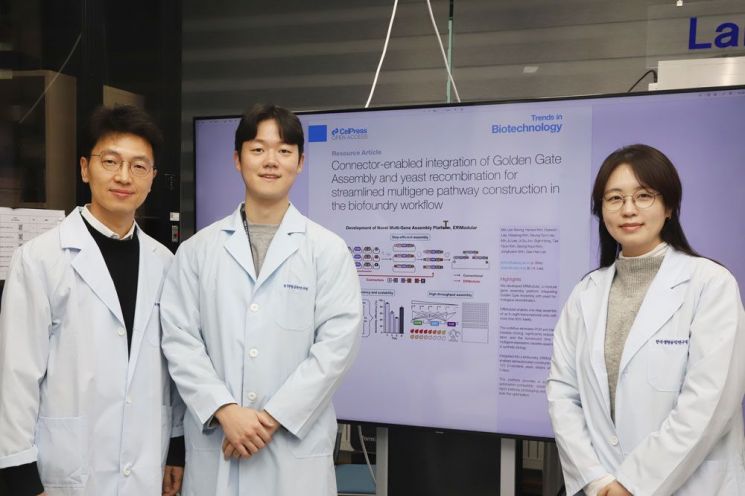 Dr. Lee Daehee's research team. Provided by Korea Research Institute of Bioscience and Biotechnology
To produce pharmaceuticals and eco-friendly materials using microorganisms, it is essential to design multiple genes so that they can function in balance with one another. However, traditional methods require genes to be sequentially joined one by one, with results checked at each stage, making it difficult to assemble multiple genes simultaneously and leading to lower-than-expected success rates.
In contrast, the platform technology developed by the research team features a connector system that allows multiple genes to be linked together at once, similar to LEGO blocks.
According to the research team, this enables up to eight genes to be assembled simultaneously in a single experiment, achieving a high success rate of over 80%, which is more efficient than conventional gene assembly methods.
The team also validated the practical applicability of EffiModular by integrating the technology into a biofoundry automation system. Using the production process of beta-carotene-a well-known antioxidant and functional food ingredient-as a model, they varied gene combinations in the experiment.
Within just three days, the team successfully created 120 different yeast strains, each with a unique method for producing beta-carotene. This achievement dramatically shortened the research period compared to traditional microbial design methods, which typically require several months.
During the comparative analysis of beta-carotene production across the 120 strains, the team found that the activity of a specific gene (crtI, responsible for producing an enzyme needed to convert intermediates in carotenoid biosynthesis, including beta-carotene) had a significant impact on overall production.
They clearly demonstrated with large-scale experimental data that, even if other genes are sufficiently activated, low expression of the crtI gene can greatly limit total production. This result moves beyond previous approaches that relied on a small number of experiments, showing that systematic improvements in microbial design can be achieved using large-scale data.
Dr. Lee stated, "EffiModular is a technology designed to be compatible with automated research infrastructure, enabling high-speed, large-scale experimentation in biofoundry environments. We expect that, if this technology is combined with artificial intelligence (AI)-based design, it could become a core platform for next-generation bio research."
Meanwhile, the results of this study (paper) were recently published online in the international journal 'Trends in Biotechnology,' which covers synthetic biology and bioengineering.
© The Asia Business Daily(www.asiae.co.kr). All rights reserved.
![Clutching a Stolen Dior Bag, Saying "I Hate Being Poor but Real"... The Grotesque Con of a "Human Knockoff" [Slate]](https://cwcontent.asiae.co.kr/asiaresize/183/2026021902243444107_1771435474.jpg)















