Majority Support New Nuclear Power Plants in Public Opinion Survey
Two New Nuclear Plants Likely to Proceed as Planned Under 11th Basic Electricity Plan
Korea Hydro & Nuclear Power Expected to Resume Site Selection Process
i-SMR Promotion T
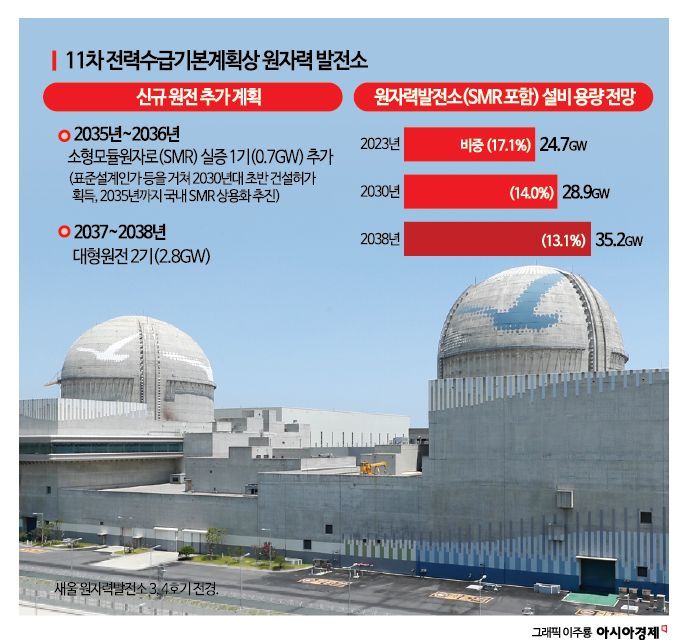
As concerns over mid- to long-term power shortages grow due to the spread of artificial intelligence (AI) and the expansion of the semiconductor industry, a recent government-conducted public opinion survey has revealed that there is overwhelming support for the construction of new nuclear power plants. As a result, the government is increasingly likely to set its policy direction toward building two new nuclear power plants and one small modular reactor (SMR) in accordance with the 11th Basic Plan for Long-term Electricity Supply and Demand.
On January 21, an official from the Ministry of Climate, Energy, and Environment stated, "We plan to announce the policy direction for new nuclear power plant construction soon, based on the results of the past two energy mix policy forums and the latest public opinion survey." The government has decided to establish the new nuclear power plant construction policy as a priority, separate from the formulation of the 12th Basic Plan for Electricity Supply and Demand. This is because the site selection process takes considerable time, making further delays difficult to justify.
Prior to the survey, the ministry held two policy forums on December 30 of last year and January 7 of this year, under the theme of "Desirable Energy Mix." At the first forum, Ok Kiyeol, Head of the Energy System Division at Korea Power Exchange, emphasized, "To drastically reduce greenhouse gas emissions, we must make renewable energy the main power source while also utilizing nuclear power, which is a carbon-free energy source." He added, "We also need to secure flexible resources to respond to the intermittency and volatility of renewable energy."
At the second forum, discussions focused primarily on the flexible operation technology of nuclear power plants as a way to overcome the intermittency and volatility of renewable energy.
Subsequently, starting from January 12, the government commissioned two institutions to conduct a public opinion survey of 3,000 citizens over the course of a week. With the majority of the public expressing support for the construction of new nuclear power plants, the ministry is expected to soon formalize its plans for new nuclear plant construction.
In February of last year, the government finalized the 11th Basic Plan for Long-term Electricity Supply and Demand after reporting to the National Assembly, deciding to build two additional nuclear power plants and one SMR by 2038. However, after Minister Kim Seonghwan took office, he repeatedly stressed the need for public debate on additional nuclear power construction, raising concerns about a possible "phase-out of nuclear power, season 2." Minister Kim is a well-known opponent of nuclear power, having served as mayor of Nowon District and as a member of the National Assembly.
President Lee Jaemyung also heightened these concerns during a press conference in September of last year, stating, "It takes more than 15 years to build a nuclear power plant, and except for sites where construction was halted, there are no available locations. We need to rapidly expand solar and wind power, which can be built in just one or two years."
However, a shift in sentiment has been detected recently. At the second energy mix forum, Minister Kim remarked, "Ideally, I would like to see all electricity generated from renewable sources, but given the need to provide a stable power supply, this is not easy." He also stated, "Korea has many important industries, such as semiconductors, so we must operate the power supply reliably."
It is interpreted that, in the context of rapidly increasing power demand driven by AI, Minister Kim acknowledged the necessity of nuclear power to compensate for the intermittency of renewable energy and to ensure a stable electricity supply.
Kim Yongbeom, Chief Presidential Policy Secretary, also stated in a recent interview, "To supply the electricity needed for the AI and semiconductor industries, the construction of new nuclear power plants is unavoidable." The overwhelming support for additional nuclear power plant construction in the latest public opinion survey is seen as a reflection of the public's shared understanding of these circumstances.
If the government confirms the decision to build additional nuclear power plants, the previously stalled process of selecting sites for new plants is expected to accelerate. Korea Hydro & Nuclear Power began the site selection process for new nuclear plants in March of last year, immediately after the 11th Basic Plan was finalized.
Originally, the plan was to accept applications from local governments wishing to host nuclear power plants through an open call in the second half of last year. However, with increased policy uncertainty under the new administration, progress has stalled. According to the nuclear industry, residents in Gyeongju, Yeongdeok, and Uljin in North Gyeongsang Province, as well as Ulju in Ulsan, are reportedly positive about hosting nuclear power plants.
Meanwhile, the i-SMR Technology Development Project Group is also planning to apply for standard design certification from the Nuclear Safety and Security Commission soon. The target date for approval is 2028. If the licensing process proceeds as scheduled, module manufacturing and construction could begin in 2030, with commercialization expected within five years.
© The Asia Business Daily(www.asiae.co.kr). All rights reserved.

















