6,000 More Housing Units to Break Ground Within Three Years
Restructuring Seoul’s Growth Model and Strengthening Balanced Development in Northern Seoul
Utilizing Public Contributions as Infrastructure Resources for Northern Seoul
The Seoul Metropolitan Government has decided to increase the number of housing units to be started within three years from 79,000 to 85,000. A new installment payment system for the 'Mirinae Jib' rental deposit, aimed at newlywed couples, will also be introduced.
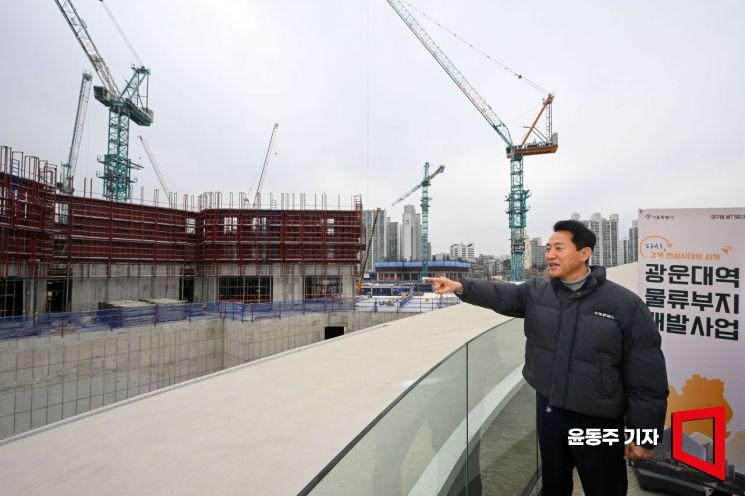 Seoul Mayor Oh Se-hoon visited the construction site of the logistics land near Kwangwoon University Station in Wolgye-dong, Nowon-gu, Seoul on the 12th to inspect the 'SEOUL ONE' site being built by HDC Hyundai Development Company. 2026.01.12 Photo by Yoon Dongju
On January 20, the Seoul Metropolitan Government announced that it would sequentially hold the '2026 New Year Work Report' with the participation of 29 departments and bureaus. The goal is to secure practical momentum for this year's core agenda items: 'housing supply' and the realization of 'the Renaissance of Northern Seoul.'
On the first day, work reports were presented by the Housing Bureau, Urban Space Headquarters, Future Space Planning Office, and the Balanced Development Headquarters. Seoul Mayor Oh Se-hoon reviewed strategies for rapid housing supply and urban space innovation.
The Housing Bureau decided to increase the number of housing units to be started within three years to 85,000, which is 6,000 more than the original plan. By strengthening progress promotion meetings and administrative support, the city aims to accelerate the pace of housing supply through early groundbreaking. The city will fully implement the Fast-Track Integrated Planning 2.0 with the goal of starting construction on 310,000 units by 2031.
The city will provide intensive support for 24 sites, each with an area of less than 30,000 square meters, that are eligible for early groundbreaking within three years, covering management disposition, relocation, and demolition, to advance the groundbreaking schedule by one year. Since pre-sale usually occurs within three to six months after groundbreaking, the pace of supply that citizens experience is expected to become even faster.
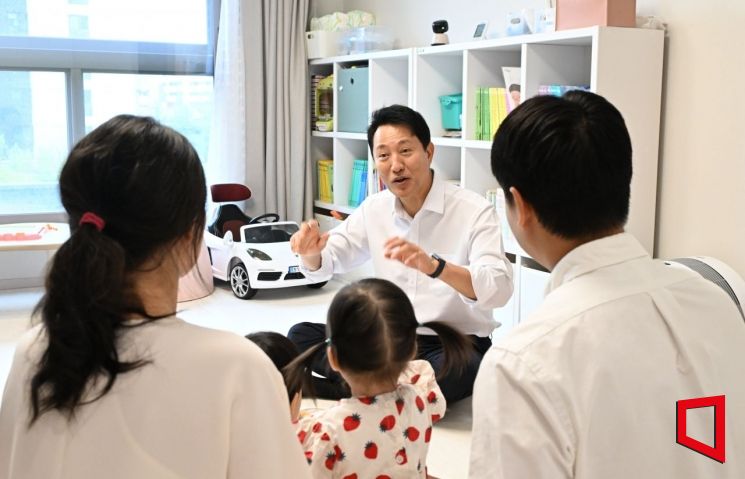
For the long-term rental housing program for newlyweds, 'Mirinae Jib,' the city will introduce an installment payment system for the rental deposit, with 70% paid upon move-in and 30% upon move-out. The remaining 30% of the deposit will be subject to a low interest rate of 2.5% (tentatively), further reducing the financial burden.
A survey of residents moving into the Olympic Park Foreon and Lotte Castle East Pole complexes under the Mirinae Jib program found that, among 46 households that moved in as of December 2024, a total of 48 children were born. In addition, 82% of respondents stated that they plan to have children in the future, indicating the policy's effectiveness.
The Balanced Development Headquarters is launching a structure for balanced growth throughout Seoul, marking the first year of the 'Renaissance of Northern Seoul.' The plan is to connect three key projects: the soon-to-open Seoul Arena, the Seoul Digital Bio City (S-DBC) being established at the Chang-dong train depot, and the redevelopment of the Kwangwoon University Station area into a complex facility, transforming the area into a city where people can live, work, and enjoy leisure in close proximity.
S-DBC will be developed as a new industrial hub for Seoul, starting with SH Corporation's application for designation as an industrial complex early this year and signing MOUs for leading companies to move in during the first half of the year. The Kwangwoon University Station area development project, including the relocation of HDC Hyundai Development Company headquarters, has paved the way for expanding jobs and living and cultural infrastructure.
Additionally, this year, the Seoul Metropolitan Government will begin developing 'Edge City,' a new growth hub to foster currently undeveloped areas such as the Sinnae train depot as major centers in the Seoul metropolitan area. Efforts will also continue to improve the preliminary feasibility study (pre-feasibility) system, which currently hinders the expansion of major transportation networks in northern Seoul, such as the Gangbuk Line, Mokdong Line, and Nangok Line. The city is preparing to propose to the central government in the first half of the year to establish a fair evaluation system that reflects the characteristics of the metropolitan area.
The Urban Space Headquarters will promote key development projects for northern Seoul, such as the development of 11 special planning zones in the Yongsan Electronics Market area and the integrated development of Yujin Shopping Center and Inwang Market to revitalize the Hongje Station area. The city will also pursue measures to revitalize 'non-station areas (potential growth zones)' that have been left out of development. Large-scale office and commercial spaces with increasing vacancies due to the spread of remote work and changes in industrial structure will be converted for residential and cultural uses. The city also plans to improve facilities at aging subway stations to enhance convenience for citizens.
The Future Space Planning Office reported that public contributions secured through prior negotiations on private development, including Yongsan Seoul Core, will be prioritized as resources for infrastructure and growth in northern Seoul. The city also plans to promote balanced regional development and mutually beneficial growth through pilot projects such as the 'Regional Win-Win REITs,' a new development model in which citizens participate and share profits.
Mayor Oh Se-hoon stated, "Now is the time to take a step beyond setting the direction, so that the results of our policies are clearly visible throughout the city and move citizens beyond simple awareness to genuine inspiration. Housing, space, and balanced development policies will be organically connected as a single urban strategy, continuously supplying housing and planning spaces, as well as achieving balanced development between southern and northern Seoul, to design both the present and future of the city and improve the quality of daily life for citizens."
© The Asia Business Daily(www.asiae.co.kr). All rights reserved.


















