Kickoff Meeting for Credit Evaluation System Reform Task Force
Incentives Needed to Effectively Expand Alternative Credit Evaluation
The Financial Services Commission is reviewing the current credit evaluation system, which has focused on collateral and repayment history, and will discuss possible improvements with experts.
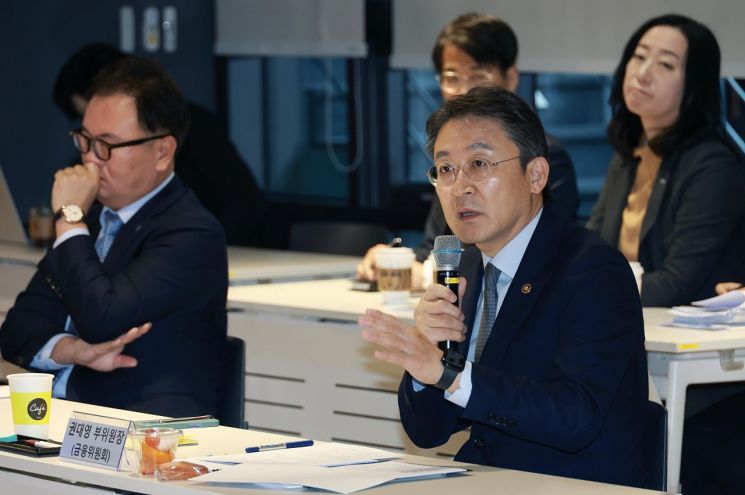 Kwon Daeyoung, Vice Chairman of the Financial Services Commission, is speaking at the kickoff meeting of the Credit Rating System Reform Task Force held on the morning of the 20th at the NICE Information Service Conference Hall in Yeongdeungpo-gu, Seoul. Financial Services Commission
On the morning of January 20, the Financial Services Commission held a meeting of the "Credit Rating System Reform Task Force," presided over by Vice Chairman Kwon Daeyoung. This task force was convened to address national policy tasks such as advancing credit assessment for small business owners, as well as to implement presidential work report initiatives, including the establishment of an Alternative Information Center and the introduction of Credit Growth Accounts. The task force is composed of experts from various fields, while related organizations such as credit information companies, the Korea Credit Information Services, the Korea Federation of Banks, and the Korea Federation of Savings Banks are supporting the expert discussions.
During the meeting, participants noted the need to adjust evaluation criteria and redevelop models to ensure the reliability of personal credit assessments. Choi Cheok, Head of the Research Institute at Korea Credit Bureau (KCB), stated, "The proportion of consumers who receive a personal credit score of 950 or higher, accounting for 28.6% of all individuals assessed, has increased significantly." He added that, as of the end of 2024, those with insufficient credit transaction information-such as the elderly, young adults, and homemakers (thin filers)-received an average credit score of 710, highlighting the need to improve the evaluation system to be more inclusive of these groups.
There were also calls for practical incentives to promote alternative credit assessment, which has been introduced as an alternative to traditional repayment-focused credit evaluation. Suggested measures included the introduction of a pseudonymous data combination fast-track system, customer-driven comprehensive consent, the establishment of an alternative information hub infrastructure, and the provision of policy incentives.
For small business credit evaluation, participants emphasized the need to build a database that integrates both financial and non-financial information, such as by consolidating scattered data, and to reflect the characteristics of each business sector.
The Financial Services Commission plans to announce improvement measures for each task as discussions are concluded, starting with this meeting. In addition to the task force discussions, the commission will also commission research projects led by private sector experts to further specify and support detailed tasks.
Vice Chairman Kwon stated, "The credit evaluation system should serve as a strong safety net for inclusive finance, rather than a high barrier of 'ruthless finance.' To shift from exclusive to inclusive finance, we must thoroughly review the entire credit evaluation system."
© The Asia Business Daily(www.asiae.co.kr). All rights reserved.