Failure to Meet Flagrant Offender Requirements and Lack of Disability Accommodations Recognized
Lower Court Ruling Finalized as Appeal Dismissed Without Full Review
The Supreme Court has upheld a lower court ruling that found the police's arrest of the representative of the National Solidarity for the Elimination of Discrimination against Persons with Disabilities (Jeonjangyeon) as a flagrant offender during a protest for disability mobility rights to be unlawful. The state must pay a total of 10 million won in damages to Park Kyungseok, former representative of Jeonjangyeon, and his personal care assistant.
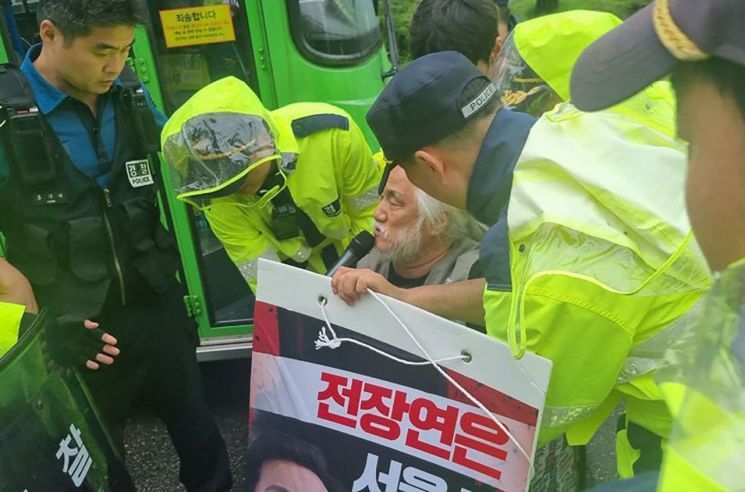 Police arresting Park Kyungseok, former representative of Jeonjangyeon, near National Assembly Station on Uisadang-daero, Yeouido-dong, Yeongdeungpo-gu, Seoul, on July 14, 2023, on charges of obstruction of business and violation of the Road Traffic Act during a protest. Photo by Yonhap News Agency
According to the legal community on January 19, the Supreme Court's third division (Presiding Justice Oh Seokjun) finalized the lower court's decision, which partially ruled in favor of Park and his assistant A in their damages lawsuit against the state, by dismissing the appeal without a full review on January 15.
Dismissing an appeal without a full review is a procedure in civil and administrative cases (excluding criminal cases) where the Supreme Court rejects an appeal without substantive deliberation if it finds no legal errors in the appellate court's ruling. As a result of the finalized verdict, the state must pay 7 million won to Park and 3 million won to assistant A, respectively.
On July 14, 2023, Park was arrested as a flagrant offender at a bus stop in Yeouido-dong, Yeongdeungpo-gu, Seoul, on charges of blocking a city bus and disrupting its operation during a protest, but was released the following day. Assistant A, who was supporting Park at the time, was also taken into custody and questioned.
Subsequently, Park filed a lawsuit, arguing that "the arrest was made despite not meeting the requirements for a flagrant offender, and the conveniences stipulated by the Act on the Prohibition of Discrimination against Persons with Disabilities, such as a dedicated transport vehicle for persons with disabilities, were not provided." He also claimed that "he was unlawfully detained even after the investigation was completed."
The first-instance court ruled, "It was an unlawful arrest that did not meet the requirements for a flagrant offender, namely the obviousness of the crime and the necessity of arrest," and stated, "The state is liable to compensate the plaintiffs for damages caused by the illegal acts of public officials in the course of their duties."
The court found that Park and others were on the road for less than a minute before being arrested, and although the protest was unreported, it could not be definitively classified as subject to a dispersal order under the Assembly and Demonstration Act.
The court also pointed out that after the arrest, Park and others, who have disabilities, were left surrounded on the sidewalk for about 25 minutes in the rain, and that their rights were violated and the Act on the Prohibition of Discrimination against Persons with Disabilities was breached during the transport to the police station.
Furthermore, the court noted that the police detained Park for about 30 hours after the investigation before releasing him, and found a significant likelihood that this violated the Criminal Procedure Act, which requires immediate release if a detention warrant is not requested within 48 hours of arrest.
The state appealed the decision, but the appellate court also found no legal errors in the first-instance ruling and dismissed the appeal.
© The Asia Business Daily(www.asiae.co.kr). All rights reserved.
![Clutching a Stolen Dior Bag, Saying "I Hate Being Poor but Real"... The Grotesque Con of a "Human Knockoff" [Slate]](https://cwcontent.asiae.co.kr/asiaresize/183/2026021902243444107_1771435474.jpg)















