20 Policy Proposals for RE100 Activation Delivered
Majority of Companies Facing Difficulties Cite "High Costs"
Request for Improvements to Excessive PPA-Related Costs
The Korea Economic Association has called on the government to provide policy support to improve the conditions for corporate renewable energy supply and to ease the cost burden on businesses.
On January 20, the Korea Economic Association announced that it had submitted its “RE100 (Renewable Energy 100%) Activation Policy Agenda” to the Ministry of Climate, Energy and Environment. This proposal includes a total of 20 policy tasks across two areas: stimulating demand and expanding supply, in order to facilitate smooth renewable energy procurement for companies.
With the government announcing plans for RE100 industrial complexes last year and finalizing the national greenhouse gas reduction target (NDC) for 2035, the demand for renewable energy procurement by companies is expected to increase further. In response, the Korea Economic Association emphasized the need for policy support to improve the conditions for renewable energy supply and to alleviate the cost burden on companies arising from the use of renewable energy.
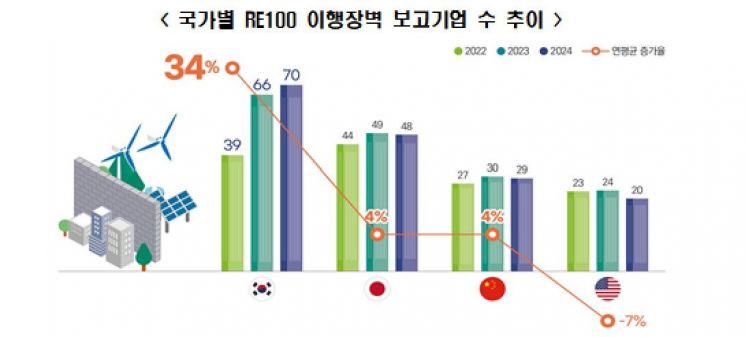
According to the “RE100 2024 Annual Report” published by the Climate Group and the Carbon Disclosure Project (CDP) Committee, as of 2024, 70 companies in Korea were reported to have faced difficulties in procuring renewable energy. This figure is 3.5 times higher than that of the United States (20 companies) and represents an increase of about 80% compared to 2022 (39 companies). In contrast, major countries such as the United States, Japan, and China have seen either a decrease or stabilization in RE100 implementation barriers.
Among the companies experiencing difficulties in renewable energy procurement, the majority-51.4% (36 companies)-cited high costs as the biggest challenge.
In response, the Korea Economic Association submitted a total of 20 policy proposals to the Ministry of Climate, Energy and Environment, covering two areas: “Promoting Renewable Energy Demand and Supporting RE100 Implementation” and “Expanding Renewable Energy Supply and Enhancing Governance.”
First, the Korea Economic Association requested improvements to excessive additional costs related to “Power Purchase Agreements (PPAs),” which allow companies to purchase electricity directly from power generators. Currently, when companies procure renewable energy through PPAs, they are required to pay not only the base electricity charge but also additional fees such as transmission and distribution network usage fees and the Electric Power Industry Infrastructure Fund, amounting to 18-27% of the generation cost. Therefore, the association proposed incentives for companies entering into PPAs, such as exemption from the Electric Power Industry Infrastructure Fund and reductions in trade insurance premiums. Additionally, it recommended a temporary exemption of PPA-related additional costs until the competitiveness of domestic renewable energy reaches a level comparable to that of major countries.
The association also argued for expanding the range of businesses eligible to enter into PPA contracts. According to current regulations, direct PPA contracts are limited to high-voltage electricity users (300 kilowatts or more), which excludes small-scale electricity users such as telecommunications relay stations and temporary power at construction sites from utilizing direct PPAs. The Korea Economic Association therefore requested institutional improvements to allow small-scale electricity users to procure renewable energy through direct PPAs as well.
Furthermore, to enhance the usability of the system, the association proposed introducing an “N:N contract model” for direct PPAs. Under current regulations, direct PPA contracts are limited to 1:1, N:1, or 1:N models between power generators and electricity users, which restricts participation by small and medium-sized enterprises and small-scale power generators.
Lee Sangho, Head of the Economic and Industrial Division at the Korea Economic Association, stated, “Global credit rating and investment agencies are increasingly setting companies’ efforts to reduce carbon emissions as key evaluation criteria, highlighting the growing importance of low-carbon supply chain management. To ensure that our companies can maintain international competitiveness and smoothly procure renewable energy, it is essential to improve the system and provide policy support.”
© The Asia Business Daily(www.asiae.co.kr). All rights reserved.
![Clutching a Stolen Dior Bag, Saying "I Hate Being Poor but Real"... The Grotesque Con of a "Human Knockoff" [Slate]](https://cwcontent.asiae.co.kr/asiaresize/183/2026021902243444107_1771435474.jpg)
















