4.5% Growth Rate in Q4 Last Year... Lowest in Nearly Three Years
Retail Sales Down for Seven Consecutive Months... Fixed Asset Investment Drops 3.8%
Population at 1.40489 Billion... Declines for Fourth Consecutive Year
China recorded a 5% gross domestic product (GDP) growth rate last year. While the country succeeded in achieving its target growth rate of “around 5%,” the trend of sluggish domestic demand and investment continues.
On January 19, the National Bureau of Statistics of China announced that the country’s annual GDP for last year reached 141.879 trillion yuan, representing a 5.0% increase year-on-year at constant prices.
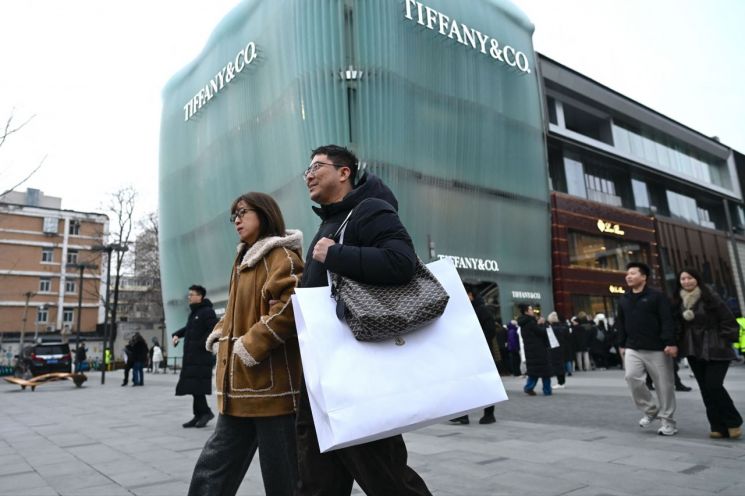 People walking in front of a shopping mall in Beijing, China, on the 18th (local time). Photo by AFP Yonhap News
This aligns with the authorities’ target of “around 5%” growth, and matches the expert forecasts compiled by Reuters (4.9%) and Bloomberg (5.0%).
Despite Achieving the “Around 5%” Target Last Year, Fourth Quarter Performance Was Weak
China’s quarterly growth rates last year were 5.4% in the first quarter, 5.2% in the second quarter, 4.8% in the third quarter, and 4.5% in the fourth quarter. The fourth quarter growth rate was at the same level as the first quarter of 2023, when consumption and investment were sluggish due to the COVID-19 pandemic. This marks the lowest level in nearly three years. Notably, considering that Chinese authorities typically boost consumption and expand government investment at the end of the year to meet growth targets, the fourth quarter growth rate last year was significantly lower. The fourth quarter growth rate was 5.2% in 2023 and 5.4% in 2024.
Larry Hu, Chief China Economist at Macquarie Group, stated, “China’s economic growth rate slowed each quarter last year compared to the same period the previous year, showing that domestic demand remains weak. The most important issue is not the headline growth rate, but whether China can break out of its current dual-speed growth structure.”
Retail Sales Growth Rate Falls for Seventh Consecutive Month... Real Estate Investment Also Declines
Detailed indicators show a slowdown in domestic demand and investment. Annual retail sales increased by 3.7% year-on-year last year. In December, retail sales grew by 0.9% year-on-year, falling short of the expert forecast of 1.2%. Retail sales figures, which include department stores, convenience stores, and other types of retailers, serve as a gauge of domestic economic activity. China’s retail sales growth rate has declined for seven consecutive months since May of last year, marking the longest period of decline since 2021, when the country was affected by COVID-19.
Annual fixed asset investment decreased by 3.8% year-on-year. This decline was larger than the 3% drop expected by economists surveyed by Reuters. Fixed asset investment is an indicator of investment in factories, public infrastructure, housing, and more. Despite government efforts to stimulate the economy, overall investment, including in the real estate market, has stagnated. Fixed asset investment had been on a steady upward trend since the 1980s. Although there was a temporary decline in 2020, it returned to positive growth the following year. However, last year’s negative fixed asset investment has led to observations that investment in real estate and infrastructure has reached a turning point.
Last year, infrastructure investment fell by 2.2%, real estate development investment dropped by 17.2%, and manufacturing investment grew by only 0.6%. The area of newly sold commercial housing decreased by 8.7%, and sales revenue fell by 12.6%. Private investment declined by 6.4%, and even excluding real estate investment, it still decreased by 1.9%.
Since 2023, China has set a target growth rate of “around 5%.” The country announced that it achieved its targets each year: 5.2% in 2023, 5.0% in 2024, and 5.0% in 2025. According to a Reuters survey of 73 economists, next year’s growth rate is expected to slow to 4.5% and remain at this level through 2027.
China’s Population Declines for Fourth Consecutive Year... Number of Births Falls Below 8 Million
Meanwhile, the urban unemployment rate last year was 5.2%, up 0.1 percentage point from the previous year. The urban unemployment rate in December stood at 5.1%. As of the end of last year, China’s population was 1.40489 billion, a decrease of 3.39 million compared to the end of 2024, marking the fourth consecutive year of decline. The number of births last year was 7.92 million, with a birth rate of 5.63‰. For the fourth year since 2022, the number of births has remained below 10 million and has now fallen below 8 million.
By age group, the working-age population aged 16 to 59 was 851.36 million, accounting for 60.6% of the total population. This share has continued to decline, having been 62.0% in 2022, 61.3% in 2023, and 60.9% last year. The population aged 60 and over was 323.38 million, representing 23.0% of the total, while those aged 65 and over numbered 223.65 million, or 15.9%. These figures are up by 1.0 percentage point and 0.3 percentage point, respectively, from the 22.0% and 15.6% recorded in 2024.
The National Bureau of Statistics of China stated, “In 2025, the national economy maintained a development trend of gradual improvement amid stability, enduring various pressures. However, the impact of changes in the external environment has intensified, and domestically, issues such as strong supply and weak demand have become more pronounced, with both longstanding problems and new challenges still present in the process of economic development.”
© The Asia Business Daily(www.asiae.co.kr). All rights reserved.
![Clutching a Stolen Dior Bag, Saying "I Hate Being Poor but Real"... The Grotesque Con of a "Human Knockoff" [Slate]](https://cwcontent.asiae.co.kr/asiaresize/183/2026021902243444107_1771435474.jpg)















