From Marginalization to Core of Balanced Development for Island Regions...
"Urgent Need for Enactment of Special Integration Law"
The Wando County Council has officially expressed its support for the administrative integration of Gwangju Metropolitan City and Jeonnam Province.
On January 19, during the 335th extraordinary session, the Wando County Council adopted the "Statement of Support for Gwangju-Jeonnam Administrative Integration" and urged the advancement of administrative integration as a response to the crisis of local extinction.
Through the statement, the council emphasized, "To address the escalating crisis of local extinction caused by population decline, super-aging, youth outflow, and the weakening of industrial foundations, a fundamental change that goes beyond the current fragmented administrative system is necessary."
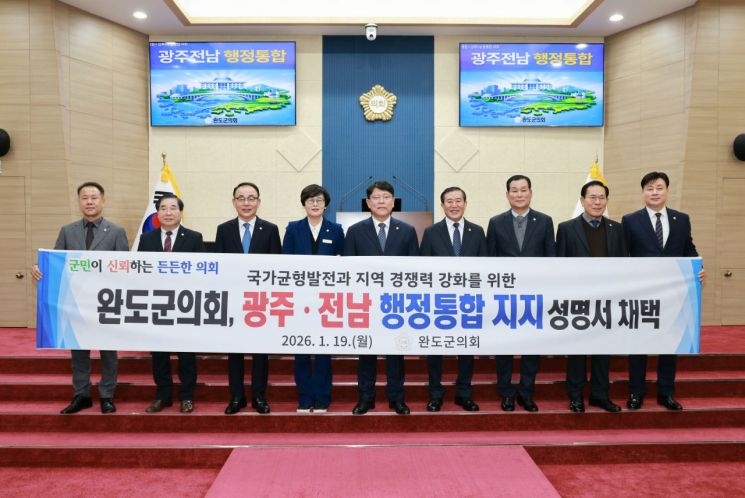 Wando County Council officially supported the administrative integration of Gwangju Metropolitan City and Jeonnam Province and issued a "Statement of Support for Gwangju-Jeonnam Administrative Integration." Photo by Wando County Council
In particular, the council pointed out, "Although Gwangju and Jeonnam have already shared history, culture, and industry as a single living and economic zone, the separated administrative systems have led to policy duplication and accumulated inefficiencies."
The council stated, "Jeonnam is the first region in the country to enter a super-aged society, and the crisis of local extinction is no longer just a concern but a reality," adding, "There are clear limitations to responses at the level of individual local governments."
The council also stressed, "The administrative integration of Gwangju and Jeonnam is a timely task to counter the dominance of the Seoul metropolitan area and to achieve balanced national development," and added, "It must serve as a turning point for systematically fostering key strategic industries such as artificial intelligence (AI), energy, marine, fisheries, and tourism, and for fundamentally strengthening regional competitiveness through fiscal expansion and the transfer of authority."
Regarding island, rural, and fishing communities such as Wando, the council asserted, "These areas must not be marginalized in the integration process, but instead be positioned as a core axis of balanced development," and emphasized that "strengthening the competitiveness of marine and fisheries industries must also be accompanied by the expansion of essential living infrastructure such as transportation, healthcare, and education."
In the statement, the council called for ▲democratic implementation through sufficient information disclosure and resident briefings; ▲guaranteeing substantial incentives such as fiscal special provisions, transfer of authority, and relocation of public institutions through the enactment of a special integration law; and ▲reflecting the principle of balanced regional development, allowing urban, rural, and island areas to grow together.
Kim Yanghun, Chairperson of the Council, stated, "The administrative integration of Gwangju and Jeonnam is a critical turning point to secure the future of Jeonnam and offer hope to the next generation," adding, "The Wando County Council will actively participate in responsible discussions and actions to ensure that the integration debate leads to concrete implementation, not just declarations."
© The Asia Business Daily(www.asiae.co.kr). All rights reserved.
![Clutching a Stolen Dior Bag, Saying "I Hate Being Poor but Real"... The Grotesque Con of a "Human Knockoff" [Slate]](https://cwcontent.asiae.co.kr/asiaresize/183/2026021902243444107_1771435474.jpg)
















