National Solidarity Council for Public Housing Districts
Adopts Five-Point Proposal; Lawmakers from Both Parties Attend
"Policies Infringing on Citizens' Property Rights Must Be Stopped"
The National Solidarity Council for Public Housing Districts (NSCPHD) held a New Year Policy Forum at 2:00 p.m. on the 19th in Meeting Room 8 of the National Assembly Members' Office Building under the theme, "Is the Government's Housing Supply Policy and Violation of Private Property Rights Acceptable as It Is?"
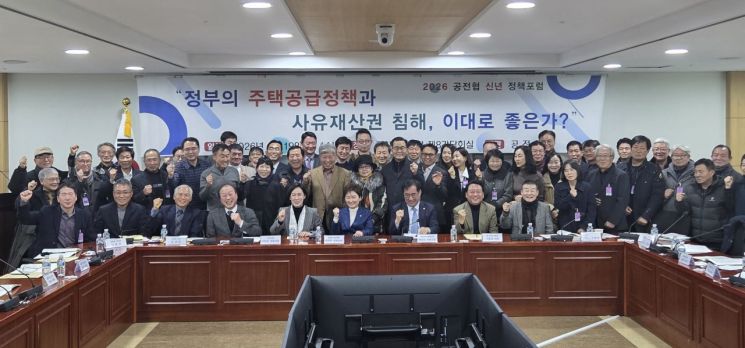 The National Solidarity Council for Public Housing Districts held a New Year Policy Forum on the 19th under the theme "Is the Government's Housing Supply Policy and Violation of Private Property Rights Acceptable as It Is?" Participants are taking a commemorative photo after the forum. Courtesy of the National Solidarity Council for Public Housing Districts.
The forum was attended by over 80 participants, including representatives from residents' countermeasure committees in the third phase new towns and metropolitan expropriation districts such as Gyeonggi and Incheon, as well as representatives from national countermeasure committees in Busan, Daegu, and Gwangju, livelihood cooperative leaders, and advisors to the NSCPHD. Lawmakers from both the ruling and opposition parties, including Lee Eonju (Senior Supreme Council Member of the Democratic Party), Maeng Sungkyu (Chairman of the National Assembly’s Land, Infrastructure and Transport Committee), Lee Inseon (Chairwoman of the National Assembly’s Gender Equality and Family Committee), and former lawmaker Lee Kwangjae (former Secretary General of the National Assembly), also attended to deliver congratulatory and encouraging remarks.
During the forum, the NSCPHD, led by Chairman Lim Chaegwan and central headquarters officials, along with representatives from 96 residents' countermeasure committees nationwide, adopted a "Government Proposal for the Protection of Private Property Rights in Forced Expropriation Districts."
The NSCPHD’s proposal to the government contains five key items: ▲Initiation of compensation within two years after the project approval notice, and imposition of a 'delayed interest' penalty in the event of compensation delays; ▲Raising the application ratio for land appraisal re-evaluation standards (from 110% to 130%); ▲Comprehensive revision of the "Capital Gains Tax Act" to expand the scope and amount of capital gains tax reductions for expropriation districts; ▲Expansion of land-for-land compensation methods, with demands for lower prices and prompt supply; ▲Preparation of livelihood support measures for original residents and expansion of eligible business sectors.
The policy forum featured a presentation by attorney Lee Jonghun (DONGIN Law Group), and designated panelists included Jo Junghun, Chairman of the Land and Housing Committee at Citizens' Coalition for Economic Justice (certified appraiser); Jung Yanghyun, attorney and managing partner at HOW Law Firm; Gong Daeseok, Vice Chairman of the NSCPHD; and Lee Eunyoung, CEO of Gaia Consult.
In his opening remarks, NSCPHD Chairman Lim Chaegwan emphasized, "The government's indiscriminate housing supply policy is premised on the sacrifice of landowners," adding, "It is only right to halt policies that infringe on citizens' property rights, which the state is supposed to protect. Now is the time to shift to policies that balance public interest with citizens' rights."
Attorney Lee Jonghun, in his presentation, stressed the need for a paradigm shift in forced expropriation, stating, "If those subject to expropriation are seen not merely as targets but as partners or collaborators in overall land development, we can expect remarkable results in housing supply through land development." He called for a change in government thinking in areas such as timely and fair compensation, deferral of capital gains taxation, activation of land-for-land compensation, and expansion of livelihood cooperative work.
Jo Junghun, Chairman of the Citizens' Coalition for Economic Justice, pointed out, "Indiscriminate public projects will trigger a vicious cycle of oversupply, cost increases, and deepening polarization in the real estate market," adding, "The legitimacy of procedures is just as important as the outcome of land supply."
Attorney Jung Yanghyun raised the need for remedies for damages caused by compensation delays and called for a significant increase in the supply area of apartment housing sites for relocation measures, arguing, "For apartment housing sites allocated to relocation beneficiaries, the per capita land area should be significantly raised from the current less than 66 square meters to about 132 to 165 square meters."
© The Asia Business Daily(www.asiae.co.kr). All rights reserved.
![Clutching a Stolen Dior Bag, Saying "I Hate Being Poor but Real"... The Grotesque Con of a "Human Knockoff" [Slate]](https://cwcontent.asiae.co.kr/asiaresize/183/2026021902243444107_1771435474.jpg)
















