Stricter Independence Standards Accelerate Industry Withdrawal
KT, Naver Cloud, and Others Decide to Drop Out
Debate Intensifies Over Domestic Architecture Requirements
"The industry had concerns about the current situation even before the launch of the national AI project. The government needs to establish clear standards, even at this stage."
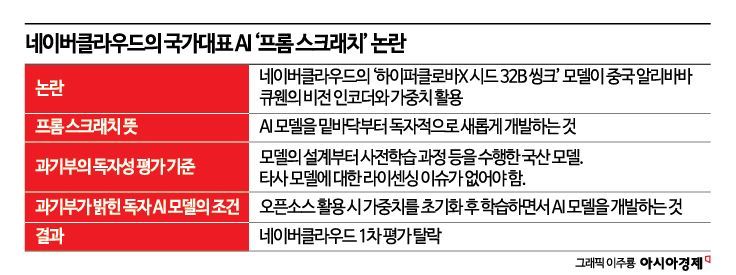
In the wake of the intense backlash following the first round of evaluations for the independent artificial intelligence (AI) foundation model project, it is expected that even stricter standards will be applied in the upcoming second round. As a result, a growing number of companies have already decided not to make another attempt.
According to the industry on January 19, the Ministry of Science and ICT announced that it would reopen applications for the second evaluation, including teams that were previously eliminated. However, KT, Naver Cloud, Kakao, and NC AI have all decided not to reapply. Major startups are also seriously considering whether to try again, but as of now, none have officially announced their intention to do so.
A senior official at KT told The Asia Business Daily, "We have received many inquiries about participating in the reopened application, but from the start, we had no intention of making another attempt," adding, "We have been working to strengthen our AI capabilities, and as we will soon welcome new leadership, we expect to propose specific measures to contribute to strengthening national AI competitiveness in the future."
Companies that were eliminated in the first round continue to express their difficulties. On various IT industry forums such as Blind, there are ongoing debates about the criteria for independence. Naver is reported to have concluded that it has sufficient infrastructure, such as graphics processing units (GPUs), to develop competitive models independently. However, as Naver was considered the leading candidate for selection, the shock of defeat still lingers.
An industry insider, who requested anonymity, said, "The national AI project became a hot topic, and we considered joining the consortium. However, we did not participate because we believe that a truly independent AI must have a domestically developed architecture from the ground up," adding, "If we are to nurture a truly homegrown AI with a long-term vision, we need to build everything from data collection to model architecture from scratch, even if it takes time." The source explained that a well-tuned Chinese derivative model cannot dispel concerns about independence, and that the architecture itself-not just fine-tuning an overseas model-must be our own.
Another company representative commented, "This was inevitable. While open source can be used, if the core weights are used without updates, it is not an independent AI," adding, "If the government had clarified the relevant standards before the first selection, the industry could have avoided trial and error."
There are also concerns that it will be difficult for new companies to participate, as the second round of evaluations is scheduled for June to July and only three elite teams will be selected. One company stated, "With stricter independence criteria, companies joining late simply do not have enough time," adding, "The timing of GPU supply will differ by company, and for startups, which have significantly fewer resources and personnel compared to large corporations, it is not easy to take on the challenge."
However, some argue that applying excessively strict standards for independence is unrealistic. Lee Jihyung, President of the AI Graduate School Association and Professor at Sungkyunkwan University, pointed out, "If the element of 'independence' is applied too strictly, there will be no domestic AI models that meet the criteria," adding, "Independent technologies can be developed in the process of referencing other models."
Kyung Hyun Cho, Professor at New York University, stated on his social media, "The intelligence of AI lies in seamlessly integrating various observations-such as tokens, images, and audio snippets-using highly capable neural network models," adding, "The evaluation method should remain flexible and be continuously adjusted to keep pace with rapidly evolving technologies."
© The Asia Business Daily(www.asiae.co.kr). All rights reserved.
![Clutching a Stolen Dior Bag, Saying "I Hate Being Poor but Real"... The Grotesque Con of a "Human Knockoff" [Slate]](https://cwcontent.asiae.co.kr/asiaresize/183/2026021902243444107_1771435474.jpg)
















