As U.S. President Donald Trump has played the "tariff card" against eight European countries opposing America's intention to annex Greenland, Europe is responding with both anger and frustration, and is now moving to devise countermeasures.
The day after President Trump announced that, starting next month, a 10% tariff would be imposed on U.S.-bound goods from countries that have deployed small military contingents to Greenland, and that this rate would rise to 25% from June 1, representatives from European Union (EU) member states agreed to meet at 5 p.m. on January 18 (local time) in Brussels, Belgium, to discuss their response.
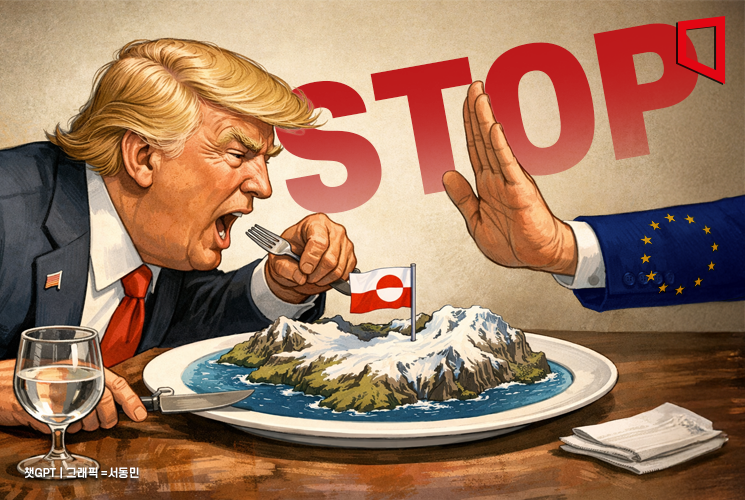
Europe immediately unleashed criticism against President Trump for threatening NATO (North Atlantic Treaty Organization) allies with tariffs. French President Emmanuel Macron declared, "We will not yield to intimidation," while British Prime Minister Keir Starmer, who has previously refrained from openly criticizing President Trump, also issued an unusually strong rebuke, stating, "This is completely wrong."
Kaja Kallas, EU High Representative for Foreign Affairs and Security Policy, wrote on X (formerly Twitter), "China and Russia must be having a field day," adding, "If Greenland's security is at risk, it can be resolved within NATO. Tariffs risk making both Europe and the United States poorer."
Given that last year's trade agreement with the Trump administration was considered a "humiliating negotiation," there is also a significant sense of resignation. In July of last year, European Commission President Ursula von der Leyen met with President Trump in Scotland, United Kingdom, and reached a trade deal that centered on imposing a 15% tariff on most EU products. In a survey conducted in September of the same year by the French think tank Groupe d'Etudes G?opolitiques (GEG) among EU citizens, 52% of respondents reported feeling "humiliated," and 50% supported President von der Leyen's resignation.
Bloomberg News commented on President Trump's latest tariff threat, stating that it "reminded European leaders of the harsh reality that 'no agreement is ever final,'" and pointed out, "Whether tariffs will actually be imposed remains unclear, but by trampling on an agreement just six months later, he has insulted close allies."
Major foreign media outlets and experts also noted that it is unclear whether the Trump administration can actually impose tariffs on the European countries mentioned. The Associated Press, citing European diplomats and others, reported that since the EU is a single market, there are doubts about how President Trump intends to levy tariffs on individual countries.
There is also uncertainty as to whether additional tariffs can actually be imposed from next month as President Trump claims, since the U.S. Supreme Court is currently reviewing whether the International Emergency Economic Powers Act (IEEPA) can serve as the legal basis for such broad tariffs.
© The Asia Business Daily(www.asiae.co.kr). All rights reserved.

















