Visit to Ecopro HN Chopyeong Site
Emphasis on a "Safe Workplace" With Zero Accidents
Dongchae Lee, founder of Ecopro, is accelerating his technology-driven management activities by visiting key business sites, including Ecopro BM's future materials development facilities, to mark the New Year.
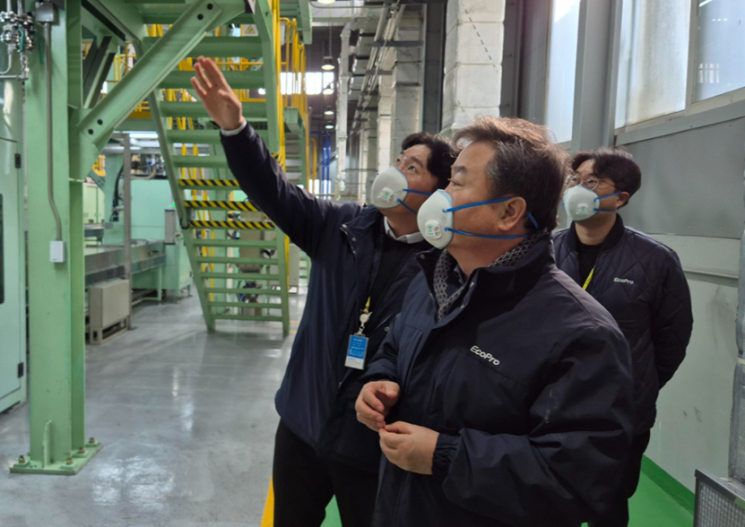 Dongchae Lee, founder of Ecopro (center), is visiting the Ecopro BM research building in Cheongju, Chungbuk, and talking with related personnel. Ecopro
Ecopro announced on January 18 that founder Lee visited the Ecopro BM research building in Cheongju, Chungbuk, on January 7 to inspect the current status of future materials development.
On that day, Lee stated, "Let us thoroughly prepare for the future that will come after the crisis," and urged, "Please focus our research capabilities on developing materials for the all-solid-state battery era, which will be a game changer in the battery industry."
The Ecopro BM research building in Cheongju, Chungbuk, was the first base established by Ecopro, where the company initially conducted research and development of eco-friendly materials and catalysts such as adsorbents.
Lee emphasized, "It was here that we sowed the seeds of Ecopro and grew into a global eco-friendly company," adding, "We must continue to take on challenges so that the cathode materials we develop for all-solid-state batteries can lead Ecopro to its second leap forward."
At this year's kick-off meeting, Lee announced four key management policies: strengthening technology leadership, advancing overseas business sites, diversifying customers, and reinforcing profit-and-loss management. He stressed, "The way for Ecopro, which has grown through technology, to overcome the current crisis lies in strengthening our differentiated research and development capabilities," and added, "Without technological prowess, there is no future."
On January 5, Lee also visited the Chopyeong site of Ecopro HN in Jincheon, Chungbuk. The Chopyeong site manufactures secondary battery materials and semiconductor materials, including crucibles and dopants. Covering a land area of about 50,000 square meters, the Chopyeong site is expected to contribute to the localization of crucibles, which are essential containers used in the battery cathode firing process. Currently, domestic secondary battery materials companies rely on imports for crucibles, but with the Chopyeong site, the competitiveness of Korea's secondary battery ecosystem is expected to be strengthened.
Lee urged, "We must secure manufacturing competitiveness that can surpass our rivals through innovation," and added, "Please make special efforts to create a safe workplace."
© The Asia Business Daily(www.asiae.co.kr). All rights reserved.
![Clutching a Stolen Dior Bag, Saying "I Hate Being Poor but Real"... The Grotesque Con of a "Human Knockoff" [Slate]](https://cwcontent.asiae.co.kr/asiaresize/183/2026021902243444107_1771435474.jpg)















